
Print it or save it
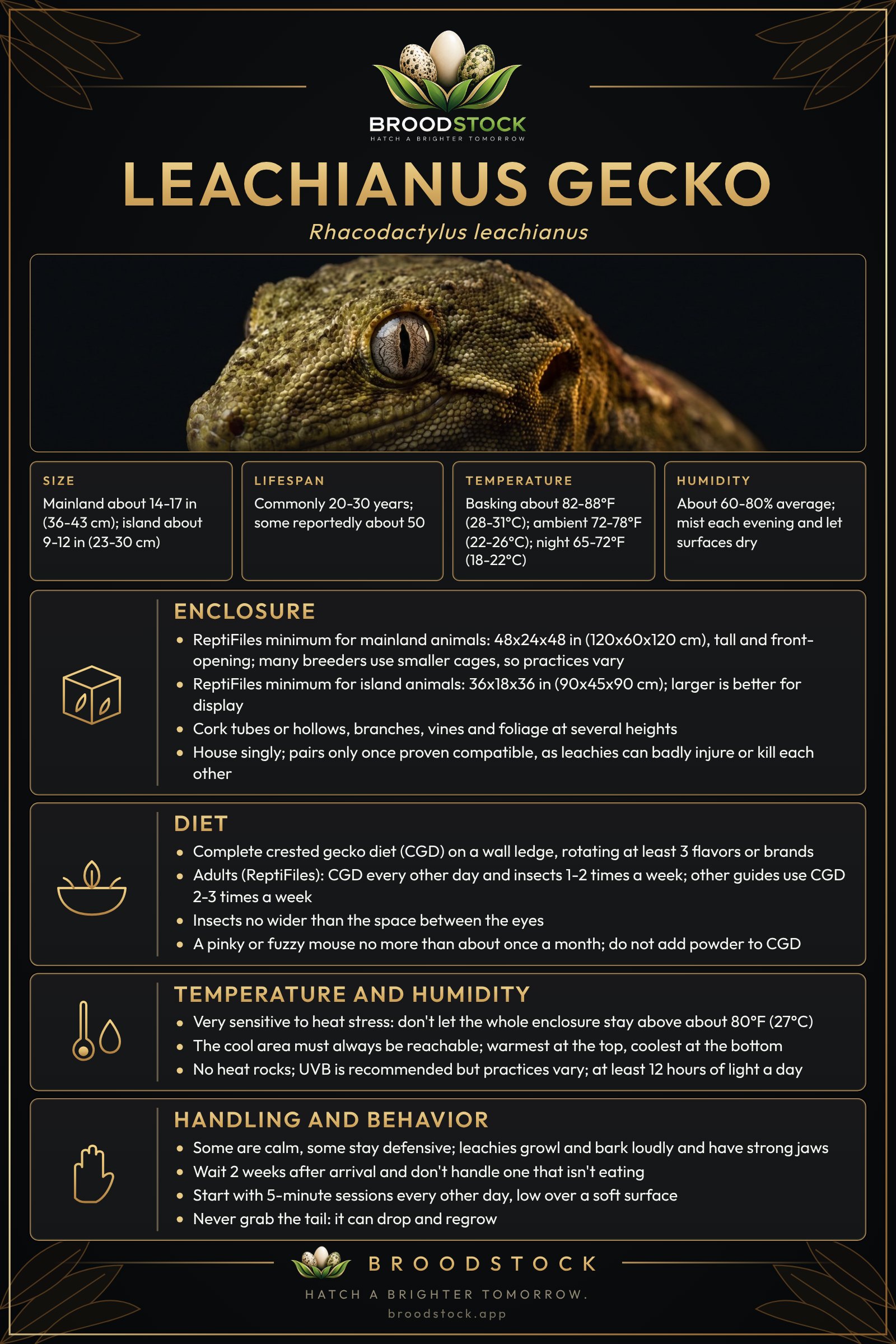
The care sheet is a one-page summary you can print or keep on your phone. The full care text is below.
Keeping Leachianus Gecko? Broodstock tracks feeding, weights, sheds, enclosures and equipment for every animal you keep, and it is free to start.
Scientific name
Rhacodactylus leachianus
Adult size
This is the largest living gecko, and it has a short, stubby tail. Size varies with locality. Grande Terre (mainland) animals reach about 14-17 in (36-43 cm) and about 250-500 g (9-18 oz). Island animals (Isle of Pines and nearby islets, the old 'henkeli' form) reach about 9-12 in (23-30 cm) and about 150-300 g (5-11 oz).
The old subspecies are no longer recognized, so populations are tracked by locality instead.
Lifespan
Lifespan is commonly 20-30 years with good care. Some individuals reportedly reach about 50 years, so expect a very long commitment.
Enclosure
Use a tall, front-opening arboreal enclosure. ReptiFiles gives minimums of 48x24x48 in (120x60x120 cm) for mainland animals and 36x18x36 in (90x45x90 cm) for island animals. Many breeders house adults in smaller tubs or PVC cages (around 18x18x24-36 in), so practices vary, although larger is better for display animals.
Offer wide cork tubes or hollows, since these geckos live in tree hollows. Add branches, vines, ledges and foliage at several heights, plus off-ground hides. Use a moisture-holding soil-type substrate with leaf litter. Hatchlings begin in shoebox-size tubs and move up as they grow.
House them singly. Try pairs only once they have proven compatible, because leachies can badly injure or kill each other.
Temperature
Basking surface: about 82-88°F (28-31°C) (ReptiFiles uses 86-88°F (30-31°C)). Ambient: 72-78°F (22-26°C). Night: 65-72°F (18-22°C). The top should be warmest and the bottom coolest, and the cool area must always be reachable.
Leachies are very sensitive to heat stress, so don't let the whole enclosure stay above about 80°F (27°C). In a room that holds in the mid 70s°F, some breeders use no basking lamp at all.
Humidity
Average humidity should be about 60-80%. A swing from about 50% by day to near 100% at night is fine. Mist every evening, and in the morning if needed. Then let surfaces dry before misting again, which prevents mold and bacteria. Include a water dish too. Too little ventilation is bad, and so is too much: low humidity has been linked to stunted juveniles.
UVB
UVB is recommended. Leachies survive on dietary D3 but do better with UVB, although some breeders skip it, so practices vary. Aim for a UVI of about 2.0-3.0 at the basking area. Use a 22 in T5 HO 5.0/6% forest bulb (ReptiSun 5.0, Arcadia Forest 6%) about 9-12 in (23-30 cm) above the basking branch, or an Arcadia ShadeDweller about 6-8 in. Check readings with a Solarmeter 6.5, and replace the lamp every 12 months.
Lighting
Provide at least 12 hours of light a day, with lights off at night.
Heating
Use low-wattage white incandescent heat lamps over the mesh (ReptiFiles suggests two 40 W bulbs), on a dimmer or thermostat. Put a probe thermometer on the basking surface. Some guides do not recommend ceramic emitters or red or blue bulbs. Do not use heat rocks. Use two thermometer/hygrometers, one at the top and one at the bottom.
Diet
Leachies are omnivores. Feed a complete crested gecko diet (CGD) along with insects. On the ReptiFiles schedule, juveniles (0-12 months) get CGD daily and insects every other day. Adults get CGD every other day and insects 1-2 times a week. Other guides give CGD 2-3 times a week. Serve CGD on a wall ledge rather than the floor, and rotate at least 3 flavors or brands.
Insects must be no wider than the space between the eyes: crickets, dubia and discoid roaches, locusts, hornworms. For a treat, offer a pinky or fuzzy mouse no more than about once a month. In the wild they eat fruit, nectar, sap, insects and small vertebrates.
Supplements
CGD is already fortified, so do not add powder to it. Dust insects with calcium. If UVB is used, choose one without D3 (e.g. Arcadia CalciumPro Mg, Repashy SuperCal NoD); if not, choose a D3 calcium. Follow the label. One guide says skipping an occasional dusting is fine. Practices vary, since some breeders also leave a small dish of calcium/vitamin powder in the enclosure. Females that are laying need good calcium intake.
Shedding
With the right humidity, shedding is usually clean and the gecko eats the skin. For stuck shed, put the gecko in a small ventilated container with a damp paper towel at slightly above room temperature for 30-60 minutes. Repeat a few times if needed, and see a vet if it persists. Check the toes and tail tip.
Handling
Temperament varies a lot. Some are calm and others stay defensive. They growl and bark loudly and have strong jaws.
Wait 2 weeks after arrival, and don't handle one that isn't eating. Each evening, rest a hand in the enclosure for a few minutes so the gecko learns your scent. Then begin 5-minute sessions every other day and build up. Hold the feet, body and tail, work slowly, handle in the evening, and keep low above a soft surface. Never grab the tail, because it can drop and regrow.
Brumation
Leachies do not truly brumate.
Health signs to watch
Take the gecko to an experienced reptile vet for any of these: still not feeding 2 weeks after arrival; weight loss; bite wounds from a cage-mate, which can be severe; signs of heat stress (gaping, lethargy, collapse); retained shed; a soft or deformed jaw or limbs (metabolic bone disease); and females straining or failing to lay (egg binding). Stunted juveniles usually point to low humidity, too much ventilation or too few hiding places.
Welfare
Where an animal comes from matters. Captive leachies trace back to dozens of localities. On Grande Terre these include sites such as Mt. Koghis, Yate, Poindimie, Mt. Humboldt and 'Type C'. Island and islet localities include Pine Island, Nuu Ana, Nuu Ami, Moro, Bayonnaise, Brosse, Caanawa, Koe and Merone. Some wild localities (e.g. Duu Ana) may no longer exist, so captive lines may be all that is left.
Because New Caledonia protects the species, pet animals should be captive-bred. Pairs that do not get along can maim one another fast. These geckos are very sensitive to heat.
Keep every animal's care in one place
Log feedings, weights and sheds, set reminders, and let Ranger, the built-in AI manager, help with the rest. Free to start, no card needed.