
Print it or save it
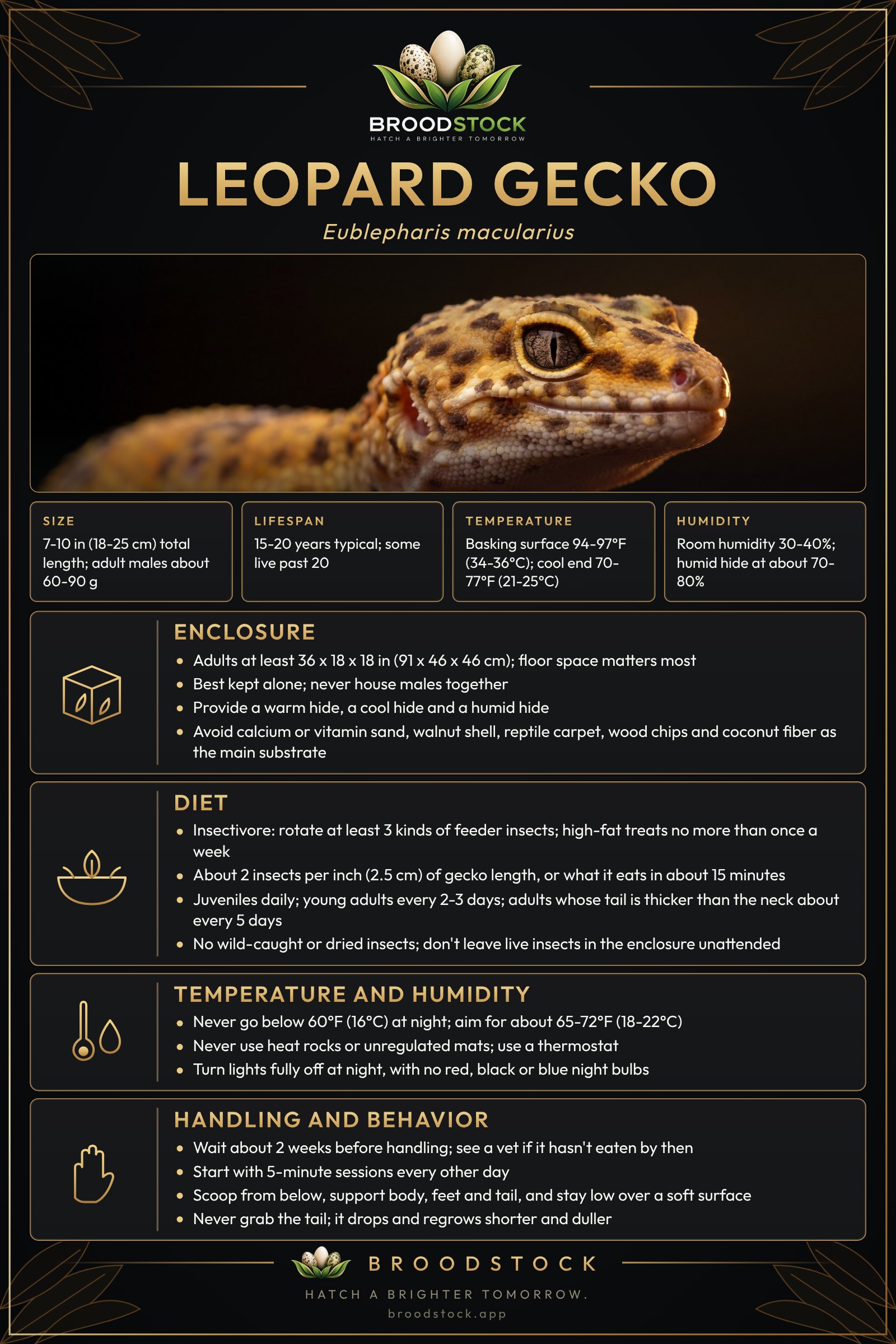
The care sheet is a one-page summary you can print or keep on your phone. The full care text is below.
Keeping Leopard Gecko? Broodstock tracks feeding, weights, sheds, enclosures and equipment for every animal you keep, and it is free to start.
Scientific name
Eublepharis macularius
Adult size
Total length is 7-10 in (18-25 cm), and females are usually smaller. Adult males weigh about 60-90 g, while adult females start at about 45 g.
Lifespan
A typical captive lifespan is 15-20 years, and some animals pass 20 years.
Enclosure
Leopard geckos live on the ground, so floor space matters most. Adults need at least 36 x 18 x 18 in (91 x 46 x 46 cm), which is about 4.5 sq ft (0.4 sq m) of floor. Tanks of 10-20 gal are too small as permanent adult housing.
They are best kept alone. Never house males together.
Use paper towel, shop towel or tile during quarantine and for sick geckos. It is also a cautious choice for small juveniles. Once past quarantine, healthy geckos can live on a packed mix of soil, sand and clay at least 4 in (10 cm) deep. Do not use calcium or vitamin sand, walnut shell, reptile carpet, wood chips or coconut fiber as the main substrate. The enclosure needs at least a warm hide, a cool hide and a humid hide.
Temperature
Basking surface: 94-97°F (34-36°C). Warm hide floor: 90-92°F (32-33°C). Cool end: 70-77°F (21-25°C). Nights can be cooler, about 65-72°F (18-22°C), but never below 60°F (16°C). Some vets want nights to stay above about 68°F (20°C).
Humidity
Aim for room humidity of 30-40%, with a screen top and good airflow. Add a humid hide at about 70-80% in the middle to cool end, lined with moistened soil-based substrate.
Loose sphagnum moss or shredded paper towel can be swallowed, so many keepers avoid them. Some vets still suggest damp moss or paper towel, so practices vary.
UVB
UVB is recommended. According to Oonincx et al. 2020, leopard geckos produce vitamin D3 from UVB, but the same study found that dietary D3 alone supported normal growth, so practices vary. They fall in Ferguson Zone 1 (shade-dweller). Aim for a basking UVI of 0.5-1.5 for normally pigmented geckos, and no more than 0.5-0.7 for albino, hypo and patternless morphs, measured with a Solarmeter 6.5.
Use a low-output T5 over the warm end, such as Arcadia ShadeDweller Max 2.5% or ShadeDweller 7% (Zoo Med and Reptile Systems T5 lamps also work). Over mesh, normal pigmentation calls for 2.5% at 8-14 in (20-35 cm) or 7% at 10-18 in (25-45 cm). For hypo morphs, use 2.5% at 12-14 in (30-35 cm) or 7% at 16-18 in (40-45 cm).
Swap the T5 tubes out every 12 months. Add shaded hides so the gecko can get out of the light.
Lighting
Run about 14 h of light in summer and 12 h in winter, although 12 h all year is acceptable. Turn lights fully off at night, and do not use red, black or blue night bulbs.
Heating
For the main heat, use an overhead halogen or incandescent lamp at one end. Start around 50 W halogen over mesh, or a 75-100 W spot bulb inside the cage. A deep heat projector or ceramic heat emitter is only for night heat if the room gets cold, with the DHP on a proportional/dimming thermostat.
An under-tank mat is an optional extra beneath the warm hide. Bury or cover it, and always use a thermostat with the probe in the warm hide. Never use heat rocks or unregulated mats. Check temperatures with an IR temp gun and a probe thermometer.
Diet
Leopard geckos are insectivores. Staples include crickets, dubia or discoid roaches, mealworms, silkworms, black soldier fly larvae and captive-bred hornworms, and you should rotate at least 3 kinds. Offer about 2 insects per inch (2.5 cm) of gecko length, or whatever it eats in about 15 minutes. Feed juveniles daily and young adults every 2-3 days. Adults with a tail thicker than the neck eat about every 5 days.
High-fat treats (superworms, waxworms, butterworms) should come no more than once a week. Do not feed wild-caught insects, wild hornworms or dried insects. Pinkie mice are only for helping a gecko regain condition after it drops its tail. Live insects left alone in the enclosure can bite a sleeping gecko, so don't leave them unattended.
Supplements
Dust feeder insects with calcium. Many care guides say a light dusting at most feedings, while some vets suggest weekly for adults that are not breeding and more often for laying females. Practices vary.
With UVB, use calcium without D3 (e.g. Repashy SuperCal NoD, Zoo Med Repti Calcium without D3, Arcadia CalciumPro Mg), or a low-D3 all-in-one made for UVB setups (Repashy Calcium Plus LoD, which also supplies vitamins). Without UVB, pick a calcium with D3, such as Repashy Calcium Plus or Zoo Med Repti Calcium with D3. Only a single D3 source should be used.
Give a multivitamin with preformed vitamin A (retinol, not just beta-carotene): weekly for young geckos and every 2 weeks for adults (e.g. Zoo Med Reptivite without D3). Repashy SuperVite contains D3, so pair it only with D3-free calcium. No multivitamin is needed alongside Repashy Calcium Plus or Calcium Plus LoD.
Feed the insects a commercial gut-load diet for at least 24 hours first, such as Repashy Bug Burger, Arcadia InsectFuel or Mazuri Better Bug. Egg-laying females in particular may get an optional dish of plain calcium with no D3. Do not add vitamins to the water.
Shedding
Before and during a shed the gecko turns pale or grayish, and it usually eats the skin. The main prevention is a humid hide. After every shed, check the toes and tail tip, because stuck shed can cut off blood flow and cost toes.
For stuck shed, put the gecko in a ventilated tub with a damp towel at about 80°F (27°C) for no more than 20 minutes, then gently lift the skin. Repeat the next day. If shed is still stuck after a week, or it affects the eyes, see a reptile vet. Juveniles shed about every 1-2 weeks, and adults about every 1-2 months.
Handling
Wait about 2 weeks after bringing a gecko home before handling it, and see a vet if it has not eaten by then. Begin at 5 minutes per session every other day, then lengthen gradually. Scoop from below, support the body, feet and tail, and stay low over a soft surface. Never grab the tail. It drops, and it regrows shorter and duller.
Brumation
Winter cooling is optional and only for healthy adults over about 1 year old that have a plump tail and a recent clear fecal test (finish any parasite treatment at least 1 month before). Stop food about 2 weeks before cooling, and keep fresh water available.
A common schedule is heat off in early December at 60-72°F (16-22°C), then heat back on in early March, with food again about 2 weeks later once the gecko is active and drinking. Weigh weekly, and stop and see a reptile vet if it loses more than 10% of its starting weight. Some breeders use a shorter, milder cool-down. That approach is not well documented, so practices vary.
Health signs to watch
Weigh weekly. Sudden weight loss or a shrinking tail is the earliest warning.
See a reptile vet for: weight loss over about 10%; a thin 'stick' tail with weight loss or regurgitation (possible cryptosporidiosis, which is contagious, so quarantine); a soft jaw or bent limbs (metabolic bone disease); stuck shed on toes, tail tip or eyes; bloating, straining or no feces (impaction); wheezing or bubbles at the mouth (respiratory infection); a gravid female straining or unable to pass eggs (egg binding); head tilt or circling (enigma syndrome); and bladder stones. A new gecko that has not eaten within 2 weeks also needs a vet.
Welfare
The enigma morph is tied to a heritable neurological syndrome (head tilt, circling, star-gazing, seizures). A peer-reviewed assessment treats it as a concern for heritable defects in breeding, and many breeders avoid it. Lemon Frost carries a link to malignant iridophoroma (skin tumours). Avoid these traits or disclose them clearly.
Keep every animal's care in one place
Log feedings, weights and sheds, set reminders, and let Ranger, the built-in AI manager, help with the rest. Free to start, no card needed.