
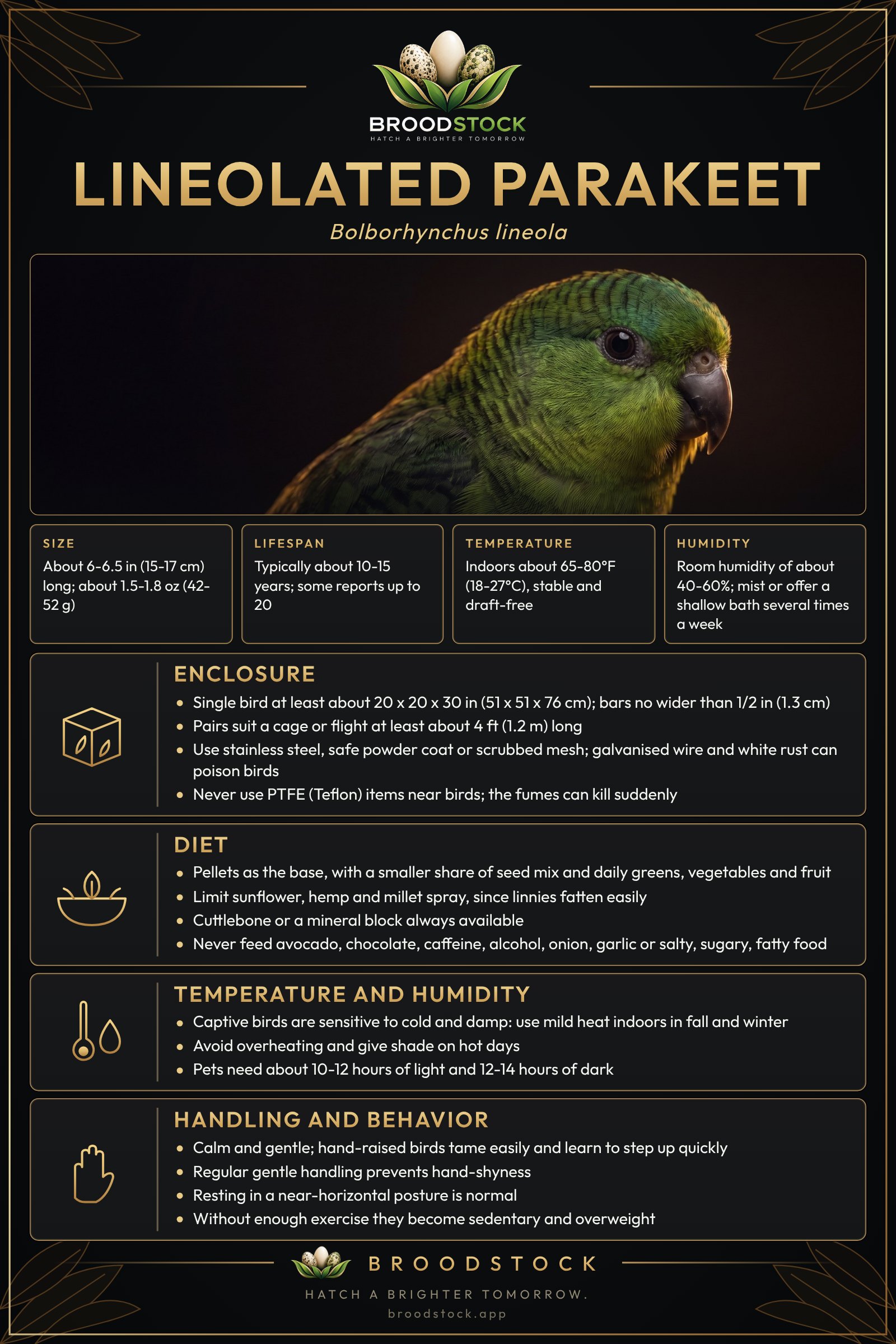
Print it or save it
The care sheet is a one-page summary you can print or keep on your phone. The full care text is below.
Keeping Lineolated Parakeet? Broodstock tracks feeding, weights, sheds, enclosures and equipment for every animal you keep, and it is free to start.
Scientific name
Bolborhynchus lineola
Adult size
Length is about 6-6.5 in (15-17 cm), with a short tail, and weight is about 1.5-1.8 oz (42-52 g). They are budgie-sized but stockier, and hens are slightly smaller.
Lifespan
They typically live about 10-15 years with good care. Reports of 15 years or more exist, and some quote up to 20.
Enclosure
A pair suits a cage or flight at least about 4 ft (1.2 m) long. A single bird needs a minimum of about 20 x 20 x 30 in (51 x 51 x 76 cm), with bar spacing no wider than 1/2 in (1.3 cm), and bigger is better.
Linnies climb and walk foot over foot more than they fly. Provide plenty of natural branch perches about 1.5 in (4 cm) thick at different heights, plus ladders, ropes and swings, chew and foraging toys and a shallow bath dish. They also forage on the floor, so keep it clean and dry.
They are social flock birds that do best in pairs or groups. They are peaceful with other small gentle birds, although compatibility in mixed collections is not well studied. Keep them away from kitchen fumes.
Choose stainless steel, safe powder coat or well-scrubbed mesh. New galvanised (zinc-coated) wire, 'white rust' and old lead solder or paint can poison birds that chew them. Scrub new mesh with a wire brush and dilute vinegar, rinse it well before birds go in, and repeat if white rust forms.
Temperature
Indoors, keep them at about 65-80°F (18-27°C), stable and draft-free. They come from cool mountain forests, but captive birds are sensitive to cold and damp. In fall and winter, house them indoors with mild heat, or in a warm-climate outdoor aviary with a heated shelter. Avoid overheating, and give shade on hot days.
Humidity
Normal room humidity, about 40-60%, suits them. Linnies love misting and spray baths, and often hang upside down with wings open to catch the drops. Mist them or offer a shallow bath several times a week.
UVB
Ideal is natural unfiltered sunlight with shade, in a secure cage. Supervise it, for about 20-30 minutes 2-3 times a week at 65-85°F (18-29°C). UVB cannot pass through window glass.
For indoor birds, an avian UVB fluorescent tube or compact bulb above the cage for at least 3-4 hours a day is an option, replaced about every 6 months. This comes from general avian vet guidance and not linnie-specific research. Stop if the bird squints, rubs its face or reddens around the eyes.
Lighting
Pets need about 10-12 hours of light and 12-14 hours of dark.
Heating
Winter housing should be heated with a thermostat-controlled source.
Never use cookware, drip pans, irons, heat lamps or heaters with a non-stick PTFE (Teflon) coating near birds. Overheated PTFE gives off colourless, odourless fumes that can kill birds suddenly, even from another room.
Diet
In the wild the diet is fruit, dry and sprouting seeds, and insect larvae. In captivity, base the diet on pellets, with a smaller share of small-parrot seed mix (canary seed and millets, some oats, buckwheat and safflower). Add leafy greens, vegetables and fruit daily. Soaked or sprouted seed is good. Limit sunflower, hemp and millet spray, because linnies fatten easily.
They eat through the day, often holding food in a foot. After fruit and vegetables they produce large, loose droppings, which is normal.
Never feed avocado, chocolate, caffeine, alcohol, onion, garlic, mushrooms, dried uncooked beans, fruit pits, apple seeds, tomato leaves or stems, or any salty, sugary or fatty food.
Supplements
Keep a cuttlebone or mineral block available at all times, with extra calcium for laying hens (egg binding is a concern in the genus). Seed-fed birds benefit from a bird vitamin and mineral supplement with vitamins A and D3, used as the label directs. Pellet-fed birds rarely need it. They do not need grit.
Shedding
Juveniles are paler, with fainter barring that darkens with age and successive molts. Adults go through a molt each year, often once breeding is over. Give extra protein during molt. Any feather loss outside a molt needs a check by an avian vet.
Handling
Linnies are calm, gentle and quiet, with soft chatter rather than shrill calls. Some learn words or sounds, and cocks more often. Hand-raised birds tame easily and learn to step up quickly, and regular gentle handling prevents hand-shyness.
A near-horizontal resting posture is normal for them, and for sleep they may burrow into clothing. When they call loudly, the cause is usually distress or an empty food dish. Birds that do not get enough exercise turn sedentary and put on weight.
Health signs to watch
Watch for fatty tumours (lipomas) and obesity, linked to seed-heavy, high-fat diets. Intestinal worms come from soiled floors, so keep a regular worming and fecal-check program with an avian vet. Bacterial and fungal (yeast) infections occur. Psittacosis (Chlamydia) can infect people, and birds can carry it with no signs. Egg binding in hens (fluffed on the floor, tail bobbing, straining) is an emergency.
Housing that is cold and damp can make them ill. PTFE (Teflon) fume poisoning may be behind sudden breathing trouble or death. New birds need quarantine, and an avian vet visit every year is advised.
Welfare
Seed-only diets are linked to fatty tumours, so avoid them. Wild populations are considered stable (IUCN Least Concern) and the species is on CITES Appendix II, with captive-bred birds supplying the trade.
Keep every animal's care in one place
Log feedings, weights and sheds, set reminders, and let Ranger, the built-in AI manager, help with the rest. Free to start, no card needed.