
Broodstock / Care sheets / Milk Snake
Milk Snake Care Sheet
Lampropeltis triangulum complex (commonly kept: Honduran, Pueblan, Sinaloan)
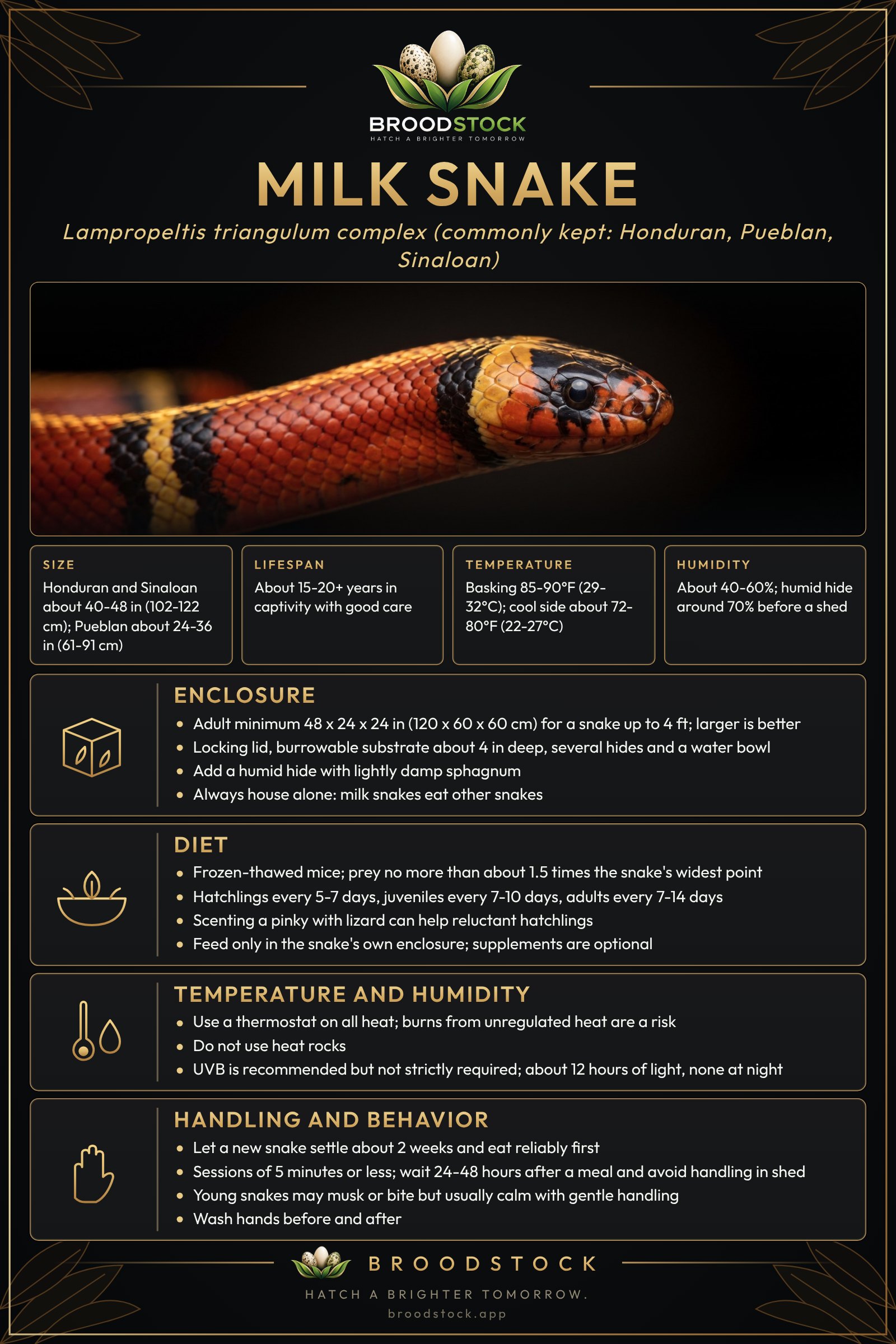
Print it or save it
The care sheet is a one-page summary you can print or keep on your phone. The full care text is below.
Keeping Milk Snake? Broodstock tracks feeding, weights, sheds, enclosures and equipment for every animal you keep, and it is free to start.
Scientific name
Lampropeltis triangulum complex (commonly kept forms: Honduran, Pueblan, Sinaloan)
Adult size
Size depends on the form. A Honduran reaches about 40-48 in (102-122 cm), and some grow to 5 ft or more. Sinaloans measure about 40-48 in (102-122 cm), and Pueblans about 24-36 in (61-91 cm). Across the whole complex the range is about 14-72 in. Hatchlings of the larger forms are about 8-10 in.
On taxonomy, Ruane et al. 2014 split L. triangulum. Some reptile checklists place Honduran (hondurensis) under L. abnorma, and Pueblan (campbelli) and Sinaloan (sinaloae) under L. polyzona, although the split is debated.
Lifespan
In captivity they live about 15-20+ years with good care. Honduran milk snakes reach about 20 years (SeaWorld). A captive record of about 21 years for the complex is listed by Animal Diversity Web.
Enclosure
An adult needs a minimum of 48 x 24 x 24 in (120 x 60 x 60 cm) for a snake up to 4 ft, and more room for Hondurans over 4 ft. Smaller forms like Pueblans (under 3 ft) can manage with somewhat less floor space, but larger is better for all.
Young snakes begin in a small secure tank or tub and move to bigger quarters as they grow. The enclosure needs a locking lid, burrowable substrate about 4 in deep, multiple hides because the snakes are secretive, a humid hide and a water bowl.
Always house milk snakes alone, because they eat other snakes.
Temperature
Basking surface: 85-90°F (29-32°C). Cool side: about 72-80°F (22-27°C). Night: about 70-75°F (21-24°C), with heat off unless the room drops lower. If it does, use a thermostat-controlled ceramic or radiant panel.
Humidity
Average humidity should be about 40-60%, and normal room humidity is usually enough. A humid hide with lightly damp sphagnum is a good addition, especially in dry climates and before a shed, when the hide should be around 70%.
UVB
UVB is recommended but not strictly required on a whole-prey diet. Keepers differ on UVB for snakes, and many keep them healthy without it. In the Ferguson zone table, Pueblan and Sinaloan sit in Zone 1 (max about 0.6-1.4), while Honduran (and Nelson's) milk snakes sit in Zone 2 (max UVI about 1.1-3.0 at the basking spot).
ReptiFiles targets UVI 2.0-3.0 using a T5 HO 5.0 or 6% tube spanning about half the enclosure on the warm side. Mount it about 9-12 in above the basking surface over mesh, or 12-14 in without. For Zone 1 forms, aim lower, using more distance or a shade-dweller tube, and keep plenty of shade. Confirm readings with a Solarmeter 6.5.
Lighting
Average about 12 hours of light, varied with the seasons: up to about 14-15 hours in summer and 9-10 in winter, changed gradually. Keep lights off at night.
Heating
Use overhead halogen heat lamps over the basking area on a dimming or proportional thermostat. Two 50 W halogen floods suit an average enclosure, and up to 4 suit snakes over 48 in. Swap to a 50 W basking spot bulb if it runs too hot. Tubs and racks commonly use thermostat-controlled under-tank heat (belly heat). Add night heat only if needed, using a ceramic heat emitter or radiant panel on a thermostat. Do not use heat rocks.
Diet
Frozen-thawed mice are the staple, with small rats or several mice for large Hondurans. Prey should be no more than about 1.5 times the snake's widest point, or about 10% of body weight. Feed hatchlings every 5-7 days, juveniles every 7-10 days, and adults every 7-14 days depending on body condition.
Some hatchlings, especially of the smaller forms, are reluctant to take mice at first, since wild hatchlings eat mostly small snakes and lizards. Scenting a pinky with lizard can help. Meals should be given inside the snake's own enclosure only.
Supplements
Supplements are optional because whole prey from rodents on a complete diet meets most needs. When you do dust, keep it light and occasional, not at each meal, using a single calcium plus multivitamin powder containing D3. Under UVB, a low-D3 powder such as Repashy Calcium Plus LoD or Arcadia RevitaliseD3 is the pick. With no UVB, D3 comes from food alone, so a standard-D3 powder such as Repashy Calcium Plus or Zoo Med Reptivite with D3 is fine too.
Females recovering after laying can have extra plain calcium without D3 (Repashy SuperCal NoD or Zoo Med Repti Calcium without D3) for a few weeks. Do not combine D3-containing products, and replace powders about every 6 months.
Shedding
Signs of a coming shed are dull skin, cloudy or blue eyes, hiding and a drop in appetite. Avoid handling during a shed. Keep a humid hide with damp moss. The shed should come off whole, including eye caps, and retained eye caps need a vet rather than removal at home.
For stuck shed, give a 10-15 minute lukewarm soak and then gentle help. Never pull it dry. A hatchling's first shed comes within a few days after hatching. A typical shed interval is not well documented for milk snakes, but young snakes shed more often than adults.
Handling
Give a new snake about 2 weeks to settle and eat reliably before handling. Begin with sessions of 5 minutes or less, and handle at least weekly but no more than once a day. Wait 24-48 hours after a meal, and avoid handling during a shed. Keep the body supported.
Young snakes are often squirmy and may musk or bite, but they usually calm down with regular, gentle handling. Wash your hands before and after.
Brumation
A winter cool-down is optional for pets. Fast for 2-3 weeks so the gut is empty. Then cool the snake over 7-10 days to about 50-60°F (10-16°C) for 8-12 weeks, starting around November, with the room dark and belly heat off. Keep water available and check the snake regularly. Warm back up over 7-10 days to normal temperatures. Use only healthy adults of good weight.
Health signs to watch
Watch for: retained shed and eye caps; mites; respiratory infection (wheezing, nasal discharge, open-mouth breathing); regurgitation of mucus-covered prey a few days after eating with a firm mid-body swelling (possible cryptosporidiosis, so quarantine and see a vet); egg binding (straining or restlessness with no eggs after 24-48 hours); hatchlings that never start feeding; obesity; and burns from unregulated heat.
A seasonal drop in appetite around cooling is normal, yet refusing food while losing weight calls for a vet. An annual vet check is recommended.
Welfare
Always house milk snakes singly. They are solitary, and cagemates face stress, competition and cannibalism. Escape-proof enclosures are essential because the larger forms are strong. Hatchlings should each be fed apart from the others.
Many hobby lines are not genetically pure. Some founders were natural intergrades or came with wrong locality data. Keep honest records, and do not sell mixed animals as locality-pure.
Keep every animal's care in one place
Log feedings, weights and sheds, set reminders, and let Ranger, the built-in AI manager, help with the rest. Free to start, no card needed.