
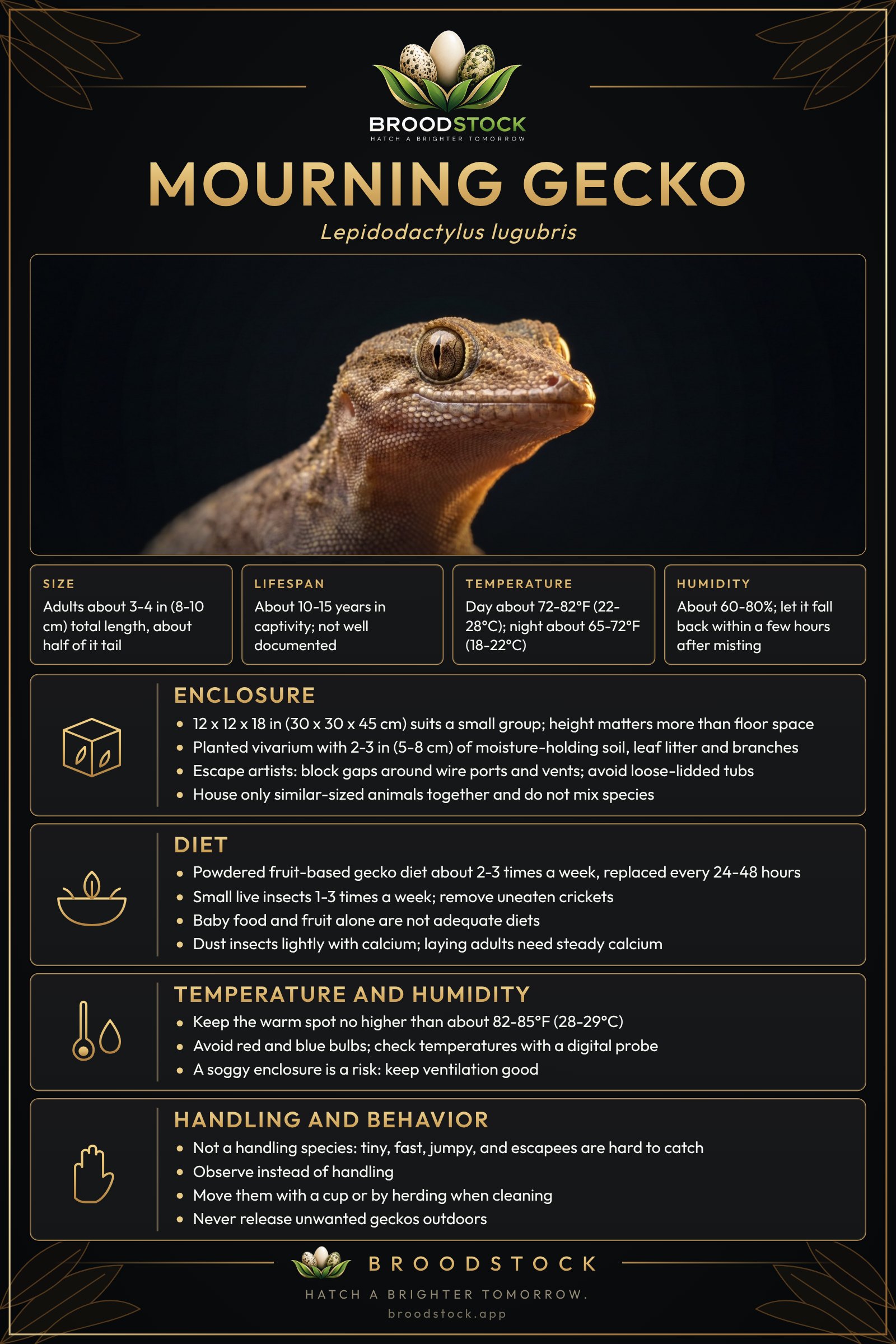
Print it or save it
The care sheet is a one-page summary you can print or keep on your phone. The full care text is below.
Keeping Mourning Gecko? Broodstock tracks feeding, weights, sheds, enclosures and equipment for every animal you keep, and it is free to start.
Scientific name
Lepidodactylus lugubris is an all-female, clonal species that reproduces by parthenogenesis. It is thought to descend from a hybrid of two parent species in the western Pacific. Several clonal lines exist; certain ones are sold under names such as "yellow-bellied" mourning gecko. Males turn up rarely and are reported to be sterile.
Adult size
These geckos are tiny. Adults are about 3-4 in (8-10 cm) in total length, with about half of that being tail. Snout-vent length is a little over 1.5 in (40 mm) at maturity. At hatching, snout-vent length is under 1 in (about 19 mm).
Lifespan
Captive animals live about 10-15 years, and one supplier reports 15 years or more. This is not well documented from long-term records.
Enclosure
They are arboreal and social, so height matters more than floor space. A 12 x 12 x 18 in (30 x 30 x 45 cm) terrarium suits a small group. One supplier suggests up to 5-6 adults, and another guide uses it for a pair. A dedicated breeder suggests at least 3.5 gal (13 L) per gecko.
Use a planted vivarium with 2-3 in (5-8 cm) of moisture-holding soil mix over a drainage layer, plus leaf litter, branches, vines, ledges, cork and live plants. They are escape artists, so block gaps around wire ports and vents, and avoid plastic tubs with loose lids.
They are usually kept in small groups, although one supplier says singles and pairs are also fine, so practices vary. House only similar-sized animals together, and do not mix species. Every adult lays eggs, so a colony grows quickly. Plan for egg removal or more space.
Temperature
By day, keep them at about 72-82°F (22-28°C), with a gentle warm spot no higher than about 82-85°F (28-29°C) and cooler areas. At night, about 65-72°F (18-22°C). A room that stays above about 65°F (18°C) often makes added heat unnecessary.
Humidity
Aim for about 60-80%. It can rise toward 85% for short periods in summer, and hatchlings do best at the higher end. After misting, let it fall back within a few hours so the enclosure does not stay soggy. Mist once or twice a day, enough to leave droplets they can drink, and keep ventilation good.
UVB
UVB is optional. The advice differs, so practices vary. Low-level UVB is used by many keepers and at least one large breeder, for example a 5.0 or 6% compact or linear lamp on the warm-spot side, with lots of plant shade. Replace it every 12 months. A window gives no UVB, because glass and plastic block it.
Lighting
Give about 12 hours of light and 12 hours of dark on a timer. Plant lighting helps a planted vivarium. Keep lights off at night.
Heating
Heat is usually one low-wattage white incandescent or halogen bulb above the mesh, on a dimmer or thermostat. Use it only if room temperature calls for it, giving a warm spot of no more than about 85°F (29°C). Avoid using red or blue bulbs. Use a digital probe to check temperatures.
Diet
These geckos are omnivores. Feed a powdered fruit-based gecko diet (crested gecko diet type) about 2-3 times a week in a small ledge cup, replacing it every 24-48 hours. Small live insects go in 1-3 times a week. Choices are fruit flies (D. melanogaster for hatchlings, D. hydei for larger geckos), pinhead or 1/8-1/4 in crickets, small roach nymphs and small black soldier fly larvae. Offer only what is eaten, and remove uneaten crickets. Baby food and fruit on their own do not make an adequate diet.
Supplements
Dust insects lightly with calcium. Use one with D3 if there is no UVB, or a low-D3 or no-D3 product if UVB is used. If the powdered gecko diet is not the main food, a multivitamin about once a week is worth adding. Calcium and vitamins are already in complete powdered gecko diets. Adults that lay need a steady calcium supply, as they produce eggs throughout the season.
Shedding
They shed like other geckos, but frequency is not well documented. Low humidity, or gecko diet dried onto the toes, face or skin, leads to stuck shed and toe damage. Hatchlings are most at risk. A damp moss area and thorough misting help.
Handling
This is not a handling species. They are tiny, fast and jumpy, and escapees are hard to catch. Observe them instead. When cleaning, move them with a cup or by herding.
Brumation
This tropical species does not brumate.
Health signs to watch
Watch for egg binding and calcium depletion in heavily laying adults (a 2023 case study's female died of egg binding after 13 clutches). Signs include a thin body, weak limbs or a swollen belly with no laying. Other problems are dehydration and stuck shed in dry enclosures, hatchlings eaten by adults, and escapes. Overcrowding as the colony grows causes stress and nipping. New animals need quarantine, and you should find out what they were fed before you bought them.
Welfare
Every adult lays fertile eggs, so a colony can outgrow its enclosure within a year or two. Plan for egg removal, homes for offspring, or more space before starting. Unwanted geckos must never be released outdoors. To avoid egg binding and depletion, heavy layers need plenty of calcium and food. Look but don't touch is the rule with this species, which is usually kept in small groups.
Keep every animal's care in one place
Log feedings, weights and sheds, set reminders, and let Ranger, the built-in AI manager, help with the rest. Free to start, no card needed.