
Broodstock / Care sheets / Owl Finch
Owl Finch Care Sheet
Taeniopygia bichenovii (IOC now lists it as Stizoptera bichenovii; also called Double-barred or Bichenov's Finch)
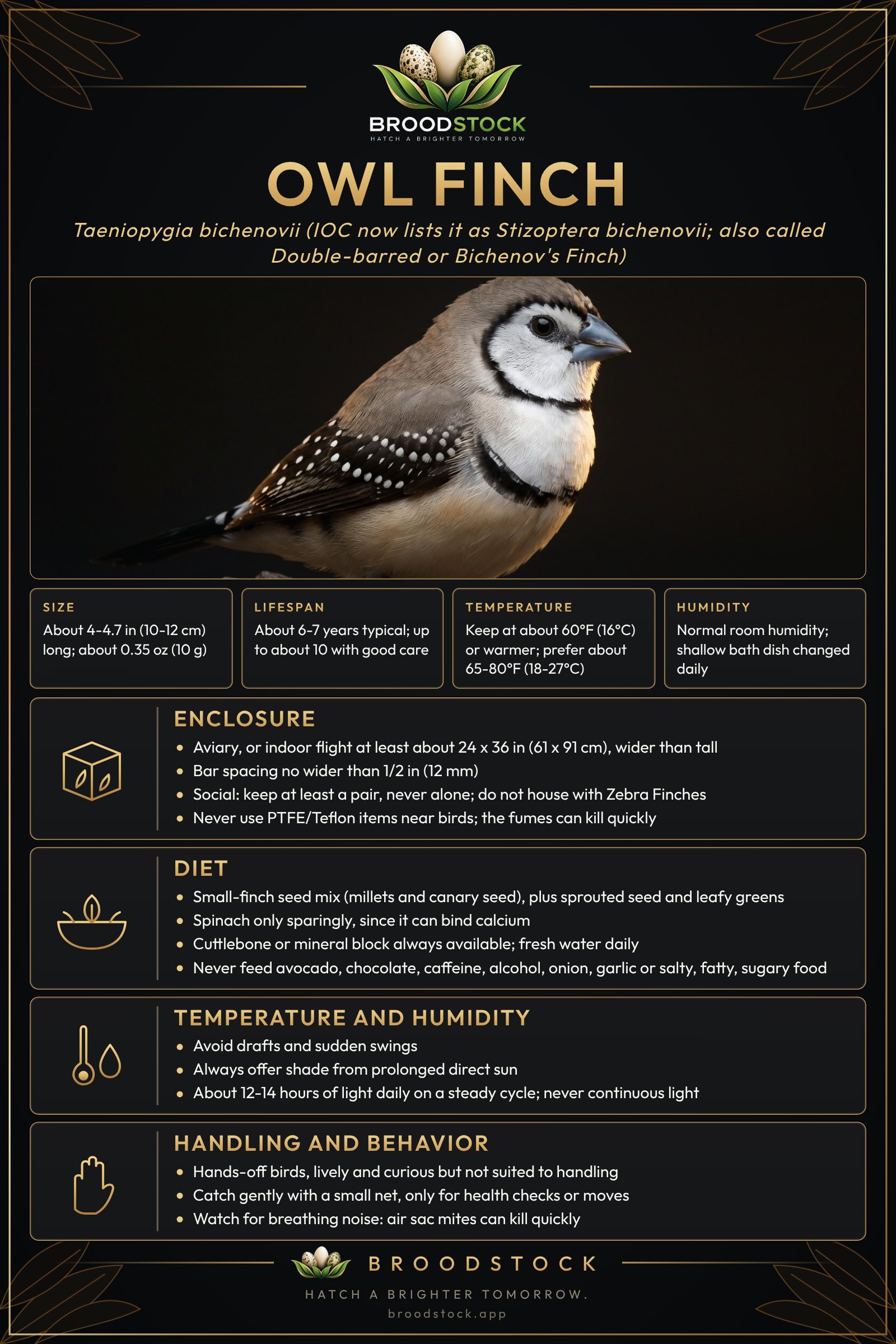
Print it or save it
The care sheet is a one-page summary you can print or keep on your phone. The full care text is below.
Keeping Owl Finch? Broodstock tracks feeding, weights, sheds, enclosures and equipment for every animal you keep, and it is free to start.
Scientific name
Taeniopygia bichenovii, which IOC now lists as Stizoptera bichenovii. It is also called the Double-barred or Bichenov's Finch.
Adult size
Length is about 4-4.7 in (10-12 cm), averaging about 4.3 in (11 cm), and weight is about 0.35 oz (10 g).
Lifespan
In aviculture, about 6-7 years is typical, and up to about 10 years with good care.
Enclosure
They do best in an aviary with plenty of branches and safe planting, or an indoor flight of at least about 24 x 36 in (61 x 91 cm). Make it wider than tall, since they fly lengthwise. Bar spacing should be no wider than 1/2 in (12 mm).
They are social, so keep at least a pair and never a single bird. If you keep more than one pair, three or more pairs settle better than two. They are peaceful with other placid finches, but do not house them with Zebra Finches, their close relative, to avoid accidental hybrids. Keep them away from kitchen fumes.
Never run non-stick pans, irons, or any heat lamps and heaters with a PTFE/Teflon coating near birds. The fumes can kill birds quickly, even from another room.
Temperature
Keep them at about 60°F (16°C) or warmer. They prefer the warmer side of about 65-80°F (18-27°C). Avoid drafts and sudden swings, and always provide shade from prolonged direct sun.
Humidity
Normal room humidity is fine. No target specific to this species is documented, though one US finch breeding facility ran at about 65% RH. Offer a shallow bath dish and change it daily.
UVB
Little is documented about UVB for this species. Unfiltered natural sunlight is the best option, such as an outdoor flight or an open window (glass blocks UV), with shade always available. Avian vet evidence on UVB lamps for birds is mixed, so a lamp is optional. If you use one, choose a bird-specific full-spectrum/UVB lamp, follow the maker's distance advice and run it on the normal day cycle. The diet has to supply vitamin D3.
Lighting
Give about 12-14 hours of light a day on a steady day and night cycle. Never use continuous light.
Heating
Do not use heat sources that carry a PTFE/Teflon coating near birds. That covers non-stick pans, irons, and some heat lamps and heaters. The fumes kill small birds quickly.
Diet
Base the diet on a quality small-finch seed mix (millets and canary seed), with finch pellets if the birds accept them. Often offer sprouted seed and fresh green seed heads, and give leafy greens all year (kale, bok choy, endive, silverbeet). Give spinach only sparingly, because it can bind calcium. Egg food or soft finch food can be added. Live food (small mealworms or similar grubs, about 2-4 per bird a day) is optional for most of the year.
Change the water daily.
Never feed avocado, chocolate, caffeine, alcohol, onion, garlic, fruit pits, apple seeds, or any human food that is salty, fatty or sugary.
Supplements
Keep a cuttlebone or mineral block and a small amount of fine mineral grit available at all times. Some keepers also offer charcoal. Laying hens commonly get extra calcium (crushed baked eggshell or a liquid calcium). Birds that are seed-based and indoors without UV need an avian vitamin supplement with A and D3.
Shedding
Juveniles are duller, with indistinct chest bars, and molt into adult plumage by about 3-4 months. Adults molt yearly, usually after breeding. Give extra protein. If feathers go patchy outside a molt, suspect plucking by cagemates or mites.
Handling
These birds are hands-off. They are lively and curious but not suited to handling. Catch them gently with a small net, and only for health checks or moves.
Health signs to watch
Take the bird to an avian vet for any of these: tail bobbing, clicking or open-mouth breathing (air sac mites, serious in this species and worse under stress); crusty growths on the beak, face or legs (scaly face mites); a fluffed, sleepy appearance; a hen straining or sitting on the floor (egg binding); diarrhea or weight loss (gut infections, worms).
A regular worming and parasite control plan is needed for aviary birds. A vet or experienced keeper should trim overgrown nails or beak. Exposure to PTFE fumes can lead to sudden death.
Welfare
Quarantine new birds and act on any breathing noise, because air sac mites can kill this species fast. Do not allow any hybridizing with Zebra Finches. Sexing errors are common, so get a DNA sex test before buying a pair. Keep them as hands-off pets, and never keep a single bird alone.
Keep every animal's care in one place
Log feedings, weights and sheds, set reminders, and let Ranger, the built-in AI manager, help with the rest. Free to start, no card needed.