
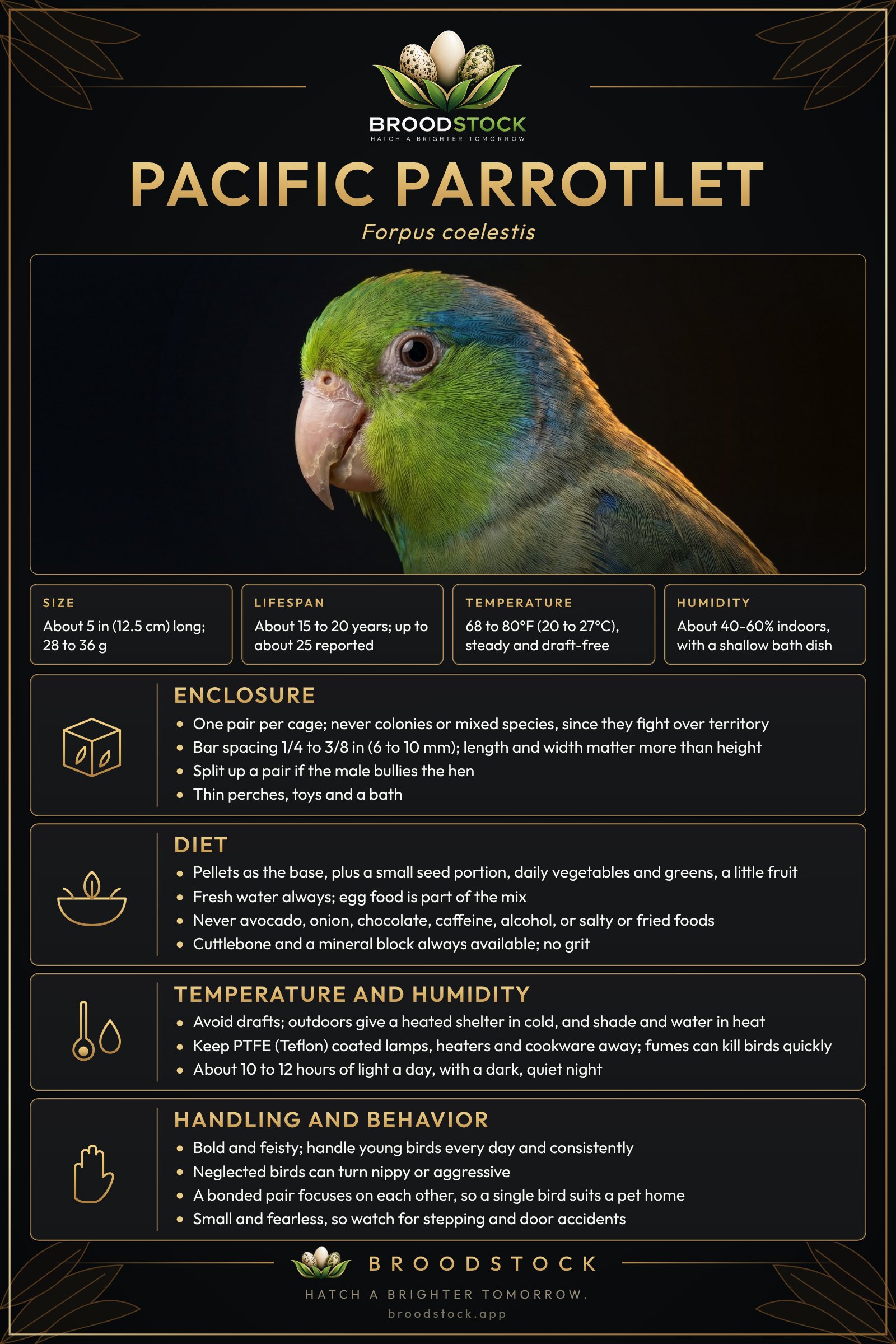
Print it or save it
The care sheet is a one-page summary you can print or keep on your phone. The full care text is below.
Keeping Pacific Parrotlet? Broodstock tracks feeding, weights, sheds, enclosures and equipment for every animal you keep, and it is free to start.
Scientific name
Forpus coelestis
Adult size
Length is about 5 in (12.5 cm), and adults weigh 28 to 36 g.
Lifespan
With good care, expect roughly 15 to 20 years in captivity. Reports of up to about 25 years exist.
Enclosure
Choose bar spacing of 1/4 to 3/8 in (6 to 10 mm). In the cage, length and width matter more than height, and bigger is better.
Keep only one pair per cage. Never run colonies, and never house them with other species, since they fight over territory and will take on larger birds. Split up a pair if the male bullies the hen.
Offer varied thin perches, toys and a bath.
Temperature
About 68 to 80°F (20 to 27°C) is comfortable, as long as the air is steady and free of drafts. Limits for outdoor aviaries are poorly documented. In cold weather give a heated shelter, and in heat give shade and water.
Humidity
Little is documented here. Keepers often aim for roughly 40-60% indoors and provide a shallow bath dish.
UVB
UVB is optional and not needed when the diet is mostly pellets. The best source is direct, unfiltered sunlight in a safe carrier or aviary, because window glass blocks UVB. Aim for at least 30 minutes a week. One avian vet handout suggests 20 to 30 minutes two or three times a week in warm months.
If you use a bulb, pick an avian full-spectrum/UVB bulb and mount it at the distance the maker states. Too close can harm the eyes, so stop if the bird squints or rubs its face. Put it on the same timer as the day length, and replace it on the maker's schedule since output fades (about 6 months for many bulbs).
With no UVB or sun, the bird gets vitamin D3 from the pellet part of its diet.
Lighting
A normal day is about 10 to 12 hours of light followed by a dark, quiet night; this is general parrot practice. For chronic layers, cut light to 10 hours and remove the nest box.
Heating
Keep the room steady at 68 to 80°F (20 to 27°C), and use thermostat-controlled heat only. Do not use PTFE (Teflon) coated heat lamps, heaters or nonstick cookware near birds, because the fumes can kill birds quickly.
Diet
Base the diet on pellets sized for small parrots or parrotlets. Add a small portion of small seed (canary, millets, some oats/hulled grains, little sunflower), vegetables and leafy greens daily, a little diced fruit, and egg food. Always provide fresh water.
Never offer avocado, onion, chocolate, caffeine, alcohol, or salty or fried foods.
Supplements
Keep cuttlebone available all the time and replace it often, and add a mineral block. Calcium deficiency is the commonest dietary problem in breeding hens. A liquid calcium in the water during laying is optional. On a pellet diet, choose one with no added vitamin D3 so it is not doubled; a D3 version only suits seed-heavy birds without sun or UVB.
Do not give grit, since parrots hull their seed. Give no routine multivitamin on a mostly pellet diet. Seed-heavy birds are prone to vitamin A deficiency while being switched to pellets.
Shedding
Species-specific information is thin. Birds usually molt once or twice a year, often following breeding, and indoor birds may molt lightly all year.
Handling
They are bold, feisty and strong-willed for their size. A hand-fed single bird makes an affectionate pet when handled every day, but may turn nippy or aggressive if ignored. Bonded pairs focus on each other, so a lone bird makes the better pet. Handle young birds consistently and set clear limits.
Brumation
Parrotlets do not have a true seasonal rest period.
Health signs to watch
Take the bird to an avian vet for any of these. Egg binding is an emergency: the hen strains, sits fluffed on the floor and has a swollen vent. Calcium deficiency shows as soft or thin shells, trembling and trouble perching. Also watch for chronic egg laying, fight injuries (a bullied hen can be badly hurt within hours), and general signs such as fluffed feathers, tail bobbing, discharge and weight loss.
Being small and fearless, parrotlets are prone to accidents such as being stepped on or caught in doors. Mutation lines can be less vigorous. Quarantine new birds.
Welfare
Mutation lines may be less vigorous than normal greens.
Only sell birds that are fully weaned. The Australian Veterinary Association says unweaned parrots should not be sold because of crop burns, aspiration and behaviour problems later on. California also prohibits pet retailers from releasing a parrot before it can feed itself.
Keep every animal's care in one place
Log feedings, weights and sheds, set reminders, and let Ranger, the built-in AI manager, help with the rest. Free to start, no card needed.