
Broodstock / Care sheets / Pacman Frog
Pacman Frog Care Sheet
Ceratophrys cranwelli (Cranwell's horned frog; many pet 'fantasy' frogs are C. cranwelli x C. ornata hybrids)
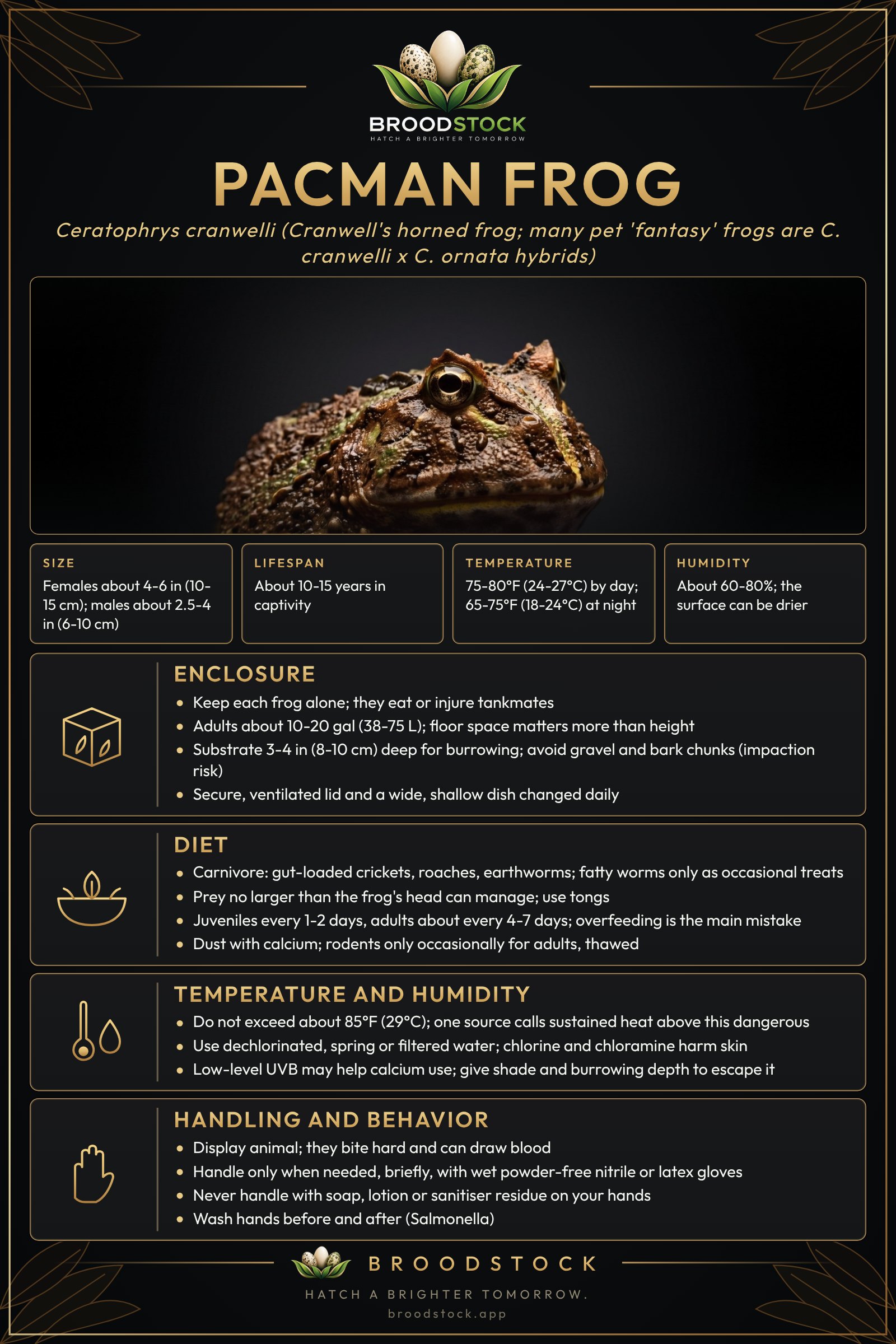
Print it or save it
The care sheet is a one-page summary you can print or keep on your phone. The full care text is below.
Keeping Pacman Frog? Broodstock tracks feeding, weights, sheds, enclosures and equipment for every animal you keep, and it is free to start.
Scientific name
Ceratophrys cranwelli (Cranwell's horned frog). Many pet 'fantasy' frogs are hybrids between Ceratophrys cranwelli and Ceratophrys ornata.
Adult size
Females typically measure about 4-6 in (10-15 cm) and occasionally reach about 7 in (18 cm). Males run about 2.5-4 in (6-10 cm). A large adult can weigh up to about 1 lb (0.5 kg). Babies are sold at roughly 1-2 in (2.5-5 cm) and take about 6-18 months to reach adult size.
Lifespan
With good care, these frogs live about 10-15 years in captivity.
Enclosure
Keep each frog alone, because they eat or injure tankmates, other pacman frogs included. They are sit-and-wait burrowers, so floor space matters more than height. Use a secure, ventilated lid.
Babies can live in small plastic tubs or about 10 gal (38 L). Adults need about 10-20 gal (38-75 L); a 20 gal long or 24 x 18 x 12 in (60 x 45 x 30 cm) is a common adult size.
Make the substrate deep enough for the frog to bury itself completely, about 3-4 in (8-10 cm) for adults. Coconut fibre (coir), peat-based soil or a fine, uniform bioactive mix all work if kept damp but not soggy, with leaf litter or moss on top. Avoid gravel, rocks, bark chunks, long sphagnum strands near feeding areas (impaction risk), and rough reptile carpet.
Provide a wide, shallow water dish that the frog can sit in, and change it daily. Spot clean daily, and replace all the substrate about monthly unless the setup is bioactive.
Temperature
The usual target is about 75-80°F (24-27°C) in the day and about 65-75°F (18-24°C) at night. Guides vary, from about 72-78°F (22-26°C) up to 80-85°F (27-30°C) by day, so practices differ. Do not let it climb above about 85°F (29°C); one guide calls sustained heat beyond that dangerous. Place thermometers at frog level in both warm and cool areas.
Humidity
Aim for about 60-80%, though guides range from about 40% to 80%. Mist once or twice daily, or keep the lower substrate damp; the surface may stay drier. Avoid stagnant, soggy conditions, which grow bacteria and mould.
Use dechlorinated tap water, spring water or filtered water for both misting and the dish, since chlorine and chloramine harm amphibian skin. Distilled water on its own is not advised for the dish.
UVB
UVB is not strictly required, but low-level UVB is increasingly recommended and may help calcium use. Fit a low-output tube (for example a ShadeDweller-type or 2.0-5.0 style lamp) over part of the enclosure. Keep the frog no closer than about 8 in (20 cm), and give plenty of shade and burrowing depth so it can escape the light. UVB cannot pass through glass or plastic. Replace the lamp as the maker says (about every 6-12 months).
Evidence for amphibians is limited; one zoo study found UVB plus supplements gave normal bone density in captive-bred frogs. Pick the calcium supplement to match whether UVB is used.
Lighting
Run lights on a timer for about 10-14 hours a day (one guide uses about 14 h in summer and 10 h in winter). Use no white or coloured lights at night. Plant lights are optional, for live plants.
Heating
Extra heat is usually unnecessary if the room stays in range. When it is needed, use a low-wattage heat bulb or a heat mat on the side of the enclosure, always on a thermostat. Never use heat rocks. If you cannot keep the room below about 85°F (29°C), this species is a poor fit.
Diet
Pacman frogs are carnivores. Staples are gut-loaded crickets, roaches (dubia, discoid), earthworms and nightcrawlers, with black soldier fly larvae, silkworms and hornworms as other options. Waxworms, superworms and mealworms are fatty, so give them only as occasional treats. Offer prey no larger than the frog's head can manage, using tongs.
Feed juveniles every 1-2 days and adults about every 4-7 days, judging by body shape. Guides range from twice weekly to once every 1-2 weeks, so practices vary. Rodents are optional and only occasional for adults (no more than about every other week), thawed frozen and not live; many keepers skip them because of the fat. Overfeeding is the main mistake, since these frogs gorge whenever food is offered.
Supplements
Insects should be dusted with calcium. If you use UVB, choose calcium without D3 or a low-D3 all-in-one (for example Repashy Calcium Plus LoD). With no UVB, choose calcium with D3. Give an amphibian multivitamin about once a week.
Juveniles get calcium at most feeds (guides say anywhere from every feeding to 2-3 times a week) and adults about weekly; practices vary. Gut-load feeders for 24-72 hours beforehand.
Shedding
Shedding happens regularly, every few days to every few weeks, and younger frogs shed more often. The skin comes off whole and is usually eaten, so you rarely see it. Ahead of a shed the skin can look dull or milky and the frog sits hunched. Skin gets thicker when conditions are dry. A frog that has formed a dry 'cocoon' will shed it and eat it once rehydrated.
Handling
These are display animals. They bite hard, and their sharp teeth can draw blood. Handle one only when necessary, briefly, in wet powder-free nitrile or latex gloves, cupping the body gently. Never handle with hands that carry soap, lotion or sanitiser residue. Wash your hands before and after.
Brumation
In the wild, these frogs estivate through dry or cold spells: they bury themselves, stop eating and form a waterproof cocoon of shed skin. In captivity this occurs if the substrate dries or temperatures drop, and the frog can look dead. A pet frog has no need for this. To end it, put back damp substrate and normal temperature, and the frog will shed the cocoon.
Health signs to watch
See an amphibian vet for any of these. Impaction (bloating, straining, no droppings, refusing food) is most common in young frogs that swallow substrate or gravel, and is possibly fatal without treatment (vet laxatives or surgery). Obesity looks like a fat, wide body with poor activity. Metabolic bone disease shows as a soft jaw, weak or twisted limbs and a poor feeding strike. Red belly or legs, lethargy or skin sores point to bacterial 'red leg' and other infections, often after poor hygiene or soggy substrate. Also watch for persistent stuck skin and dehydration. Chytrid and other fungal diseases are known to occur.
Biosecurity: quarantine new frogs apart with their own tools, disinfect equipment, never release frogs, and keep enclosure water and substrate away from wild amphibians. Salmonella is a concern, so wash your hands after touching the frog or its things.
Welfare
Pacman frogs are solitary and cannibalistic at every life stage, so never group them. Obesity is extremely common in pets because of overfeeding and fatty prey. Swallowed loose particles cause impaction, a leading preventable cause of death. Frogs and tadpoles must never be released.
Keep every animal's care in one place
Log feedings, weights and sheds, set reminders, and let Ranger, the built-in AI manager, help with the rest. Free to start, no card needed.