
Print it or save it
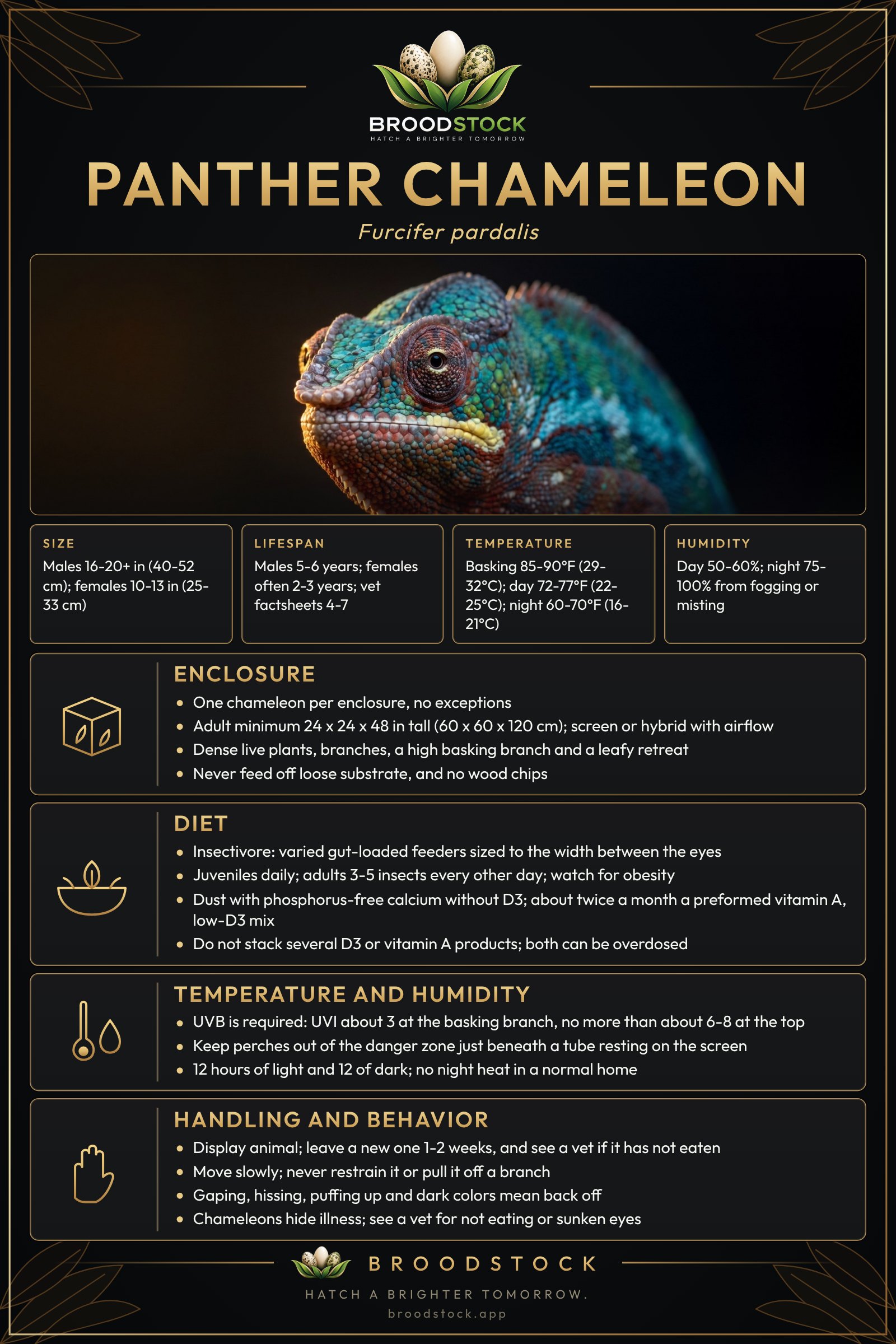
The care sheet is a one-page summary you can print or keep on your phone. The full care text is below.
Keeping Panther Chameleon? Broodstock tracks feeding, weights, sheds, enclosures and equipment for every animal you keep, and it is free to start.
Scientific name
Furcifer pardalis
Adult size
Males reach about 16-20+ in (40-52 cm) in total length. Females are smaller, usually about 10-13 in (25-33 cm).
Lifespan
Males live about 5-6 years, sometimes longer. Females often manage only 2-3 years, shortened by repeated egg production. Overall figures from vet factsheets are 4-7 years.
Enclosure
Keep one chameleon per enclosure, without exception. The adult minimum is 24 x 24 x 48 in tall (60 x 60 x 120 cm), and larger is strongly recommended, about 36 x 24 x 48 in for males. Females can manage in 24 x 24 x 48 in, with 18 x 18 x 36 in as a bare-minimum fallback. Juveniles do well in smaller screen enclosures.
Use screen or hybrid construction (three solid sides help humidity) with airflow. Mount UVB and heat fixtures on top of or above the screen, not inside. Fill it with dense live plants and branches, an open basking branch high up, and a thick leafy retreat.
The floor can be bare or drainage/soil with plants. Never feed off loose substrate or use wood chips. Mature females need a laying bin.
Temperature
Measure the basking spot at the chameleon's back; it should be 85-90°F (29-32°C). Daytime ambient is 72-77°F (22-25°C) and night is 60-70°F (16-21°C). Nights in the low 60s or high 50s°F (about 14-17°C) are fine if the animal can warm up in the morning. A normal home needs no night heat.
Humidity
By day aim for 50-60% (40-50% is acceptable in screen cages). At night it should be 75-100%, from night fogging or misting before lights-on. Ventilate well, and allow surfaces to dry out in the daytime. Mist morning and evening and add a dripper in the afternoon, since most panthers will not drink from a bowl.
UVB
UVB is required (Ferguson Zone 3). Target a UVI of about 3 at the basking branch (the chameleon's back) and no more than about 6-8 at the very top of the cage.
Use a linear T5 HO tube in an Arcadia ProT5 or Vivarium Electronics fixture, not the Zoo Med T5 fixture. Either run an Arcadia Forest/6% (Zoo Med T5 5.0) on or just above the screen with the back about 6 in below it, or raise an Arcadia 12% (Zoo Med T5 10.0) about 6 in above the screen. A tube lying right on the screen creates a danger zone just beneath it (about 2-3 in for a 6%, about 6 in for a 12%, hence the raised 12%), so keep perches out of that zone.
Measure with a Solarmeter 6.5 weekly for the first two months and monthly afterwards. Replace bulbs on schedule, and provide shaded leafy cover.
Lighting
Give 12 hours of light and 12 of dark, with no lights at night. Use bright 6500K T5 HO or LED daylight across most of the top (a quad 6500K T5 HO fixture suits a 4 ft tall cage). Switch the daylight on 15-30 minutes ahead of the basking lamp. No seasonal change in light is needed.
Heating
Place incandescent or halogen basking bulbs above the screen, for example two 60W reptile daytime bulbs, and adjust wattage or use a dimmer. Basking heat should run for only part of the day. Keepers' schedules vary, from 30 minutes to 2 hours after lights-on, to most of the day with the bulb off about 4 hours before lights-out. Watch behavior and adjust. Where warming up takes the chameleon longer than about 2 hours, warm the room instead. In a normal home, use no heat mats, rocks or night heat.
Diet
Panthers are insectivores. Offer varied gut-loaded feeders: crickets, dubia, red runner and banana roaches, black soldier flies and larvae, blue bottle flies, hornworms, silkworms, locusts, stick insects and captive-bred snails. Mealworms are fine in moderation; waxworms and morio/superworms are occasional treats. Size prey to about the width between the eyes (worms can be longer).
Juveniles eat daily, as much as they will take. Adults get 3-5 insects every other day. Obesity is worth watching for, especially in females.
Supplements
At most feedings, dust feeders lightly with phosphorus-free calcium that has no D3 (for example Repashy SuperCal NoD or Zoo Med Repti Calcium without D3), or with a calcium and bee pollen blend (Arcadia EarthPro-A). About twice a month, swap in a calcium/multivitamin with PREFORMED vitamin A (retinyl acetate or palmitate, not only beta-carotene) and a low dose of D3 (for example Repashy Calcium Plus LoD). Arcadia Revitalise D3 and Zoo Med Reptivite with D3 are other examples.
When UVB gives about UVI 3, the chameleon makes most of its D3 itself. Powders only top this up and never replace UVB. Do not stack several D3 or vitamin A products, since both can be overdosed.
Feeders should be gut-loaded for 24-48 hours first, with Repashy SuperLoad or a similar complete gutload. Nobody has established chameleons' exact vitamin needs, so schedules differ between keepers.
Shedding
Panthers shed in patches, and juveniles do so often. Good night humidity and hydration help sheds go normally. Do not pull off any skin. See a vet if you notice repeated poor sheds, dull color, or swollen eyelids or turrets, which can point to vitamin A deficiency or dehydration.
Handling
This is a display animal that tolerates little handling. Give a new arrival 1-2 weeks; if it still has not eaten, see a vet instead of handling it. To build trust, tong-feed first, then hand-feed, then let it step onto a hand or an artificial tree at the open door, pairing handling with positives. Move slowly, and never restrain it or pull it off a branch. Back off when it gapes, hisses, puffs up or turns dark.
Brumation
No brumation is needed. A nightly cool-down to 60-70°F (16-21°C) is all the cooling they need, even if it reaches the high 50s°F (about 14°C).
Health signs to watch
Egg retention/binding (swollen belly, weakness, restless digging without laying) is urgent and needs a vet. Metabolic bone disease shows as a rubbery jaw, bent or broken legs, and a weak grip or tongue, from low calcium or no UVB. Gout (swollen joints) is linked to phosphorus in dusts. Eye turret swelling or abscess is often vitamin A deficiency. Other risks are basking burns, UVB over-exposure near the lamp, foot sores and infections from wet surfaces, and obesity.
Not eating, closed or sunken eyes in daytime, or dark stress colors call for an ARAV reptile vet, because chameleons hide illness.
Welfare
Buy captive-bred. Imports taken from the wild in Madagascar nearly always carry parasites and frequently go downhill after purchase. A CITES quota also caps exports at about 3,000 a year in recent years.
A locale is the area of Madagascar a line comes from.
Keep every animal's care in one place
Log feedings, weights and sheds, set reminders, and let Ranger, the built-in AI manager, help with the rest. Free to start, no card needed.