
Broodstock / Care sheets / Poison Dart Frog
Poison Dart Frog Care Sheet
Dendrobates tinctorius (dyeing poison dart frog; includes the 'azureus' blue form, now generally treated as a morph of this species)
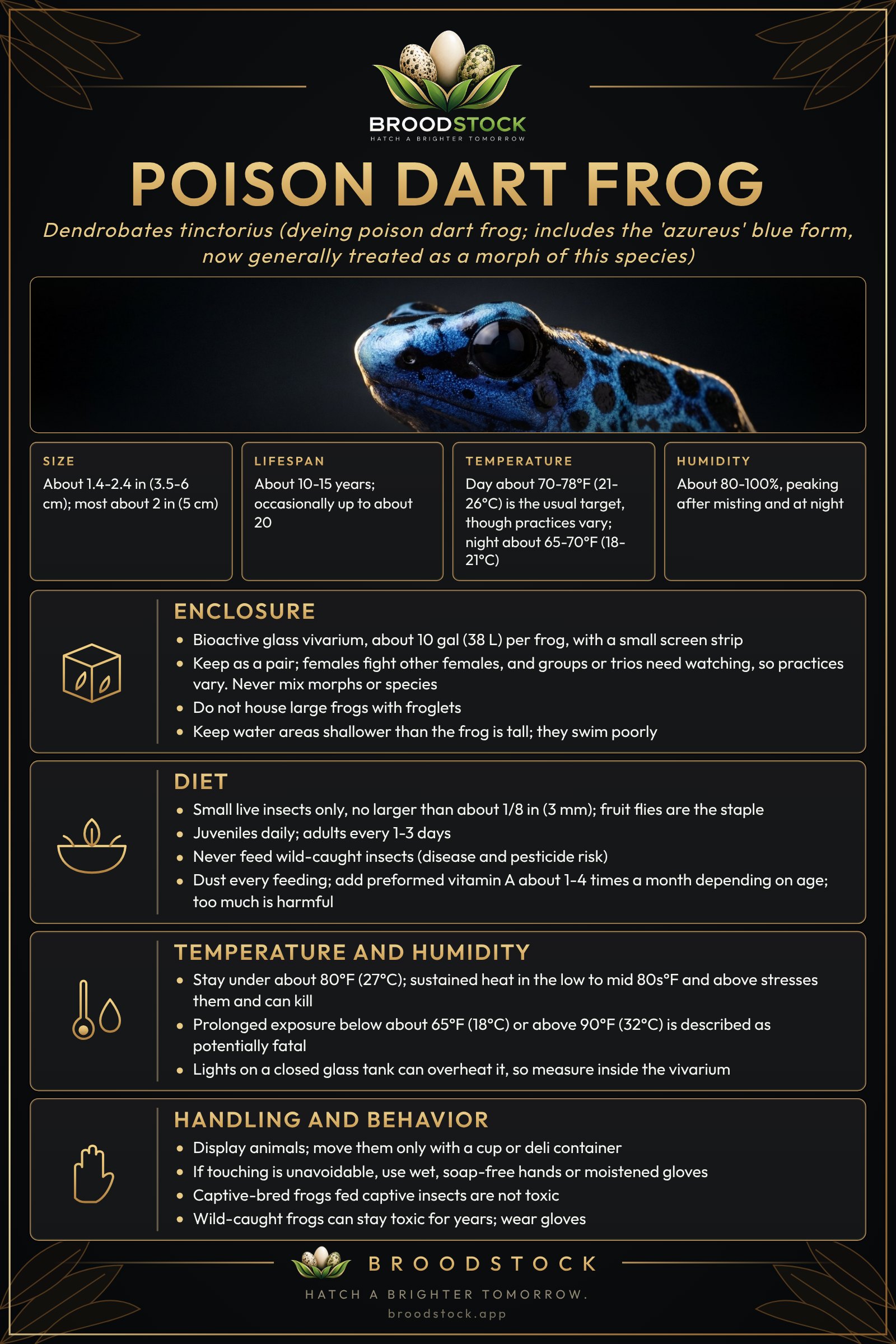
Print it or save it
The care sheet is a one-page summary you can print or keep on your phone. The full care text is below.
Keeping Poison Dart Frog? Broodstock tracks feeding, weights, sheds, enclosures and equipment for every animal you keep, and it is free to start.
Scientific name
Dendrobates tinctorius (dyeing poison dart frog), including the 'azureus' blue form, now generally treated as a morph of this species
Adult size
Adults measure about 1.4-2.4 in (3.5-6 cm) from snout to vent. Most forms reach about 2 in (5 cm) and the largest up to about 2.8 in (7 cm). Females are larger and heavier than males; zoo figures put males at up to about 0.13 oz (3.7 g) and females up to about 0.23 oz (6.5 g).
Lifespan
In captivity they live about 10-15 years, occasionally up to about 20. Wild lifespan is not well documented but is probably about 5 years.
Enclosure
Set up a bioactive vivarium that is mostly glass. Leave a small screen strip (about 10-30% of the top) so humidity is held while some air still moves. Give each frog about 10 gal (38 L) of space; a pair or trio fits an 18 x 18 x 24 in (45 x 45 x 60 cm) vivarium.
Layer it like this: a drainage layer (false bottom or clay balls) under mesh, a free-draining tropical substrate on top (ABG-type mix of fir bark, peat or coco, charcoal and moss), then deep sterilised leaf litter. Plant it with bromeliads, pothos and ferns, add cork and hides, and introduce springtails and tropical isopods, which clean up and also serve as extra food. These frogs swim poorly, so water areas must be shallower than the frog is tall.
Keep them as a pair. Females fight other females, and groups or trios (often 2 males, 1 female) need watching, so practices vary. Morphs and species must never be mixed, and large frogs must not share a vivarium with froglets.
Temperature
Daytime temperatures of about 70-78°F (21-26°C) are the usual target. Practices vary: some guides allow up to about 80°F (27°C), and one university herpetarium holds them at 75-84°F (24-29°C). A few degrees cooler at night, about 65-70°F (18-21°C), is fine.
Heat in the low to mid 80s°F (28-29°C) and above, if sustained, stresses these frogs and can kill them, so aim to stay below about 80°F (27°C). Extended time under about 65°F (18°C) or over 90°F (32°C) is described as potentially fatal. A closed glass tank can overheat from its lights, so take readings inside the vivarium.
Humidity
Humidity is high, about 80-100%, peaking after misting and at night. Mist at least twice daily or install a misting system, and use a fan or vent strip to prevent stagnant air. Misting water should be dechlorinated tap water, reverse osmosis (RO) water or spring water; tap water must be treated for chlorine and chloramine. Avoid distilled water as the only water source, and avoid bottled water with added salts.
UVB
Many successful keepers use no UVB, so it is not strictly required. A low-output lamp is an optional extra that supports calcium metabolism; if you fit one, give plenty of plant shade and set it at the maker's distance (one supplier calls it advanced-keeper equipment). Amphibian evidence is limited: a zoo study found normal bone density in captive-bred frogs given UVB plus supplements. Keepers differ on this.
Lighting
Run lights about 12 hours on and 12 off with a timer, using full-spectrum LED plant lighting for the live plants. Check that the lights do not warm the vivarium above about 80°F (27°C).
Heating
At normal room temperature, heat is usually unnecessary. If you need some, use a low-wattage heat mat on the side or back (not under a vivarium with a drainage layer), on a thermostat. Keeping the tank cool enough is more often the problem than warming it.
Diet
Feed small live insects only, no larger than about 1/8 in (3 mm). The staple is flightless fruit flies: Drosophila melanogaster for froglets and small frogs and D. hydei for adults. Springtails, isopods, bean beetles, rice flour beetles and pinhead crickets are also suitable. Both fruit flies and springtails can be cultured at home without much trouble.
Feed juveniles daily and adults every 1-3 days, offering what they eat in about 15-30 minutes. Do not feed wild-caught insects, because of disease and pesticide risk.
Supplements
Dust the food at every feeding. Most keepers either use a calcium plus multivitamin with D3 each time, or alternate calcium with D3 and a multivitamin.
Because insects lack vitamin A, captive amphibians can develop hypovitaminosis A (short tongue syndrome). Counter this with a preformed vitamin A product (for example Repashy Vitamin A Plus) about 1-4 times a month, depending on age and breeding; one breeder's protocol uses roughly monthly for adults. Overdoing vitamin A is harmful too, so stick to the label.
Optionally, add a carotenoid product (for example Repashy SuperPig) roughly weekly for colour. Powders should be replaced regularly. Keepers' routines vary.
Shedding
The skin is shed regularly and usually eaten, which is why it is rarely seen. If patches of skin stay on repeatedly, humidity may be low or the frog may be ill.
Handling
These are display animals. Handle them only when moving them, guiding them with a cup or deli container instead of hands. If you must touch them, use wet, clean, soap-free hands or moistened gloves. Captive-bred frogs fed captive insects are not toxic, since their skin alkaloids come from wild prey such as ants and mites. With wild-caught frogs, wear gloves, because they can stay toxic for years.
Health signs to watch
See an amphibian vet for short tongue syndrome (repeatedly missing prey, caused by vitamin A deficiency); metabolic bone disease (weak or bent legs, soft jaw); thinness or bloating; red or ulcerated skin; and lethargy, especially after overheating. Spindly leg syndrome (froglets with thin, non-working front legs) is linked by breeders to parental vitamin and tadpole nutrition, though this is not proven.
Chytrid fungus and ranavirus are major amphibian diseases. Buy captive-bred, quarantine new frogs apart with their own tools and have a fecal test done, disinfect equipment, never release frogs, and keep vivarium water and substrate away from the wild.
Welfare
The species has been on CITES Appendix II since 1987, so international trade requires export permits. Buy captive-bred frogs from breeders who can document their origin. Captive-bred frogs are not poisonous, but they remain fragile amphibians with absorbent skin.
Female-female aggression can be serious, so separate frogs that bully at feeding or wrestle repeatedly. Two leading avoidable causes of death are overheating and vitamin A deficiency. Keep morphs separate and correctly labelled to protect locality lines.
Keep every animal's care in one place
Log feedings, weights and sheds, set reminders, and let Ranger, the built-in AI manager, help with the rest. Free to start, no card needed.