
Print it or save it
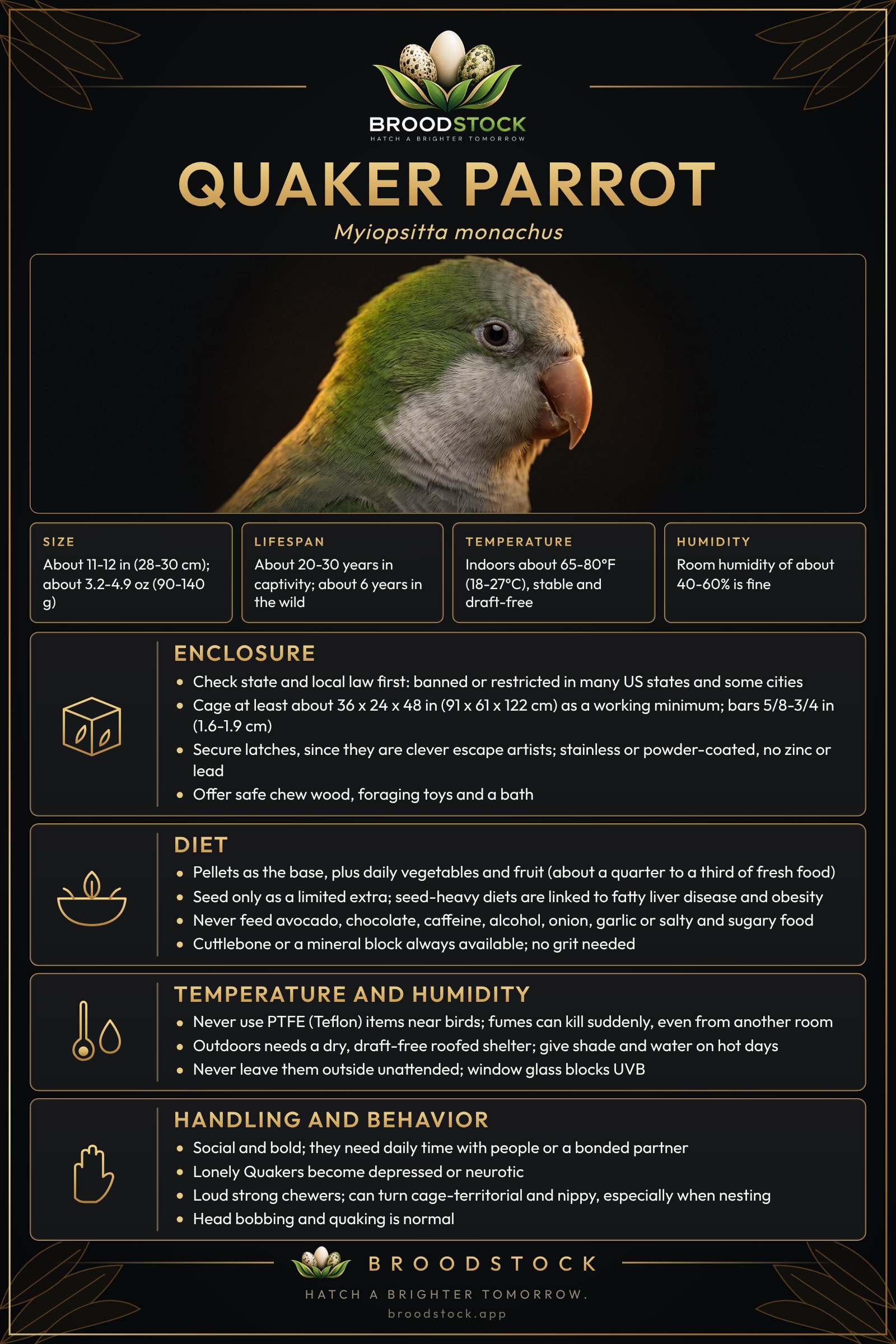
The care sheet is a one-page summary you can print or keep on your phone. The full care text is below.
Keeping Quaker Parrot? Broodstock tracks feeding, weights, sheds, enclosures and equipment for every animal you keep, and it is free to start.
Scientific name
Myiopsitta monachus
Adult size
Quakers are about 11-12 in (28-30 cm) long and weigh about 3.2-4.9 oz (90-140 g), with most around 3.5-4.2 oz (100-120 g). Hens run about 5-10% smaller.
Lifespan
Expect about 20-30 years in captivity with good care; averages of around 22-25 years are reported. Wild birds live about 6 years.
Enclosure
Start with the law. Many US states and some cities ban or restrict Quakers, since feral flocks count as an agricultural and utility pest, and birds have been confiscated where they are illegal. Under the rules checked in October 2026, a Quaker cannot be owned, sold or brought into California, Colorado, Georgia (except old license holders), Hawaii, Kansas, Kentucky, Maine, Pennsylvania, Tennessee, Wisconsin or Wyoming.
Other states are mixed. Connecticut treats it as a wild animal. Guides disagree on whether a bird may be kept there, though selling and breeding are reported as not allowed. Nebraska leaves it out of its pet cage-bird class, so captive wildlife rules apply, and secondary reports call it banned. In Idaho it counts as an invasive species and possession needs a state invasive species permit. New Jersey lists it as a potentially dangerous species requiring a state permit, and several references treat it as banned for pets. Rhode Island wants a possession permit, while Arkansas wants permits for breeding, selling or importing. Virginia needs no permit only for captive-bred birds wearing a seamless closed band. In Ohio the wings must be clipped, or the bird must otherwise be unable to fly. New York permits owning and selling but not releasing; some report banding and registration rules there too, so check with the state. Laws change, and other states and many cities have rules of their own. Before you buy, sell, ship, breed or move with a Quaker, confirm the position with the state agriculture or wildlife agency.
A large, sturdy cage is needed: roughly 36 x 24 x 48 in (91 x 61 x 122 cm) at least, as a working minimum (vet minimums for similar-sized conures). Bars should be spaced about 5/8-3/4 in (1.6-1.9 cm) and latches should be secure, as Quakers are clever escape artists. Supply plenty of safe chew wood, branches, foraging toys, nest-building twigs and a bath. Choose stainless steel or powder-coated, with no zinc or lead.
Temperature
Keep indoor temperatures stable and draft-free at about 65-80°F (18-27°C). Quakers cope well with cold, and feral colonies get through Chicago winters sheltered inside their stick nests. A captive bird kept outdoors still needs a dry, roofed, draft-free shelter or nest for roosting. No exact safe outdoor minimum is well documented. In hot weather, provide shade and water.
Humidity
Normal room humidity of about 40-60% suits them. They enjoy bathing and misting, so offer a bath or light shower several times a week.
UVB
The ideal is natural, unfiltered sunlight with shade available, in a secure cage or harness and supervised, for about 20-30 minutes 2-3 times a week at 65-85°F (18-29°C). Never leave one outside unattended, since escaped Quakers are illegal or unwelcome in many areas. UVB does not get through window glass.
Indoor birds have an option from general avian vet guidance: an avian UVB fluorescent tube or compact bulb over the cage for at least 3-4 hours a day, replaced about every 6 months. Stop using it if the bird squints, rubs its face or gets red skin around the eyes.
Lighting
Pets do best with about 10-12 hours of light, then 12 hours of dark and quiet; a Quaker that is overtired turns nippy and noisy. Remove nest material and boxes and shorten the day to rest a chronic layer. For a hen that will not stop laying, an avian vet may suggest as little as 8 hours of light.
Heating
Never use non-stick (PTFE/Teflon) cookware, drip pans, irons, or heat lamps and heaters with a PTFE coating, anywhere near birds. When PTFE overheats it releases colourless, odourless fumes that can kill birds suddenly, including in another room. Move a sick bird to a warm hospital cage and take it to an avian vet.
Diet
Seeds, fruit, blossoms, leaf buds, grasses, grain crops and a few insects make up the wild diet. In captivity, build the diet on formulated pellets. Add vegetables each day (carrot, green beans, peas, corn, leafy greens), fruit making up about a quarter to a third of fresh food, cooked beans or pulses, and a limited extra of small seed mix. High-fat seed diets are linked to fatty liver disease and obesity.
Never offer avocado, chocolate, caffeine, alcohol, onion, garlic, fruit pits, apple seeds, or salty, fatty or sugary human food.
Supplements
Keep cuttlebone or a mineral block available at all times, with extra calcium for laying hens if an avian vet advises it. Birds on pellets rarely need vitamins. Seed-fed birds benefit from a supplement with vitamins A and D3, used according to the label. Seed-hulling parrots do not need grit.
Shedding
Adults molt once or twice a year, often after breeding; give extra protein. Quakers are prone to feather-destructive behaviour (plucking, chewing). Feather loss outside a molt calls for an avian vet work-up for medical causes before you treat it as behaviour.
Handling
Quakers are very social, bold and playful. Hand-raised birds are very tame, and untamed birds can tame with patience. They talk well, especially as single pets. They are also loud, and frequent shrill calls can bother light sleepers and neighbours. Strong chewers, they will damage furniture.
A lonely Quaker becomes depressed or neurotic, so it needs daily time with people or a bonded partner. The head bobbing and quaking behind their name is normal. They can turn cage-territorial and nippy, especially when building nests.
Health signs to watch
Keep an eye out for feather-destructive behaviour (plucking, self-mutilation) and for fatty liver disease and obesity in birds on seed diets. Chlamydiosis (psittacosis) can infect people. In hens, egg binding and chronic laying show up as sitting fluffed on the floor, tail bobbing and straining, and need emergency care. PTFE (Teflon) fume poisoning may be behind sudden breathing trouble or death. New birds need quarantine, and every bird should see an avian vet once a year.
Welfare
The biggest welfare risk is legal status. A bird sold into, or moved to, a state that bans Quakers can be seized and destroyed, so breeders need to check the buyer's state and local law before each sale and shipment. Never release a Quaker outdoors or lose one; feral flocks damage crops and power infrastructure, which is the reason the laws exist.
Expect 20-30 years of a loud, demanding bird, and screen buyers accordingly. Poorly enriched birds often develop feather-destructive behaviour.
Keep every animal's care in one place
Log feedings, weights and sheds, set reminders, and let Ranger, the built-in AI manager, help with the rest. Free to start, no card needed.