
Broodstock / Care sheets / Rankin's Dragon
Rankin's Dragon Care Sheet
Pogona henrylawsoni (also spelled henrylawsonii or henrilawsoni), also called Lawson's dragon, pygmy bearded dragon or black-soil bearded dragon
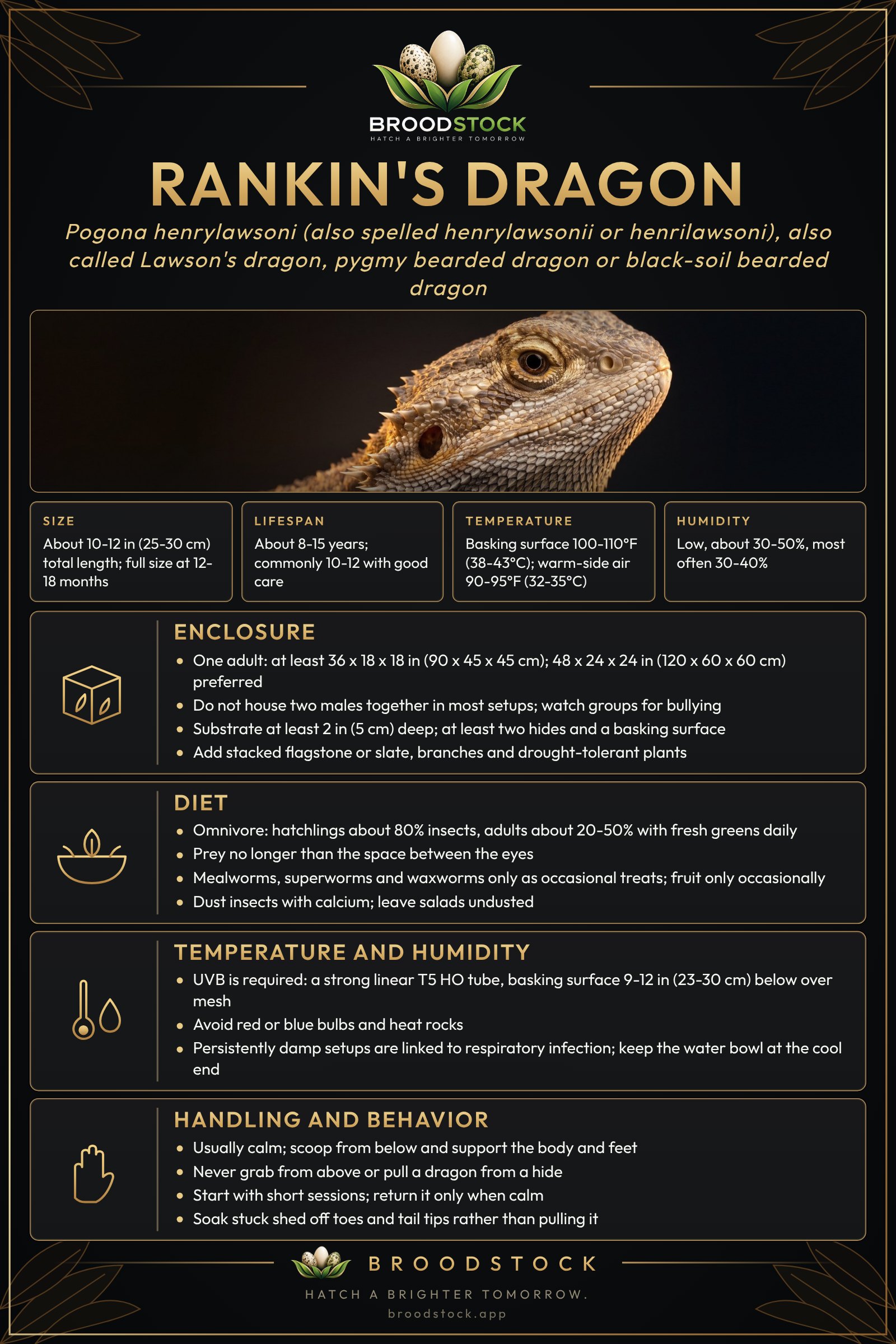
Print it or save it
The care sheet is a one-page summary you can print or keep on your phone. The full care text is below.
Keeping Rankin's Dragon? Broodstock tracks feeding, weights, sheds, enclosures and equipment for every animal you keep, and it is free to start.
Scientific name
Pogona henrylawsoni (also spelled henrylawsonii or henrilawsoni), also known as Lawson's dragon, pygmy bearded dragon or black-soil bearded dragon. The smallest Pogona, it comes from hot, dry, semi-arid parts of central and western Queensland, Australia. It can hybridise with the central bearded dragon (P. vitticeps); the fertile crosses are sometimes passed off as pure Rankin's, so ask for documented lineage.
Adult size
Total length is about 10-12 in (25-30 cm), with snout-vent about 5-6 in (13-15 cm). Well-fed females occasionally reach about 14 in (35 cm) and are often slightly larger than males. Full size arrives at about 12-18 months.
Lifespan
Typical lifespan is 8-15 years, and animals in good care often reach 10-12. A UK retailer quotes 8 years.
Enclosure
Rankin's dragons live on the ground, are active by day and like climbing low rocks. A single adult needs at least 36 x 18 x 18 in (90 x 45 x 45 cm). The preferred size is 48 x 24 x 24 in (120 x 60 x 60 cm), which is also the minimum for a male with females or a group of females. A juvenile can begin in about 20-40 gal (roughly 30 x 12 x 12 in (75 x 30 x 30 cm) up to 36 x 18 x 16 in (90 x 45 x 40 cm)).
Substrate should be at least 2 in (5 cm) deep. Good choices are a sand and topsoil mix (for example 60/40) or a desert sand/clay substrate; some breeders use paper towel or bare floors for hatchlings, though practices vary. Furnish with a flat stone or wood basking surface, two or more hides, stacked flagstone or slate, branches and drought-tolerant plants.
Do not house two males together in most setups. An older herpetarium sheet describes males living in hierarchies, yet most current guides advise against this. Bullying can occur in groups, so give them room and watch them.
Temperature
The basking surface should be about 100-110°F (38-43°C). A single care sheet goes to 115°F (46°C) and an older herpetarium sheet uses 90°F (32°C), so practices vary. Warm-side air is about 90-95°F (32-35°C) and the cool side about 75-85°F (24-29°C). Nights run about 65-72°F (18-22°C). Short drops toward 55-60°F (13-16°C) are tolerated, and a lightless heater is needed only if nights fall below that.
Humidity
Keep it low, about 30-50% and most often 30-40%; brief swings outside that range are fine. Put the water bowl and salad at the cool end. Some keepers mist lightly in the morning so the dragon drinks droplets and others avoid daily misting, so practices vary. Damp setups that persist are linked to respiratory infection.
UVB
UVB is required. Choose a strong linear T5 HO tube, such as a 10.0 or 12% desert lamp, that spans about half to two-thirds of the enclosure length, in a reflective fixture on the basking lamp's side. Place the basking surface about 9-12 in (23-30 cm) under a lamp mounted over mesh, or about 14-16 in (35-40 cm) under one inside the enclosure. Change T5 tubes about yearly (some guides say every 6 months) and T8 tubes every 6 months.
Lighting
About 13 hours of light in summer and 11 in winter works, as does a steady 12, with every lamp off at night. Activity and appetite benefit from a bright 6500K LED or plant light across the remainder of the enclosure.
Heating
Over the basking stone, mount halogen flood bulbs in a ceramic-socket dome on a dimming thermostat. Add night heat (a ceramic heat emitter or radiant panel on a thermostat) only when the room gets too cold. Red or blue bulbs and heat rocks should be avoided. An infrared thermometer measures the basking surface, and probes measure the air.
Diet
Rankin's dragons eat an omnivore diet that moves from insects toward plants with age. Roughly: hatchlings (0-3 months) are about 80% insects at 2-3 feeds a day; juveniles (3-12 months) about 60-70% insects at one or two feeds daily; adults about 20-50% insects, with fresh greens every day and insects 3-5 times a week.
Insects include crickets, dubia, discoid or red runner roaches, black soldier fly larvae, silkworms, hornworms and locusts. Fatty grubs such as mealworms, superworms and waxworms are occasional treats only (one guide waits until 18 months for these). Prey should be no longer than the space between the eyes. Greens include collards, dandelion, mustard and turnip greens, cactus pad, arugula, endive, edible flowers and weeds. Fruit is for occasional use, and a shallow water dish should always be on offer.
Supplements
Dust insects for juveniles with calcium at most feedings, and for adults about 3-5 times a week; add a multivitamin. D3 advice differs between guides. Those built around confirmed strong UVB use a low-D3 or no-D3 product (for example Repashy Calcium Plus LoD). A UK retailer instead recommends calcium with D3 daily, alternated with a multivitamin. Keepers differ. Do not dust salads.
Shedding
Shedding is in patches, as with bearded dragons. A shallow warm bath (5-10 minutes, about twice a week) helps hydration and loose skin. Soak stuck shed off toes and tail tips rather than pulling it.
Handling
They are usually calm and tolerate handling. Scoop from below, supporting the body and feet, and never grab from above or pull one from a hide. Begin with short sessions and lengthen them, returning the dragon only once it is calm. Trust builds when you hand-feed using soft-tipped tongs.
Brumation
Many adults slow down in winter or brumate. In one protocol, begin about November (Northern Hemisphere): drop the day length from 12 to about 8 hours, and over about 2 weeks bring basking temperatures down to 80-85°F (27-29°C) with nights about 60-65°F (16-18°C). Once the dragon refuses food and its gut is empty, stop feeding, keep water available, hold for about 6-8 weeks, then warm up again over 1-2 weeks.
A simpler, older herpetarium protocol is two months at room temperature with the lights off. Brumate only healthy adults in good weight; a vet check first is sensible.
Health signs to watch
Metabolic bone disease comes from weak or old UVB and missing calcium (soft jaw, kinked limbs or tail, tremors). Respiratory infection follows cold or damp enclosures. Impaction results from oversized or hard prey, or swallowed loose substrate, in poorly kept, cool setups. Obesity comes from too many fatty insects. Egg binding affects females without a good dig site or short on calcium.
Yellow fungus disease (CANV, Nannizziopsis) needs urgent vet care; prevent it with hygiene and quarantine. Adenovirus ('wasting disease') has no cure, so ask breeders whether their stock is tested and isolate suspect animals. Run a fecal test on any new arrival.
Welfare
Even though they are small, Rankin's dragons need strong UVB, a hot basking spot and genuine floor space. Never sell hybrids, or animals whose lineage is uncertain, as pure Rankin's. Stock outside Australia comes from a small number of animals exported decades ago and cannot be topped up from the wild.
Keep every animal's care in one place
Log feedings, weights and sheds, set reminders, and let Ranger, the built-in AI manager, help with the rest. Free to start, no card needed.