
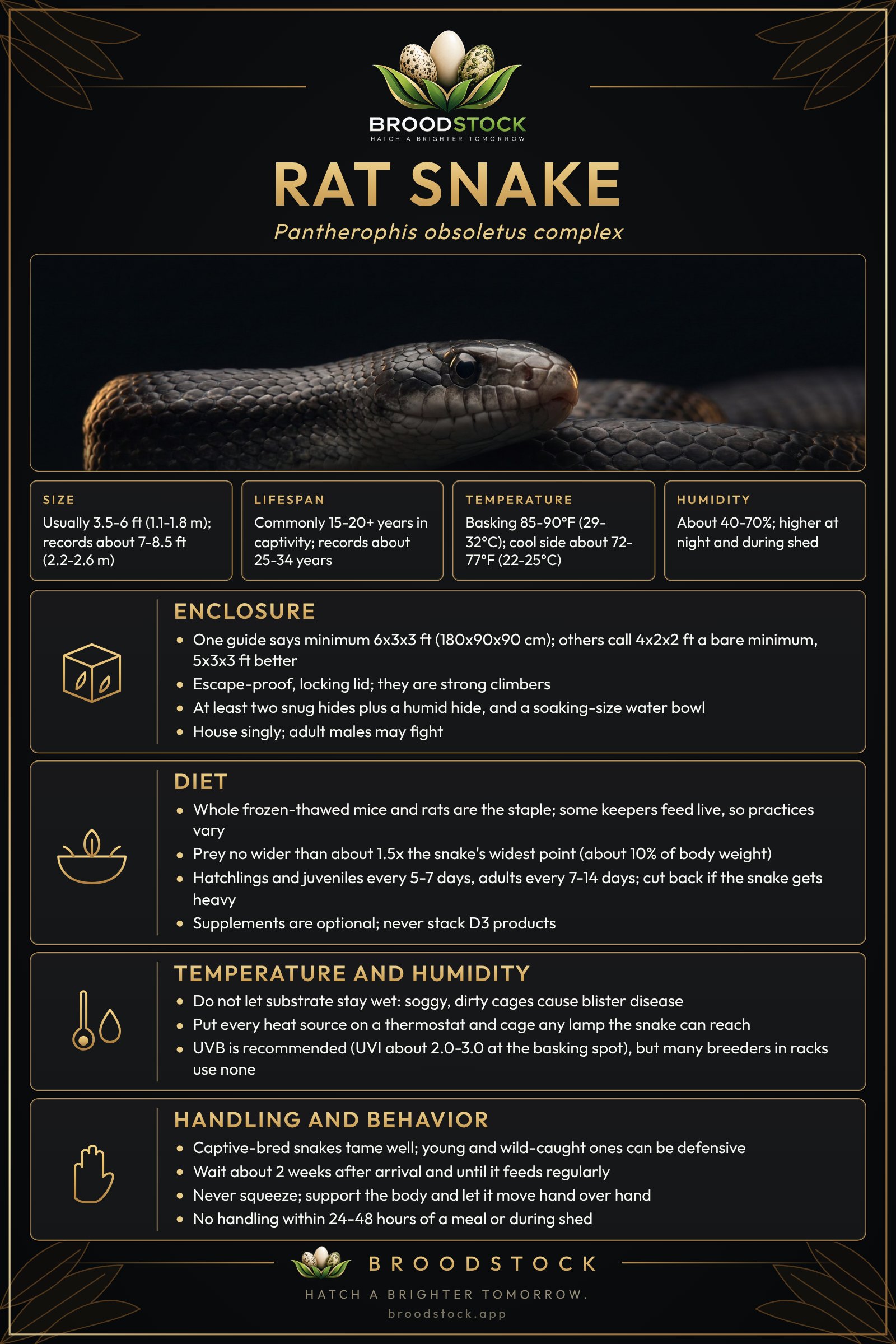
Print it or save it
The care sheet is a one-page summary you can print or keep on your phone. The full care text is below.
Keeping Rat Snake? Broodstock tracks feeding, weights, sheds, enclosures and equipment for every animal you keep, and it is free to start.
Scientific name
The Pantherophis obsoletus complex includes Pantherophis obsoletus (western), Pantherophis alleghaniensis (central or gray rat snake, called Pantherophis spiloides until the recent name correction) and Pantherophis quadrivittatus (eastern, including yellow rat snakes, which used to be called Pantherophis alleghaniensis). The older name is Elaphe obsoleta.
Adult size
Adults are usually 3.5-6 ft (1.1-1.8 m), with records of about 7-8.5 ft (2.2-2.6 m) depending on the reference. They are slender to medium in build. Wild adults weigh roughly 1.3-2.2 lb (600-1,000 g), and males are usually larger than females. Hatchlings measure 10-16 in (25-41 cm) and weigh 12-14 g.
Lifespan
In captivity 15-20+ years is common, and records stand at about 25-34 years. Estimates for wild northern populations are 25-30 years.
Enclosure
Rat snakes are semi-arboreal and very active, so height and climbing matter. ReptiFiles gives a minimum of 6x3x3 ft (180x90x90 cm) for an adult. Other care sheets list 4x2x2 ft (120x60x60 cm) as a bare minimum and recommend 5x3x3 ft (150x90x90 cm), and breeders often keep adults in large rack tubs (28-41 qt (26-39 L)), so practices vary. Hatchlings can live in a shoebox or 6 qt (6 L) tub, and juveniles in a 16-28 qt (15-26 L) tub or 20-gallon long (75 L).
The lid must be escape-proof and locking, since they climb strongly. Fit sturdy branches and shelves, at least two snug hides plus a humid hide, and a soaking-size water bowl. Smooth surfaces in the enclosure help prevent nose rubbing. Use about 4 in (10 cm) of soil-based mix with leaf litter, or aspen in tubs. House each snake alone; adult males may fight.
Temperature
Aim for 85-90°F (29-32°C) at the basking surface and about 72-77°F (22-25°C) on the cool side. Some guides just use a 72-82°F (22-28°C) gradient. At night, turn heat off or down so the enclosure cools. Place probes at the basking perch and on the cool-side floor.
Humidity
Aim for about 40-70%; guides range from 30-70% to 50-70%, so practices vary. Raise it at night and during shed. Put a humid hide with damp sphagnum on the cool side and mist more during shed. Do not let the substrate stay wet, because soggy, dirty cages cause blister disease.
UVB
ReptiFiles recommends UVB, though snakes can survive without it. Target a UVI of about 2.0-3.0 at the basking spot. Use a T5 HO 5.0/6% tube (ReptiSun 5.0 or Arcadia Forest 6%) over about half the enclosure length on the warm side, about 9-12 in (23-30 cm) from the snake over mesh or 12-14 in (30-36 cm) with no mesh. Stick to low-output bulbs (6% or less), and replace them about every 12 months. In racks, many breeders run rat snakes with no UVB at all.
Lighting
Run about 12 hours of light a day on a timer; some keepers use about 13 h in summer and 11 h in winter. For display enclosures, a 6500K LED or T5 plant light works. Leave lights off at night.
Heating
Display enclosures can use overhead halogen flood bulbs above a basking branch or shelf; ReptiFiles suggests a cluster of 50 W PAR30 floods, about four for a 6 ft enclosure. Cage any lamp the snake can reach. Racks use heat tape or mats beneath one end. As an alternative, some breeders warm the entire room, for instance with a thermostat-controlled oil-filled radiator. Every heat source belongs on a thermostat.
Diet
Feed whole prey, with frozen-thawed mice and rats as the staple and variety from chicks, quail, quail or chicken eggs, African soft-furred rats, hamsters, gerbils and Reptilinks. Prey should be no wider than about 1.5x the snake's widest point (about 10% of body weight). Feed hatchlings and juveniles every 5-7 days and adults every 7-14 days, and cut back if the snake gets heavy. In the wild the diet is mostly mammals and birds plus eggs.
Scented prey (lizard or treefrog scent) is needed for some southern hatchlings, notably gray rat snakes, which turn down pinkies at first. Frozen-thawed is the usual recommendation, though some keepers feed live, so practices vary.
Supplements
Supplements are optional, since whole prey covers the diet. If you want them, occasionally dust thawed prey with a 50/50 calcium and multivitamin mix, or an all-in-one such as Repashy Calcium Plus or Arcadia RevitaliseD3. Choose a low-D3 product when using UVB, and never stack D3 products.
Shedding
Growing juveniles shed often and adults less so. Dull color and blue or milky eyes signal an approaching shed. Raise humidity with a humid hide and extra misting, and leave the snake unhandled until it finishes. Stuck shed points to low humidity or dehydration, and persistent problems need a reptile vet. How often these snakes shed is not well documented for the group.
Handling
Captive-bred rat snakes usually tame well, but young and wild-caught ones can be defensive, with tail rattling, striking and musking. Wait about 2 weeks after arrival and until the snake feeds regularly. Keep sessions to 5 minutes or less at first and build up, about 1-2 times a week and no more than daily. Skip handling within 24-48 hours of a meal and during shed.
Let the snake move hand over hand without restraint, support its body and never squeeze. A hook helps lift defensive snakes out of the cage.
Brumation
In the wild, rat snakes hibernate roughly October-February, often in communal dens, and northern snakes are active for only about 6 months. They cannot survive freezing. A cool-down in captivity is optional for pets, and follows general colubrid practice: give the last meal about 2 weeks beforehand (keep the snake warm 7-14 days so its gut empties), cool gradually to about 50-60°F (10-16°C) (many hold about 55°F (13°C)) for 8-12 weeks, with water available and checks 2-3 times a week, then warm back over 1-2 weeks and feed. Cool only healthy, well-weighted snakes, and call a vet if one loses weight.
Health signs to watch
Look out for respiratory infection (wheezing, mucus, open-mouth breathing), mites, stuck shed, obesity and nose rub caused by escape attempts. Wet substrate causes blister disease. Internal parasites turn up mainly in wild-caught snakes, showing as loose stool, lethargy or refusing food. Handling too soon after a meal can lead to regurgitation, and breeding females can suffer egg binding. New snakes should be quarantined.
Welfare
Keep careful lineage records. The hobby's 'Texas', 'black', 'yellow', 'gray' and 'Everglades' rat snakes come from lineages that hybridize where their ranges meet, and hybrids with corn snakes have been reported, so be honest when labelling intergrades and hybrids.
Leucistic, albino and scaleless lines are on sale; how the scaleless trait affects welfare is not well documented. Wild-caught snakes are more likely than captive-bred ones to carry parasites and are less calm. Before collecting or selling native snakes, check state laws, and never let captives go free.
Keep every animal's care in one place
Log feedings, weights and sheds, set reminders, and let Ranger, the built-in AI manager, help with the rest. Free to start, no card needed.