
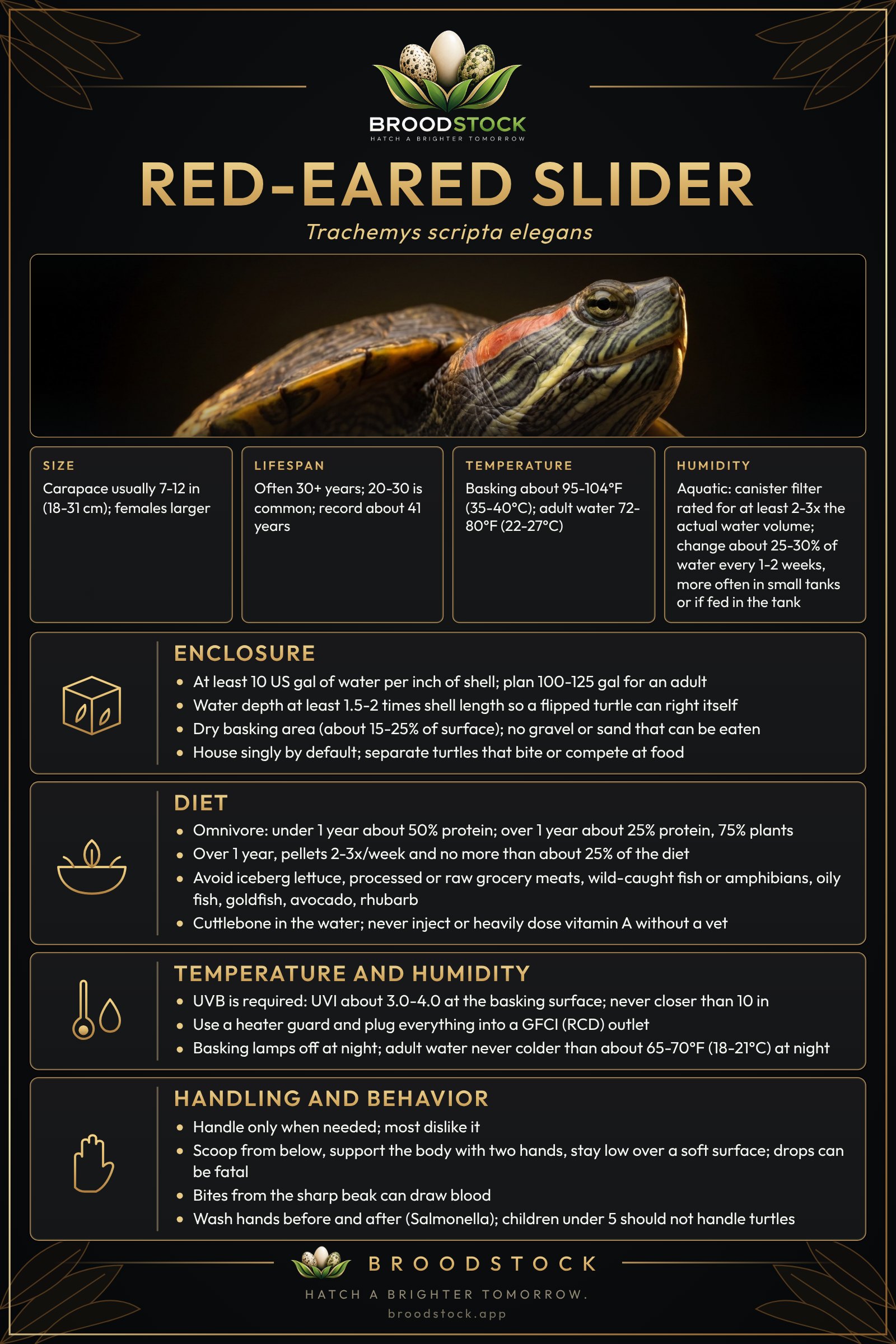
Print it or save it
The care sheet is a one-page summary you can print or keep on your phone. The full care text is below.
Keeping Red-Eared Slider? Broodstock tracks feeding, weights, sheds, enclosures and equipment for every animal you keep, and it is free to start.
Scientific name
Trachemys scripta elegans
Adult size
The carapace is usually 7-12 in (18-31 cm), with females larger. Males average about 7-9 in (18-23 cm) and females about 10-12 in (25-31 cm). A big female may weigh around 7 lb (3.2 kg). Hatchlings measure about 1-1.4 in (23-35 mm).
Lifespan
With good care, 30+ years is often reached in captivity, and 20-30 years is common. The captive record is about 41 years.
Enclosure
Size an aquatic tank by water volume: at least 10 US gal of water per inch of shell (a 4 in turtle needs 40 gal). Plan on 100-125 gal (or a stock tank/pond) for an adult, since most reach 8-11 in. Water depth should be at least 1.5-2 times the shell length so the turtle can right itself if flipped, and deeper is better. Provide a dry, fully emergent basking area (about 15-25% of surface) that the turtle can climb onto and dry off on completely. Use a bare bottom or stones too large to swallow, never gravel or sand that can be eaten. Fit a secure lid/screen with an air gap.
House turtles singly by default. If grouping, use only similar sizes and add at least 50% volume per extra turtle; separate them if there is biting or competition at food.
US law (21 CFR 1240.62) bans selling, holding for sale or offering for any other commercial or public distribution (including giveaways) live turtles with a carapace under 4 in (10 cm), and viable turtle eggs. Exceptions are bona fide scientific, educational or exhibition use (not as pets), transfers not connected with a business, and export-only shipments labeled 'For Export Only'. Turtles have to outgrow 4 in before they can be sold as pets. Also look up your state and local laws.
Temperature
The basking surface should be about 95-104°F (35-40°C), with basking-zone air about 85-90°F (29-32°C). Water temperature depends on age: hatchlings (under 1 yr) 78-82°F (26-28°C); juveniles about 75-80°F (24-27°C); adults 72-80°F (22-27°C) heated, and never colder than about 65-70°F (18-21°C) at night. Room air should be 75-85°F (24-29°C). Basking lamps go off at night, and the temperature may fall 5-10°F (3-6°C) without harm. Read a probe thermometer every day.
Humidity
Here the issue is water quality, since this is an aquatic species. Pick a canister (or sump) filter with a rating of at least 2-3x the real water volume, and avoid undergravel and small internal filters for adults. Replace roughly 25-30% of the water every 1-2 weeks (more often in small tanks or when feeding in the tank), and rinse the filter media each month in tank water rather than tap water.
Sliders cope with tap water reasonably well. If yours has chlorine or chloramine, a water conditioner (for example API Tap Water Conditioner or Seachem Prime) is inexpensive insurance, dosed for the new water only. Aim for clear, odorless water, and feed in a separate tub to cut waste. A filter cannot stand in for changing the water.
UVB
UVB is required (Ferguson Zone 3). Target a UVI of about 3.0-4.0 at the basking surface, measured with a Solarmeter 6.5. Use a linear T5 HO in a reflector, spanning about 50-75% of tank length over the basking area. A 5-6% tube (e.g. Arcadia Forest 6%, ReptiSun 5.0) sits about 11-13 in (28-33 cm) above the turtle's back, while a 10-12% tube (Arcadia Desert 12%, ReptiSun 10.0) sits about 17-21 in (43-53 cm) up. Leave no mesh between, and never closer than 10 in. No glass or plastic may sit between lamp and turtle.
Replace as the manufacturer directs: T5 HO tubes about yearly, older or weaker UVB bulbs about every 6 months.
Lighting
Provide 11-13 hours of light a day on a timer, about 13 h in summer and 11 h in winter. Lights should be completely off at night, and use no colored night lights. Alongside the UVB, a 6500K daylight LED or fluorescent is recommended.
Heating
Over the basking platform, hang halogen flood bulbs in deep ceramic-socket domes (often 75-90W or more depending on height; two lamps give a wider spot), and use a dimmer or thermostat to set the surface temperature. In the water, run a submersible aquarium heater rated for the volume, fitted with a guard (turtles break bare glass heaters) and auto shutoff; big tanks may suit two smaller heaters. Everything should be on a GFCI (RCD) outlet with drip loops, and a surge protector is better than a basic power strip.
Diet
Sliders are omnivores that shift toward plants with age. Under 1 year, feed about 50% animal protein and 50% plants: protein and greens daily, with quality aquatic turtle pellets every other day. Over 1 year, feed about 25% protein and 75% plants: leafy greens or aquatic plants daily, pellets 2-3x/week (no more than about 25% of the diet), and animal protein 1-2x/week (whole feeder fish such as guppies or platies, earthworms, snails, insects).
Portions: protein as much as is eaten in 5-10 min, greens about shell-sized, pellets about head-sized. Good greens are romaine, red/green leaf lettuce, collards, dandelion, turnip greens, endive and escarole. Avoid iceberg lettuce, processed or raw grocery meats, wild-caught fish or amphibians, regular goldfish or rosy red minnows (thiaminase; occasional only), oily fish, avocado and rhubarb. Feeding in a separate tub keeps the water cleaner.
Supplements
Leave a cuttlebone (backing removed) in the water permanently and swap it every 1-2 months. Most powder dusted directly onto food washes off in the water, so the complete aquatic turtle pellet should supply the vitamins and minerals. Under proper UVB, any extra calcium should be plain calcium without D3 (e.g. Repashy SuperCal NoD, Zoo Med Repti Calcium without D3), dusted lightly on feeder insects or mixed into a gel food 2-3x/week. Repashy gel foods such as Savory Stew (made for meat-eating omnivores including turtles) or Grub Pie can carry supplements, but treat them as variety and not the whole diet.
Vitamin A should come via pellets and dark leafy greens (red bell pepper is a good source). Do not inject it or give heavy doses without a vet, since overdose is possible. A weekly reptile multivitamin is optional and only worth it when pellets make up a small part of the diet.
Shedding
Skin and thin layers of scutes come off in small patches, typically one scute or patch at a time, though young turtles may shed more at once. Never peel it off; stuck pieces can be helped with a soft toothbrush and warm water. Shed that is retained or piles up may stem from water that is too warm, a poor diet, poor UVB or D3, too little basking, or poor filtration. Persistent stuck shed, or soft, pitted or smelly spots (possible shell rot), need a reptile vet.
Handling
Handle only when needed, since most sliders dislike it. Scoop from below and hold the shell with two hands, supporting the body. Stay low over a soft surface, because drops can be fatal. A bite from the sharp beak may break the skin and draw blood. Wash hands before and after (Salmonella), and children under 5 should not handle turtles.
Health signs to watch
Take the turtle to a vet if you see swollen or shut eyes, ear swellings (aural abscess), bubbles or discharge from the nose or mouth, open-mouth breathing, lopsided or tilted swimming, loss of appetite or no basking, a soft or deformed shell, pitted, soft or foul-smelling shell patches (shell rot), cottage-cheese lumps, straining or restless digging with no eggs laid (egg binding), weight loss or diarrhea.
The usual causes are vitamin A deficiency (poor diet), respiratory infection (cold or dirty water), MBD (no UVB or low calcium), shell rot, parasites, and thiamine deficiency (a fish-heavy diet with thiaminase fish). Take weight and size measurements once a month. Salmonella is a risk, so wash hands, and keep children under 5 away from turtles.
Welfare
Sliders that escape or are released become invasive in many countries. The EU listed them among invasive alien species of Union concern in 2016. Where that rule applies (including Northern Ireland), breeding, selling, keeping and releasing them are offences, though existing pets may live out their lives. US rules bar sales of turtles under 4 in (10 cm).
The market is already saturated and many sliders are abandoned once they grow, so line up a firm home for every hatchling and never release one.
Keep every animal's care in one place
Log feedings, weights and sheds, set reminders, and let Ranger, the built-in AI manager, help with the rest. Free to start, no card needed.