
Broodstock / Care sheets / Red-Footed Tortoise
Red-Footed Tortoise Care Sheet
Chelonoidis carbonarius
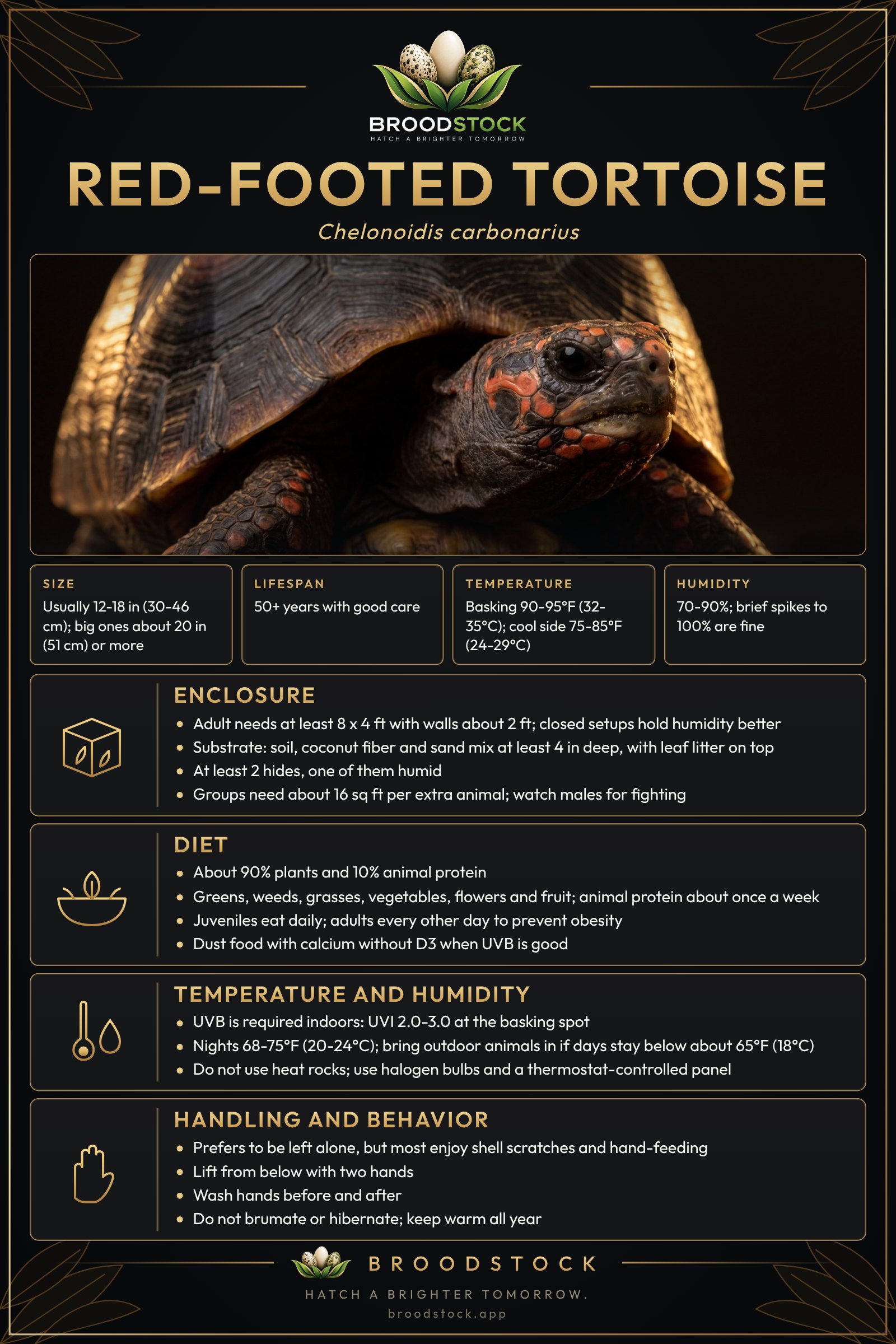
Print it or save it
The care sheet is a one-page summary you can print or keep on your phone. The full care text is below.
Keeping Red-Footed Tortoise? Broodstock tracks feeding, weights, sheds, enclosures and equipment for every animal you keep, and it is free to start.
Scientific name
Chelonoidis carbonarius
Adult size
Most adults measure 12-18 in (30-46 cm). Big ones can hit roughly 20 in (51 cm) or longer, and males run a little larger than females.
Lifespan
With good care, expect 50+ years.
Enclosure
A single adult needs an enclosure of at least 8 x 4 ft, with walls around 2 ft tall. The rule of thumb is 8 times shell length by 4 times shell length, so a 12-18 in adult works out to 8-12 x 4-6 ft. Closed or tall-sided setups keep humidity up better than open tortoise tables.
Outdoors in warm weather, walls should be at least 2 ft high and buried 12 in. Fill the floor with a moisture-holding mix of soil, coconut fiber and sand at least 4 in deep, topped with leaf litter. Provide at least 2 hides, one of them humid.
Groups can work if each extra animal gets about 16 sq ft, the animals are similar in size, and visual barriers break up sight lines. Keep an eye on males for fighting.
Temperature
The basking spot should read 90-95°F (32-35°C). The ambient or cool side should sit at 75-85°F (24-29°C), and nights at 68-75°F (20-24°C), with juveniles toward the warmer end of that range.
Outdoors, offer a shelter heated to 70-75°F (21-24°C) whenever nights drop under 50°F (10°C). Bring the tortoise inside if days stay below about 65°F (18°C).
Humidity
Keep humidity high at 70-90%; short jumps to 100% are fine. Mist the substrate 2-3x daily, or run a fogger overnight filled with distilled water, and always keep a humid hide available. Hatchlings do best around 75-80%. Dry air leads to dehydration and pyramiding.
UVB
Indoors, UVB is required. This is a Ferguson zone 2 species (partial-sun forest). Aim for UVI 2.0-3.0 at the basking spot.
One option is a T5 HO 5-6% tube (Zoo Med ReptiSun 5.0 or Arcadia 6%) mounted about 11-14 in above the shell if the light shines through mesh, or 14-17 in with no mesh. Another is a T5 HO 10-12% tube at about 17-22 in (mesh) or 21-25 in (no mesh). Cover about half the enclosure length on the warm side, and leave plenty of shade.
Lighting
Run lights about 13 hours in summer and 11 hours in winter, using a 6500K LED or plant-grow LED for daylight. Outside, natural light is enough.
Heating
For basking, use overhead halogen flood bulbs: 2-4 x 50W, kept at least 12 in from the shell. Ambient and night heat can come from a radiant heat panel on a proportional thermostat, with the probe at the cool end near 75°F / 24°C. Ceramic heat emitters are another option. Do not use heat rocks.
Diet
These omnivores eat mostly plants, roughly 90% plant and 10% animal.
Plant foods include leafy greens and weeds (dandelion, collard and turnip greens, hibiscus, grape leaves), grasses and hay, vegetables (squash, sweet potato, bell pepper), flowers and mushrooms. Fruit (papaya, mango, figs, berries, melon, banana) can make up a bigger share than it does for other tortoises. Animal protein (earthworms, roaches, snails, occasional pre-killed rodent) goes in about once a week for adults.
Juveniles can eat their fill every day. Near full size, adults should eat every other day to avoid obesity. Serve food on a plate.
Supplements
Calcium dusting on food is needed. When UVB is good, choose plain calcium without D3 (Repashy SuperCal NoD or Zoo Med Repti Calcium without D3, for example). Dosing frequency is not well documented for this species. In common practice, juveniles' food gets dusted most days, and adults' food 1-2x/week.
A multivitamin containing vitamin A is commonly given about 1-2x/month (Rep-Cal Herptivite, beta carotene, no D3, for example). If UVB is missing or unreliable, an all-in-one with D3 and vitamins, such as Repashy Calcium Plus, fits instead; in that case skip the separate multivitamin and any other D3 products. Leave a cuttlebone in as an extra, but not as the main calcium source.
Shedding
Thin, small flakes of skin come off as the tortoise grows, which is normal. The shell does not shed. As it grows, new keratin forms beneath each scute.
Take the tortoise to a reptile vet if scutes lift, peel or drop off, if areas turn soft or pitted, if reddish fluid shows under a scute, or if there is a bad smell. None of these are normal. They may point to a shell infection, often tied to dirty or wet conditions or to poor diet, UVB or calcium.
Handling
Being left alone is what they like best, though most enjoy shell scratches and being hand-fed. Pick one up from underneath using both hands. Wash your hands both before and after.
Brumation
Do not brumate or hibernate this species. It is tropical and should stay warm all year.
Health signs to watch
See a reptile vet for any of these: swollen or closed eyes (often dehydration or vitamin A problems; with hatchlings, raise humidity right away); respiratory signs such as nasal discharge or wheezing; shell rot or soft spots from dirty, wet substrate; soft shell (metabolic bone disease); pyramiding; not eating; parasites (yearly fecal exam); obesity; and straining or retained eggs.
Welfare
Red-foots are listed on CITES Appendix II. Wild populations are hunted heavily for food and also taken for the pet trade. Because they grow slowly and mature late, populations recover poorly, so buy captive-bred animals. Most animals offered now are captive-bred, a change from the 1970s-1990s.
Locality lines (Colombian, Guyana, Brazilian and others) are often mixed, so origins are hard to trace. Keep records and share what you know about a line. Since they can live 50 years or more, buyers need long-term plans.
Keep every animal's care in one place
Log feedings, weights and sheds, set reminders, and let Ranger, the built-in AI manager, help with the rest. Free to start, no card needed.