
Broodstock / Care sheets / Red Runner Roach
Red Runner Roach Care Sheet
Shelfordella lateralis, also placed in Blatta as Blatta lateralis (the name most regulators and research papers use)
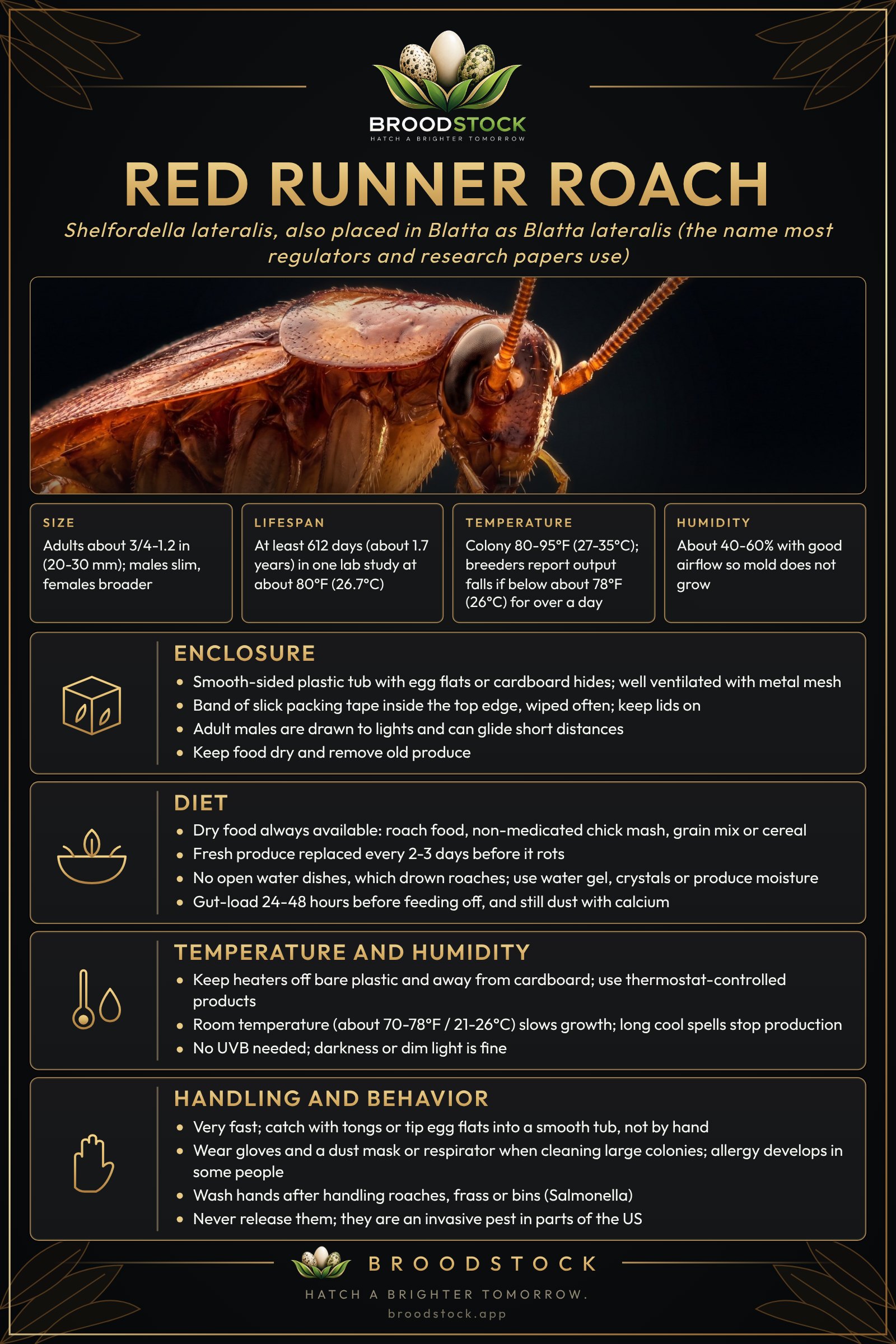
Print it or save it
The care sheet is a one-page summary you can print or keep on your phone. The full care text is below.
Keeping Red Runner Roach? Broodstock tracks feeding, weights, sheds, enclosures and equipment for every animal you keep, and it is free to start.
Scientific name
Shelfordella lateralis, which regulators and research papers usually list as Blatta lateralis. Other names are Turkestan (Turkistan) cockroach and rusty red roach. It is native from northeastern Africa across the Middle East to Central Asia, and it lays eggs (oviparous), like the oriental cockroach it shares a family with.
Adult size
Adults are about 3/4-1.2 in (20-30 mm), and males reach up to about 1.2 in (30 mm). Males are slim and rusty orange-red with long yellowish wings. Females are broader, dark brown to black with cream edging, and have only short wing stubs.
Lifespan
In a laboratory study at about 80°F (26.7°C), adults lived at least 612 days (about 1.7 years). Hobby reports give shorter figures under hot breeding conditions. Lifespan is not well documented under typical colony conditions.
Enclosure
Use a plastic tub with smooth sides: small deli tubs suit a few roaches, and up to about 30 gal / 115 L suits a breeding colony. Egg flats or cardboard provide hides. Fit metal mesh panels in the lid for good ventilation. Clean smooth plastic and glass defeat their climbing, but they are very fast and can scale textured surfaces, dried food film or frass on the walls. Many breeders tape a band of slick packing tape around the top inside edge and wipe it often. Petroleum jelly barriers reportedly work less well.
Practices vary on substrate: some breeders have none, while others spread a thin (about 3/4 in / 2 cm) layer of slightly damp sand and peat on one side for egg cases. Store food dry and clear out old produce promptly.
Temperature
For a breeding colony keep it warm, about 80-95°F (27-35°C). Breeders report that output falls off sharply if it stays below about 78°F (26°C) for more than a day. Holding them at room temperature (about 70-78°F / 21-26°C) slows growth. Over short periods they put up with a wide range, with one seller giving about 61-95°F / 16-35°C.
Humidity
Keep the colony at about 40-60% with good airflow so mold does not grow. Egg cases must stay slightly moist but not wet. Keepers with a substrate side mist it daily, while others rely on produce and water gel.
UVB
UVB is not needed. The roaches live dark or dim, and nothing reviewed suggests any benefit.
Lighting
Dark or dim conditions suit them, and no photoperiod is required. Lids should stay on, since adult males head for lights and can glide short distances.
Heating
A warm room works, or run heat cable or a heat mat on a thermostat beneath part of the tub (some breeders put it on a timer to create a night drop). To limit fire risk, use thermostat-controlled products and keep heaters off bare plastic and away from cardboard. The dry food belongs on the warmed side, where it stays dry.
Diet
Provide dry food continually (commercial roach food, non-medicated chick mash or grain mix, cereal), plus fresh produce such as carrots, sweet potato, squash, apple or orange, changed every 2-3 days before it rots. A little dry dog or fish food each week adds protein for some breeders, and one advises against cat food; practices vary.
Open water dishes drown roaches, so avoid them and give water gel or crystals, or rely on moisture from produce.
Supplements
Before feeding off, gut-load for about 24-48 hours with a calcium-rich diet and fresh produce. Feeder cockroaches, this species included, show a low calcium-to-phosphorus ratio, and feeder-roach research reports low vitamins A and E, so dusting with calcium is still advised by the reptile's care sheet. Calcium from gut-loading drops back within about a day of fasting (shown in crickets), so feed out promptly.
Shedding
Research colonies show five nymphal molts before adulthood. Freshly molted roaches are soft and pale, and others often eat them, especially females eating molting males. Enough food, protein and hides reduce this.
Handling
They move very fast, so use tongs, or tip egg flats into a smooth tub, instead of grabbing by hand. Some people who keep colonies develop a cockroach allergy, with frass dust the main exposure. Gloves plus a dust mask or respirator are advised when cleaning large colonies, and the area should be ventilated.
Since insects and their waste can carry bacteria such as Salmonella, wash your hands after touching roaches, frass or bins.
Brumation
They have no diapause in captivity. Room temperature slows growth, but colonies kept cool for long periods stop producing.
Health signs to watch
Problems include mold from damp food or substrate; ammonia and odour from wet bins (worse with cat food or gassy produce); mites and fungus gnats in damp bins; and cannibalism of molting or weak roaches when protein is short. The main practical risk is nymphs escaping into the house. Some keepers use isopods to clean up dead roaches and mites, which is optional.
Welfare
In parts of the US this species is an invasive pest outdoors. It arrived in California around 1978, probably on military equipment, and is now widespread across the urban Southwest and reported in the southern US, where it is displacing the oriental cockroach. Escaped roaches and released feeders can start new outdoor populations, so never release them. Frass and bin waste can contain nymphs or egg cases, so seal it in a closed bag before it goes in the bin.
In Florida, red runners do not appear on the FDACS lists of deregulated or commonly permitted feeder arthropods, and the state regulates non-native cockroaches under Chapter 581.083, F.S., and Rule Chapter 5B-57, F.A.C. Unless the FDACS Division of Plant Industry says otherwise in writing, treat them as not allowed for private keepers or breeders there. Hawaii bans imports of animals, insects included, that are missing from its approved lists.
Oregon approves Blatta lateralis (listed as 'red runner') without a state permit for education and pet use (OAR 603-052-1320, 2026). Pet food use is not named, so confirm feeder use with the Oregon Department of Agriculture. California's plant quarantine list names it among insects that can be shipped without a state permit (that list was being amended in 2026).
As an established outdoor pest, it may be restricted by other states too. Check with your state agriculture department before you buy, breed or ship.
Keep every animal's care in one place
Log feedings, weights and sheds, set reminders, and let Ranger, the built-in AI manager, help with the rest. Free to start, no card needed.