
Print it or save it
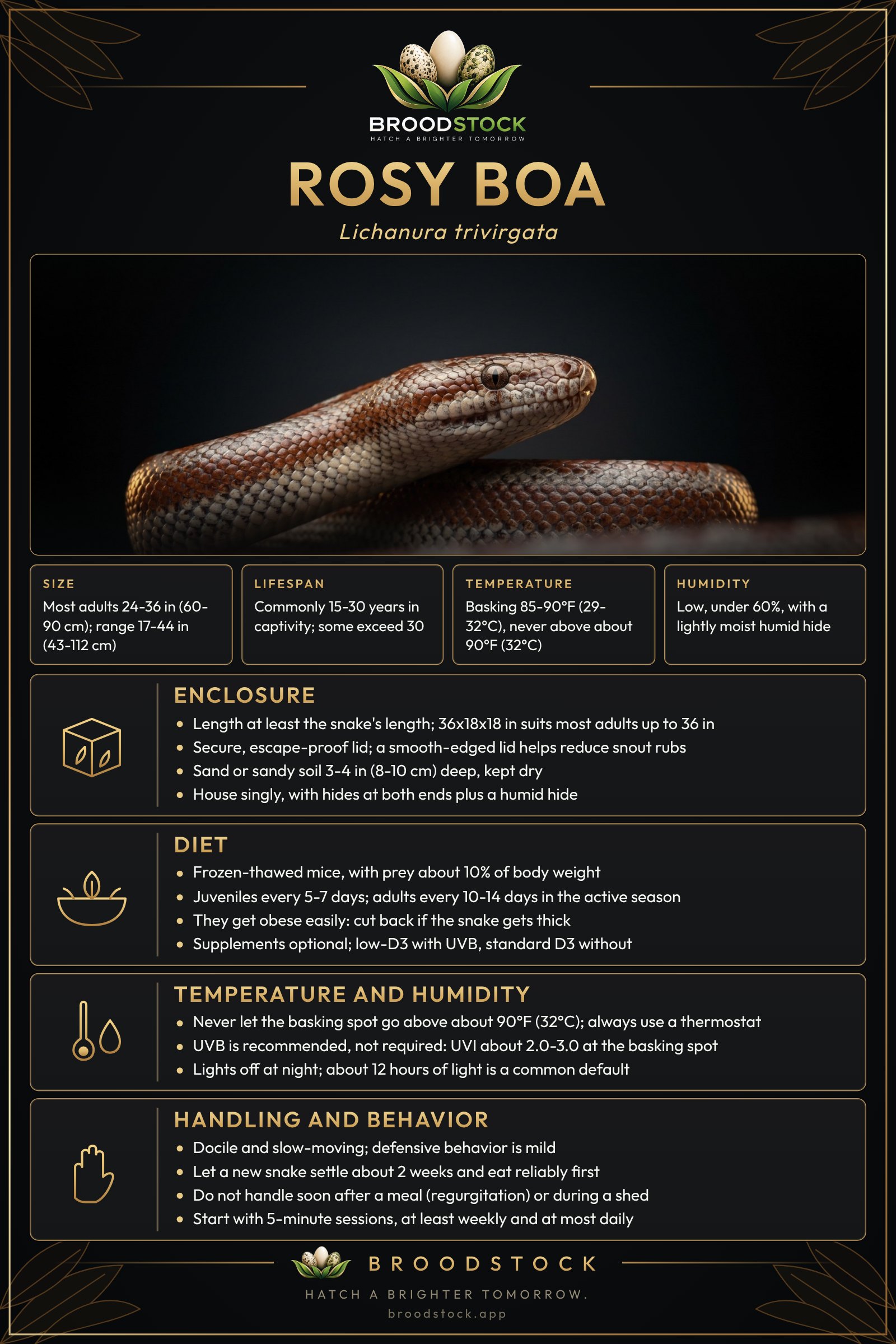
The care sheet is a one-page summary you can print or keep on your phone. The full care text is below.
Keeping Rosy Boa? Broodstock tracks feeding, weights, sheds, enclosures and equipment for every animal you keep, and it is free to start.
Scientific name
Lichanura trivirgata
Adult size
Most adults are 24-36 in (60-90 cm). Across localities and genetics the full range is 17-44 in (43-112 cm), and females outgrow males.
Lifespan
In captivity, 15-30 years is common (ADW average about 18), and some pass 30.
Enclosure
Match the enclosure to the snake: length at least equal to the snake's, and width and height at least half of it. That means 24x12x12 in for a 24 in adult, 36x18x18 in for most adults up to 36 in, and 48x24x24 in for the largest. Floor space counts for more than height. Climbing branches are unnecessary, but rocks or low logs give cover. The lid must be secure and escape-proof.
Use 3-4 in (8-10 cm) of sand or sandy soil and keep it dry. Spot clean daily and replace it every 3-6 months. Provide hides at the warm and cool ends plus a humid hide. House each snake alone.
Temperature
The basking surface should be 85-90°F (29-32°C) and never above about 90°F (32°C). Keep the cool side at 72-80°F (22-27°C). At night, 65-70°F (18-21°C) is right, and it can fall to about 60°F (16°C) with the heat off.
Humidity
Keep it low, under 60% ambient, so the enclosure stays dry. Put a lightly moist humid hide on the cool side and mist only now and then. Rosy boas handle damp badly, and excess moisture is tied to respiratory problems.
UVB
UVB is recommended but not required, since these snakes are mostly nocturnal (older sources say no special lighting). Use low-intensity UVB over 1/3 to 1/2 of the enclosure length on the warm side, aiming for a UVI of about 2.0-3.0 at the basking spot. Options are an Arcadia ShadeDweller 7% at 7-9 in (18-23 cm) through mesh (10-12 in, 25-30 cm, without), or a T5 HO 6% or ReptiSun 5.0 at 10-12 in (25-30 cm) through mesh (13-15 in, 33-38 cm, without).
Lighting
Keep lights on by day and off at night. An exact day length is not well documented for rosy boas, and about 12 hours is a common default. Reduce lights and heat for the winter cool-down.
Heating
For basking, use one or more overhead incandescent or halogen bulbs, typically 50-75 W (two for an average adult), adjusted to reach 85-90°F (29-32°C) and run on a dimming thermostat or timer. Heat tape or an under-tank pad on a thermostat also works and is common in racks. Always use a thermostat, because overheated heat tape is a fire risk.
Diet
Feed frozen-thawed mice; variety is fine. Size prey at about 10% of body weight and no wider than about 1.5 times the snake's widest point. Juveniles eat every 5-7 days. Adults eat every 10-14 days during the active season and not at all in the winter cool-down. Rosy boas get obese easily, so cut back if one gets thick. Fussy neonates may accept lizard-scented pinkies.
Supplements
Supplements are optional with whole prey. If you use one, lightly dust prey now and then with a 50/50 calcium plus multivitamin, but not at every meal. With UVB choose a low-D3 type (Repashy Calcium Plus LoD or Arcadia RevitaliseD3); without UVB, pick one with standard D3 (Repashy Calcium Plus).
Shedding
Dull color, cloudy eyes and hiding signal a shed. Keep the humid hide lightly moist during it and do not handle the snake. Afterward, check the eye caps and tail tip. Repeated stuck sheds suggest dehydration or a setup that is too dry. Retained eye caps or inflamed skin call for a vet.
Handling
Rosy boas are generally docile and slow-moving. Give a new snake about 2 weeks to settle and eat reliably before handling. Begin with 5-minute sessions, at least weekly and at most daily. Do not handle soon after a meal (regurgitation risk) or during a shed. Defensive behavior is mild: balling up with the head hidden, musking, and rarely biting.
Brumation
A winter cool-down is recommended each year, for healthy, well-fed snakes only. Fast about 14 days with the heat on, then cool to about 50-60°F (10-16°C) for roughly 6-12 weeks (December to February). Keep water available and check it weekly. In spring, bring the temperature up slowly before offering food.
Health signs to watch
Quarantine new snakes for up to 6 weeks, with a vet check and parasite testing. See a vet for wheezing, open-mouth breathing or mucus (respiratory infection; rosy boas are prone to it if kept damp, including when a water dish spills during cooling), red or cheesy gums, mites, belly blisters, regurgitation and weight loss.
Snout rubs (rostral abrasion) come from rubbing on rough lids or cage surfaces while trying to escape; a lid with smooth edges and a good hide help reduce it. Food still in the gut during cool periods can spoil, so always fast before cooling. Obesity is something to monitor.
Welfare
Do not mix subspecies or localities. Humidity must stay low, because damp housing leads to skin and breathing problems. Rosy boas are native to California and Arizona. In California, breeding or selling native reptiles requires a Native Reptile Captive Propagation Permit, only coastal and desert rosy boas are listed for commercial sale, and captive reptiles may not be released without state approval. Look up the rules in your own state.
Keep every animal's care in one place
Log feedings, weights and sheds, set reminders, and let Ranger, the built-in AI manager, help with the rest. Free to start, no card needed.