
Broodstock / Care sheets / Russian Tortoise
Russian Tortoise Care Sheet
Testudo (Agrionemys) horsfieldii
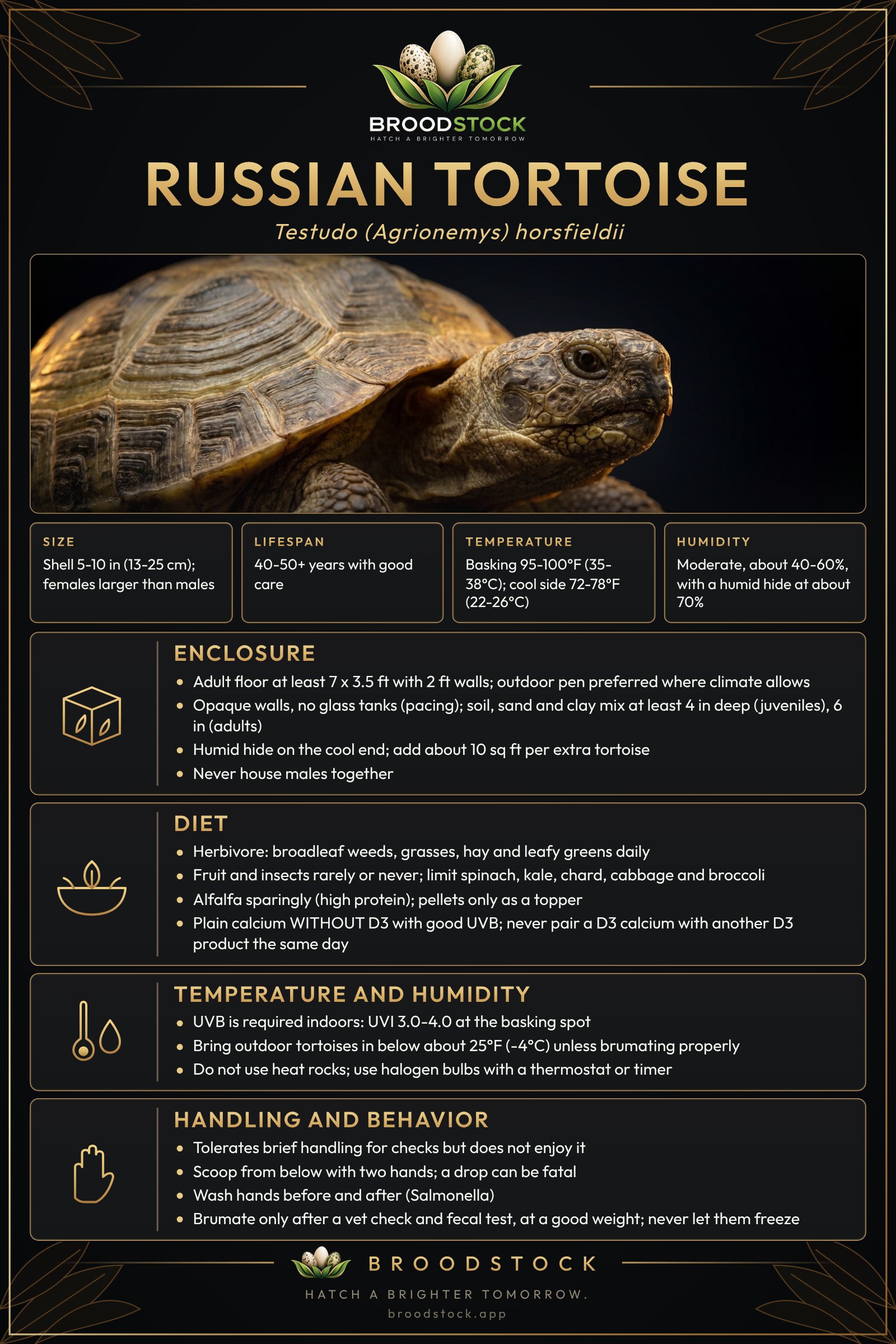
Print it or save it
The care sheet is a one-page summary you can print or keep on your phone. The full care text is below.
Keeping Russian Tortoise? Broodstock tracks feeding, weights, sheds, enclosures and equipment for every animal you keep, and it is free to start.
Scientific name
Testudo (Agrionemys) horsfieldii
Adult size
Shell length runs 5-10 in (13-25 cm). Females are bigger, at about 8-10 in, while males are about 6-8 in.
Lifespan
Expect 40-50+ years with good care.
Enclosure
An adult needs a floor of at least 7 x 3.5 ft (about 24.5 sq ft) with 2 ft walls. An outdoor pen is preferred where the climate allows; sink the walls at least 12 in, because these tortoises dig and climb. Juveniles under about 6 in can start in a 4 x 2 ft space. Use opaque walls, and do not use glass tanks because of pacing.
The substrate should be a diggable mix of soil, sand and clay, at least 4 in deep for juveniles and 6 in for adults. Put a humid hide at the cool end.
For each extra tortoise, add about 10 sq ft. Never house males together. Housing a male with a female can also lead to harassment.
Temperature
The basking surface should reach 95-100°F (35-38°C), the warm side 80-85°F (27-29°C) and the cool side 72-78°F (22-26°C). At night, 65-75°F (18-24°C) is right.
Outdoors, supply a heated shelter (about 60°F / 16°C) when nights fall below 50°F (10°C). Bring tortoises inside when it drops below about 25°F (-4°C), unless they are brumating properly.
Humidity
Ambient humidity should be moderate at about 40-60%, with a humid microclimate of about 70% (a moist substrate pocket or humid hide). Juveniles do best at about 40-75%, lower by day and higher at night. Avoid combining cold with wet conditions. Indoor tortoises get a weekly lukewarm soak; juveniles soak 10-15 min 2x/week.
UVB
UVB is required indoors for this Ferguson zone 3 species. Aim for UVI 3.0-4.0 at the basking spot, measured with a Solarmeter 6.5. Use a T5 HO 10-12% tube (Arcadia T5 HO 12% or Zoo Med ReptiSun 10.0) in a reflective fixture covering about 1/3 of the enclosure length over the warm side. Mount it about 14-16 in above the shell through mesh, or 17-20 in with no mesh. Replace the tube on the maker's schedule. Unfiltered outdoor sun takes the place of the lamp.
Lighting
Light for about 14 hours in summer, tapering to about 10 hours in winter. Indoors, a 6500K LED daylight bar is recommended. Outdoors, no artificial light is needed.
Heating
For basking heat overhead, use halogen flood bulbs in ceramic fixtures, one for juveniles and two or more for adults, run by a thermostat or timer. If night heat is needed, use a ceramic heat emitter or radiant heat panel on a thermostat. Do not use heat rocks.
Diet
Russian tortoises are herbivores that need high fiber and low protein. Offer daily staples of broadleaf weeds (dandelion, plantain, clover, mallow), grasses, hay and leafy greens (endive, escarole, watercress, romaine). Juveniles can eat as much as they like, while adults get roughly a shell-sized portion each day.
Treats can include flowers. Fruit and insects should be rare or skipped. Spinach, kale, chard, cabbage, broccoli and beet greens should be limited. Alfalfa is high in protein, so feed it sparingly. Use commercial grass-based pellets only as a topper. Serve food on a plate or tray.
Supplements
When UVB or sun is good, dust food with plain calcium WITHOUT D3 (Repashy SuperCal NoD, Zoo Med Repti Calcium without D3, Rep-Cal phosphorus-free calcium without D3), about 1-2x/week for adults. Growing juveniles are commonly dusted more often, 2-3x/week. A cuttlebone should stay in the enclosure.
A multivitamin with vitamin A is given about 1-2x/month: Rep-Cal Herptivite (beta carotene, no D3), Arcadia EarthPro-A (provitamin A, no D3) or Nekton-Rep (preformed vitamin A plus a little D3). Use calcium WITH D3 only if UVB is unreliable, and then sparingly.
Do not stack several supplements on one meal. Never pair a D3 calcium with another D3 product on the same day.
Shedding
As a tortoise grows, its skin comes away in small, thin flakes, and that is normal. The shell never sheds; each scute gets new keratin underneath as the shell enlarges.
A reptile vet is needed if scutes lift, peel or fall off, if there are soft or pitted spots, if reddish fluid appears under a scute, or if there is a bad smell. These are not normal. A shell infection is possible, often tied to dirty or wet conditions or to poor diet, UVB or calcium.
Handling
This tortoise puts up with brief handling for checks but does not enjoy it. Scoop it from below and hold the body with both hands, because a drop can be fatal. Wash your hands before and after (Salmonella).
Brumation
Healthy adults can brumate (hibernate), which is natural for the species. Only do it after a vet check and fecal test, and when the animal is at a good weight. Stop feeding but keep it warm for the first week so the gut empties, and keep soaking. Then cool by about 9°F (5°C) per week until it holds steady at 41°F (5°C). The safe range is about 36-48°F (2-9°C), and it must never freeze.
Brumation lasts 6-8 weeks for juveniles and up to about 3 months for adults. Weigh every 1-2 weeks. Loss of about 1% of weight per month is normal, but more than 8-10% means waking the tortoise and getting a vet check. After waking, warm it up and give warm soaks; see a vet if it is not urinating or eating within 7 days. Never brumate a tortoise that is sick, underweight or newly acquired.
Health signs to watch
See a vet for: respiratory signs (wheezing, bubbles or discharge from the nose, puffy or closed eyes, open-mouth breathing); not eating or lethargy outside brumation; soft or deformed shell or beak overgrowth (metabolic bone disease); swollen eyes or ear abscesses (hypovitaminosis A); heavy parasites (yearly fecal); shell injury or rot; straining or retained eggs; and weight loss above 10% in brumation. Pyramiding is mostly tied to diet and humidity.
Welfare
Nearly all Russian tortoises in the trade were wild-caught in Central Asia. The IUCN lists the species as Vulnerable, and it is on CITES Appendix II. Some stock sold as captive-bred or ranched has come from countries with no history of breeding it, so ask sellers for the real origin and favor proven captive-bred animals. Keeping this species well is not easy, and many early imports failed to survive over the long term. Hatchlings should be grown beyond 4 in before being sold in the US.
Keep every animal's care in one place
Log feedings, weights and sheds, set reminders, and let Ranger, the built-in AI manager, help with the rest. Free to start, no card needed.