
Print it or save it
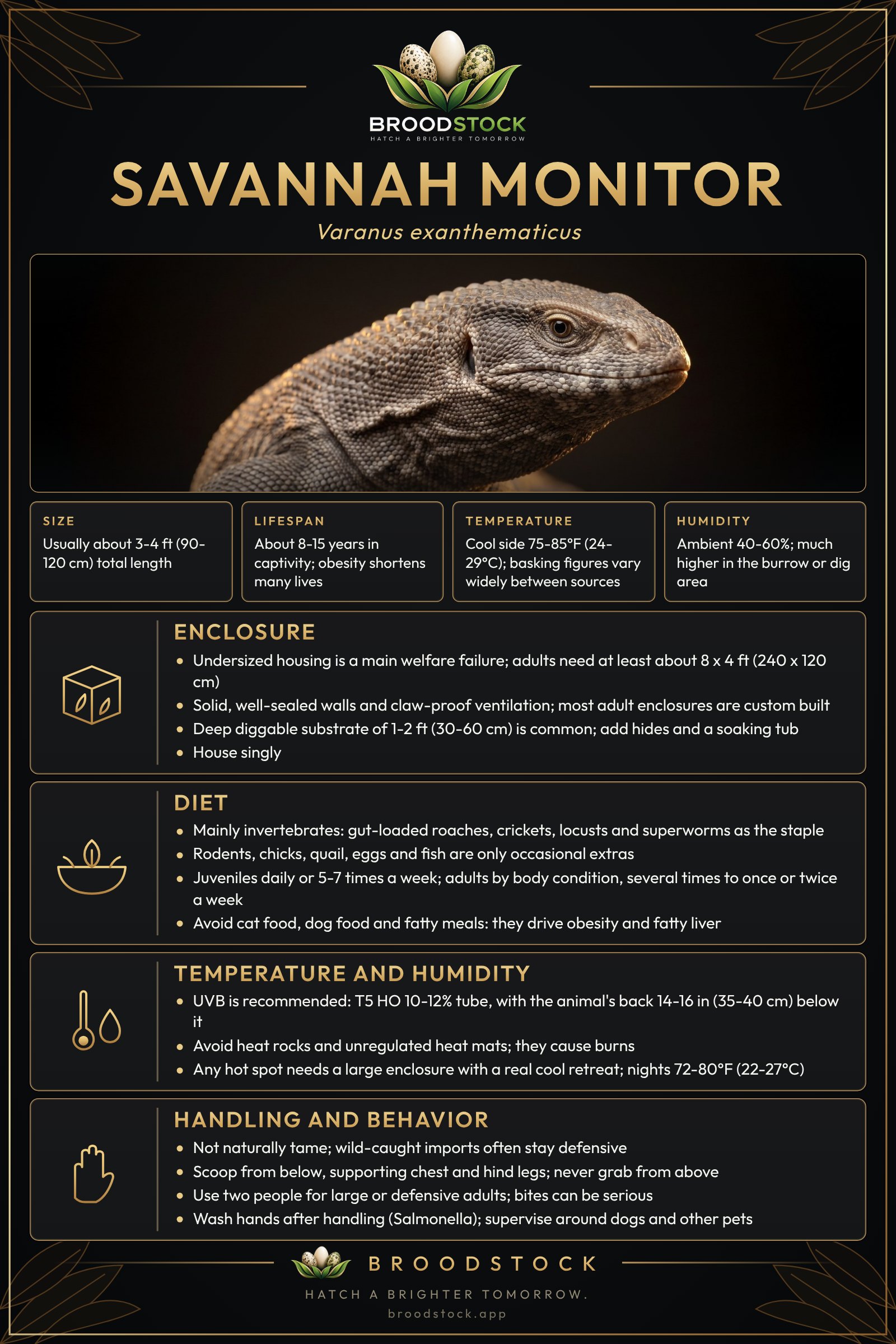
The care sheet is a one-page summary you can print or keep on your phone. The full care text is below.
Keeping Savannah Monitor? Broodstock tracks feeding, weights, sheds, enclosures and equipment for every animal you keep, and it is free to start.
Scientific name
Varanus exanthematicus, a stocky, short-legged monitor that lives on the ground in sub-Saharan Africa (Senegal east to Sudan, south toward the Congo River and Rift Valley). Habitat includes savanna, grassland, open woodland and rocky country, and it shelters in burrows. The IUCN rated it Least Concern (2021). Like other monitor lizards, it is on CITES Appendix II, so international trade needs permits. The white-throated monitor (V. albigularis) takes its place in parts of the south and east and is sometimes sold under similar names, so check what an animal really is.
Adult size
Usually about 3-4 ft (90-120 cm) in total length. A published figure goes up to about 5 ft (150 cm), but wild animals rarely top about 3.3 ft (100 cm). Wild adults studied by Daniel Bennett averaged just 1.6 lb (0.75 kg); captive animals are often much heavier, which usually reflects overfeeding. At about 5 in (13 cm), hatchlings can double their length in about four months and reach adult size in under three years.
Lifespan
Captive lifespan is usually given as about 8-15 years, with 10-12 years a common figure for good care. Animal Diversity Web gives a captive average of about 12.7 years, and a care guide claims up to 15-25 years. Many captive lives are cut short by obesity and the liver disease that goes with it.
Enclosure
Undersized housing is a leading welfare failure with this species. Guidance for an adult minimum ranges from about 6 x 5 x 4 ft (180 x 150 x 120 cm) to 8 x 4 x 4 ft (240 x 120 x 120 cm), and an exotic vet clinic recommends 8-10 ft long by 4-5 ft wide. Larger is better, and a standard 75-gallon tank only works as a short-term juvenile stopgap. Hatchlings can begin in about 36 x 24 x 20 in (90 x 60 x 50 cm), then move to adult housing at about 14-16 in (35-40 cm).
Most adult enclosures have to be custom built with solid, well-sealed walls, since these lizards exploit weak spots, and with claw-proof ventilation.
For substrate, many specialist keepers use a deep, firmly packed, slightly moist soil or soil/sand mix 1-2 ft (30-60 cm) deep, so the animal can dig burrows that hold higher humidity. Others choose solid flooring (carpet, tile, paper) plus a deep dig box of moist topsoil to cut impaction risk. Practices vary between keepers on this.
Add hides at both ends, a large water tub for soaking, and climbing structures. House each animal alone.
Temperature
A steep gradient is the goal, with a cool side at about 75-85°F (24-29°C). Basking surface figures differ widely between sources: an exotic vet clinic gives 95-105°F (35-41°C), reptile.guide gives 100-130°F (38-54°C), and specialist keeper guides use 130-150°F (54-66°C) on the surface with air under the lamp at about 105-110°F (41-43°C). Practices vary on this. Young animals may like a cooler basking spot. A hot spot of any kind belongs in a large enclosure that also has a real cool retreat. Nights run about 72-80°F (22-27°C), and some keepers just switch the heat off at night if the room stays in that range.
Humidity
Ambient humidity should be about 40-60% (a vet clinic gives 45-60%). The burrow or dig area needs to be much more humid than the room. Keep the deep substrate moist, not waterlogged, and check it with a probe hygrometer. Misting or soaking can be added as needed; a vet clinic suggests soaking 2-3 times a week.
UVB
UVB is recommended. Some older sources call it optional, but current care guides advise it. Choices include a T5 HO 10-12% tube (Arcadia Desert 12% or Zoo Med ReptiSun 10.0) running about half the enclosure length in a reflective fixture, with the animal's back about 14-16 in (35-40 cm) below it, or a lower-output 5.0 tube mounted nearer. Nothing, glass or plastic, should sit between lamp and animal. Swap tubes on the maker's schedule (often every 6-12 months).
Lighting
Provide about 12 hours of light a day. A single guide goes with about 11 hours in winter and 13 in summer. Turn all lights off at night. Activity and appetite improve under a bright 6500K LED or T5 daylight fixture.
Heating
Use overhead heat only: a cluster of halogen flood bulbs above a flat basking stone or platform wide enough to warm the whole body, on a dimming thermostat. Some sources suggest ceramic heat emitters for background or night heat. Heat rocks and unregulated heat mats burn animals, so avoid both. Measure surface temperatures with an infrared thermometer and air temperatures with digital probes.
Diet
These lizards are mainly invertebrate eaters. In the wild they take mostly insects, snails, millipedes, scorpions and similar prey, with vertebrates only occasionally. Bennett's field work found orthopterans made up most of young animals' diet.
In captivity, make gut-loaded roaches, crickets, locusts, superworms and other insects the staple, with captive-bred snails if available. Rodents, chicks, quail, eggs and fish are occasional extras and not the staple. Juveniles get insects daily or 5-7 times a week. Adults are fed by body condition, from several times a week down to once or twice a week.
Cat food, dog food and fatty meals push animals toward obesity and fatty liver, so avoid them. Some keepers report adults that fast for several months a year, matching the long wild dry season. Watch weight, and see a vet if a monitor that should be eating stops.
Supplements
Dust insects lightly with calcium. With good UVB, use either a low-D3 all-in-one such as Repashy Calcium Plus LoD, or plain calcium plus a separate multivitamin about once a week. A gravid female needs extra calcium too. Stick to one D3 product, not several.
Shedding
Savannah monitors shed in patches, like other monitors. Shedding trouble is not well documented for this species. Stuck shed on toes and tail tip usually means low humidity or no humid burrow. A moist dig area and a soaking tub solve this.
Handling
They are not naturally tame. Captive-bred animals handled calmly and regularly can grow quite tolerant, while many wild-caught or farmed imports stay defensive (tail whipping, hissing, biting). Build trust with tong feeding and short sessions. Scoop from below, supporting the chest and hind legs, and never grab from above. Large or defensive adults call for two handlers. Keep a close eye on it whenever dogs or other pets are near. Wash your hands after handling (Salmonella).
Brumation
True brumation is not required. Wild animals endure a long dry season of 3-6 months with little food, and some captive adults eat much less for part of the year. No standard cooling method is used. Never cool them to winter temperatures; nights should hold at 72-80°F (22-27°C).
Health signs to watch
Obesity is the biggest captive problem. A fat, round monitor with fat pads at the tail base is ill, not well fed, and obesity leads to fatty liver disease (hepatic lipidosis), which is often fatal.
Other problems are metabolic bone disease from too little calcium or UVB (bowed legs, short jaw, weakness); burns from hot rocks or unregulated heaters; impaction from loose particulate substrate in small or dry setups; mouth rot and respiratory infection; and mites and ticks on imports. Internal parasites are common in wild-caught and farmed imports, so get fecal tests on arrival and yearly. Adult bites can be serious, and pets have been hurt.
Welfare
This is among the most heavily traded pet lizards. It is on CITES Appendix II, so exports and imports need permits. Hundreds of thousands have been exported, mostly from Ghana, Togo and Benin, and in the US they are cheap, which leads to many impulse buys and unwanted adults. Most are wild-caught or 'farmed' (ranched) and arrive stressed and parasitized, so captive-bred animals are the better welfare choice.
The two most common captive failures are obesity (rodent-heavy or fatty diets, little exercise) and undersized housing. An adult needs a room-sized custom enclosure with at least about 8 x 4 ft (240 x 120 cm) of floor and deep diggable substrate, not a large aquarium. Insects should make up most of the diet, and weigh the animal regularly. Bites can be serious, and they are a poor choice around small children because of both Salmonella and bite risk.
Keep every animal's care in one place
Log feedings, weights and sheds, set reminders, and let Ranger, the built-in AI manager, help with the rest. Free to start, no card needed.