
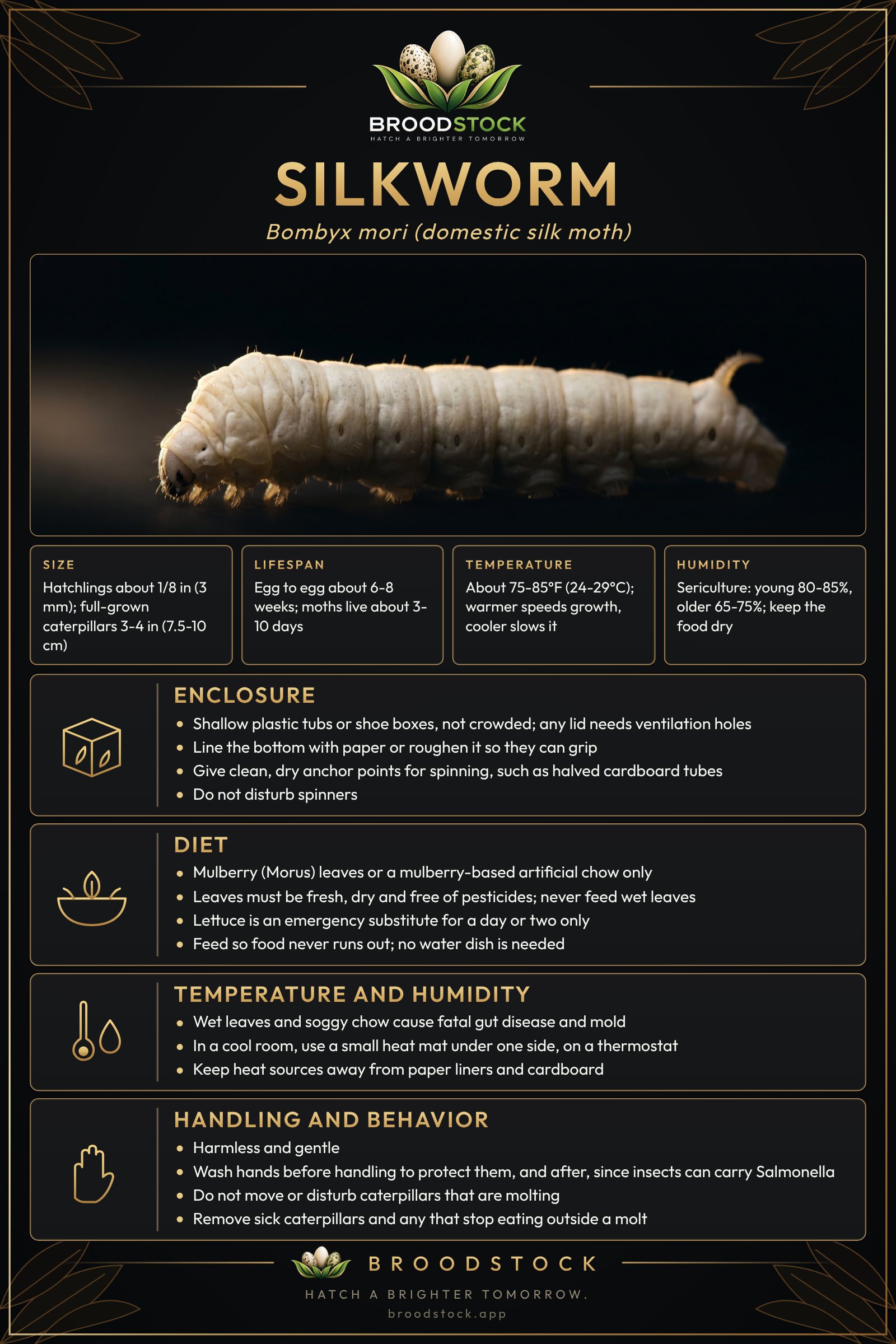
Print it or save it
The care sheet is a one-page summary you can print or keep on your phone. The full care text is below.
Keeping Silkworm? Broodstock tracks feeding, weights, sheds, enclosures and equipment for every animal you keep, and it is free to start.
Scientific name
Bombyx mori, the domestic silk moth. It is fully domesticated with no wild populations, and the moths cannot fly. Strains differ in how many generations they produce each year (one, two or many) and in whether their eggs need a cold rest.
Adult size
Hatchlings measure about 1/8 in (3 mm), and full-grown caterpillars reach about 3-4 in (7.5-10 cm). As moths, females are larger and heavier than males.
Lifespan
A full cycle from egg to egg takes about 6-8 weeks. Eggs hatch about 8-12 days after incubation begins (non-diapause). Caterpillars feed for about 3-4 weeks (20-30 days), spinning takes 2-5 days, the pupa stage runs about 10-14 days to 3 weeks or more, and moths live about 3-10 days.
Enclosure
Use shallow plastic tubs, shoe boxes or similar containers big enough that the caterpillars are not crowded. A lid is optional since silkworms rarely wander; if you use one, add ventilation holes. Paper on the floor of the tub, or a roughened surface, gives them grip.
To clean, lay plastic mesh over the caterpillars with fresh food on top, let them climb onto it, then lift them into a clean tub. For spinning, supply clean, dry anchor points such as halved cardboard tubes or egg-carton cells, and do not disturb spinners.
Temperature
Aim for about 75-85°F (24-29°C). Warmth speeds up eating and growth, and cooler air slows both. Sericulture guidance keeps young caterpillars (first to third instar) warmer, at about 79-82°F (26-28°C), and older ones at about 75-79°F (24-26°C).
Humidity
In sericulture, young caterpillars get about 80-85% relative humidity and older ones about 65-75%. Hobby keepers rarely control humidity, apart from for hatchlings, which are more sensitive. Regardless of room humidity, keep the food dry, since wet leaves and soggy chow cause fatal gut disease and mold.
UVB
UV lighting is not needed. Nothing in care or sericulture practice calls for it.
Heating
In a cool room, set a small reptile heat mat under one side of the tub on a thermostat, so caterpillars can move away from it. Check the temperature with a thermometer, and keep heat sources away from paper liners and cardboard.
Diet
Mulberry (Morus) leaves, or an artificial chow made from mulberry, are the only things silkworms eat. Leaves must be fresh, dry and free of pesticides and road spray. Wet leaves must never be fed.
Chow is mixed with water and cooked or set, kept in the refrigerator for about a month (or frozen), and grated for small caterpillars or cut into strips for large ones. Take out only what you will feed right away so the stored chow does not become contaminated.
Lettuce works only as an emergency substitute for a day or two; a longer stretch on it leaves them in poor shape and then dead. Feed one to several times a day so food never runs out, though leftover food means overfeeding. They get water from their food, so no water dish is needed.
Supplements
Silkworms are mostly water, very low in fat (about 1% as fed in published analyses), and have a low calcium to phosphorus ratio, so dust them with a calcium supplement suited to the animal being fed. Their diet is fixed (mulberry), so gut-loading comes down to good quality food.
Shedding
There are four molts for a caterpillar (five instars). Before each molt they stop eating, raise the front of the body and stay still for about a day, and they should not be moved or disturbed then. Fully grown caterpillars stop eating, shrink slightly, turn yellowish and translucent, and search for a place to spin.
Handling
Silkworms are harmless and gentle. Wash your hands before handling them to protect the silkworms, and afterward too, because insects can carry Salmonella from contaminated food. Allergic reactions to silkworms are not addressed here.
Health signs to watch
Bacterial, viral and fungal disease hit silkworms easily. Wash your hands with soap before touching the caterpillars, their food or their containers. Clear out frass and dried food daily, remove moldy chow immediately, keep food dry, and avoid crowding. Between batches, disinfect tubs and tools; sericulture relies on bleach-based disinfectants for this. Take out any caterpillar that looks sick or stops eating outside a molt, and seek health guidance from an experienced keeper if losses continue. Silkworm trays attract raids by ants and rodents.
Welfare
Silkworms are domesticated and flightless, so the risk of escape and invasion is very low, but do not release them. Leaves taken from sprayed trees must never be fed. To dispose of them, seal them in a container and freeze for at least 24 hours before discarding, as sellers advise for other feeders. Moving Bombyx mori between the contiguous US states does not require a USDA APHIS plant pest permit, but that exception does not extend to Alaska, Hawaii or US territories. Importing them takes a permit and a health certificate.
Keep every animal's care in one place
Log feedings, weights and sheds, set reminders, and let Ranger, the built-in AI manager, help with the rest. Free to start, no card needed.