Broodstock / Care sheets / Society Finch (Bengalese Finch)
Society Finch (Bengalese Finch) Care Sheet
Lonchura striata domestica
Print it or save it
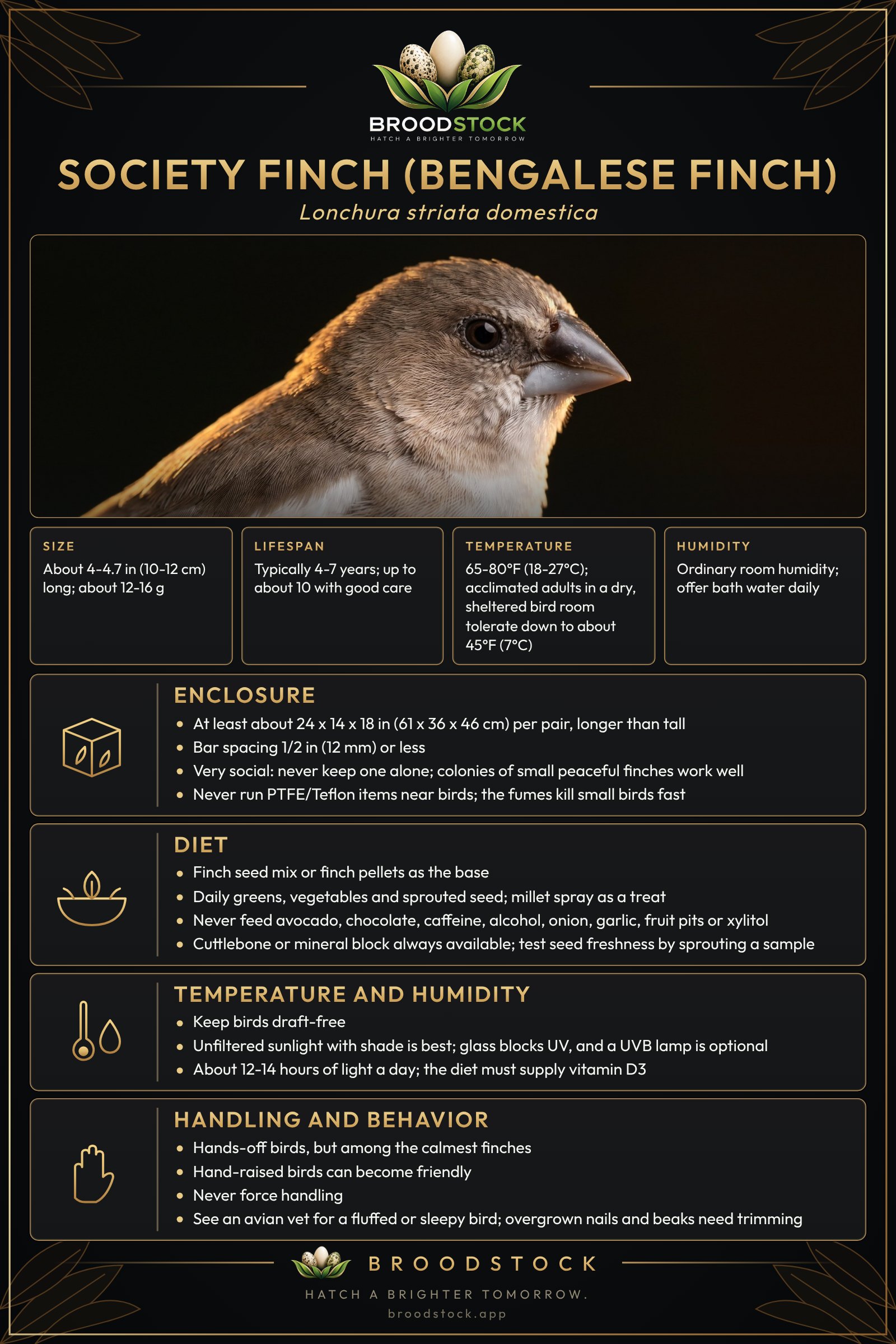
The care sheet is a one-page summary you can print or keep on your phone. The full care text is below.
Keeping Society Finch? Broodstock tracks feeding, weights, sheds, enclosures and equipment for every animal you keep, and it is free to start.
Scientific name
Lonchura striata domestica
Adult size
Length is about 4-4.7 in (10-12 cm), and weight about 12-16 g.
Lifespan
Typically 4-7 years, and up to about 10 with good care.
Enclosure
Provide at least about 24 x 14 x 18 in (61 x 36 x 46 cm) per pair, with more length than height and bar spacing of 1/2 in (12 mm) or less. Society finches are very social, so never keep one alone. They are peaceful and non-territorial, and they do well in colonies and mixed aviaries with other small peaceful finches.
Never run anything with a PTFE/Teflon coating near the birds: irons, heaters, non-stick pans and some heat lamps. The fumes kill small birds fast.
Temperature
Indoors, hold about 65-80°F (18-27°C) with no drafts. Society finches are hardy: acclimated adults in a dry, sheltered bird room tolerate down to about 45°F (7°C).
Humidity
Humidity is not well documented for this species, and breeders keep ordinary room humidity. Offer fresh bath water daily.
UVB
Little is documented about finches here. The best option is unfiltered natural sunlight with shade, as glass blocks UV. Avian vet evidence on UVB bulbs for birds is mixed, so a lamp is optional. If you use one, choose a bird-specific full-spectrum/UVB lamp, avoid flickering fluorescent tubes, follow the maker's distance, and run it on the normal day cycle. Be sure the diet supplies vitamin D3.
Lighting
Give about 12-14 hours of light daily.
Heating
Never run anything with a PTFE/Teflon coating near the birds: irons, heaters, non-stick pans and some heat lamps. The fumes kill small birds fast.
Diet
Feed a base of finch seed mix (white and other millets, canary seed) or finch pellets, with daily greens and vegetables, sprouted seed, and millet spray as a treat. Test seed freshness by sprouting a sample. Never feed avocado, chocolate, caffeine, alcohol, onion, garlic, fruit pits, apple seeds, xylitol, or salty, fatty or sugary human food.
Supplements
Keep cuttlebone or a mineral block available at all times, along with a small amount of fine mineral grit. Baked, crushed eggshell gives laying hens extra calcium. A common practice is an avian multivitamin in water or egg food. If birds get no sunlight, feed pellets or a finch vitamin that contains D3. A need for iodine is not recognized.
Shedding
Information on molting is thin beyond a single 1960 study. It found the juvenile molt starts at about 2 months and adults replace feathers so gradually that an obvious molt is rarely seen.
Handling
These are hands-off birds, though among the calmest finches, and hand-raised birds can turn friendly. Forcing handling on them is never a good idea.
Health signs to watch
See an avian vet for: a fluffed or sleepy bird; clicking or wheezy breathing (air sac mites, although society finches are not thought to be susceptible); a crusty beak, face or legs (scaly mites); a hen straining or sitting on the floor (egg binding); and diarrhea, undigested food or weight loss (Cochlosoma, common in Bengalese; Campylobacter; or avian gastric yeast). Society finches can carry Campylobacter without looking ill. Trim nails and beaks that grow too long.
Keep every animal's care in one place
Log feedings, weights and sheds, set reminders, and let Ranger, the built-in AI manager, help with the rest. Free to start, no card needed.