
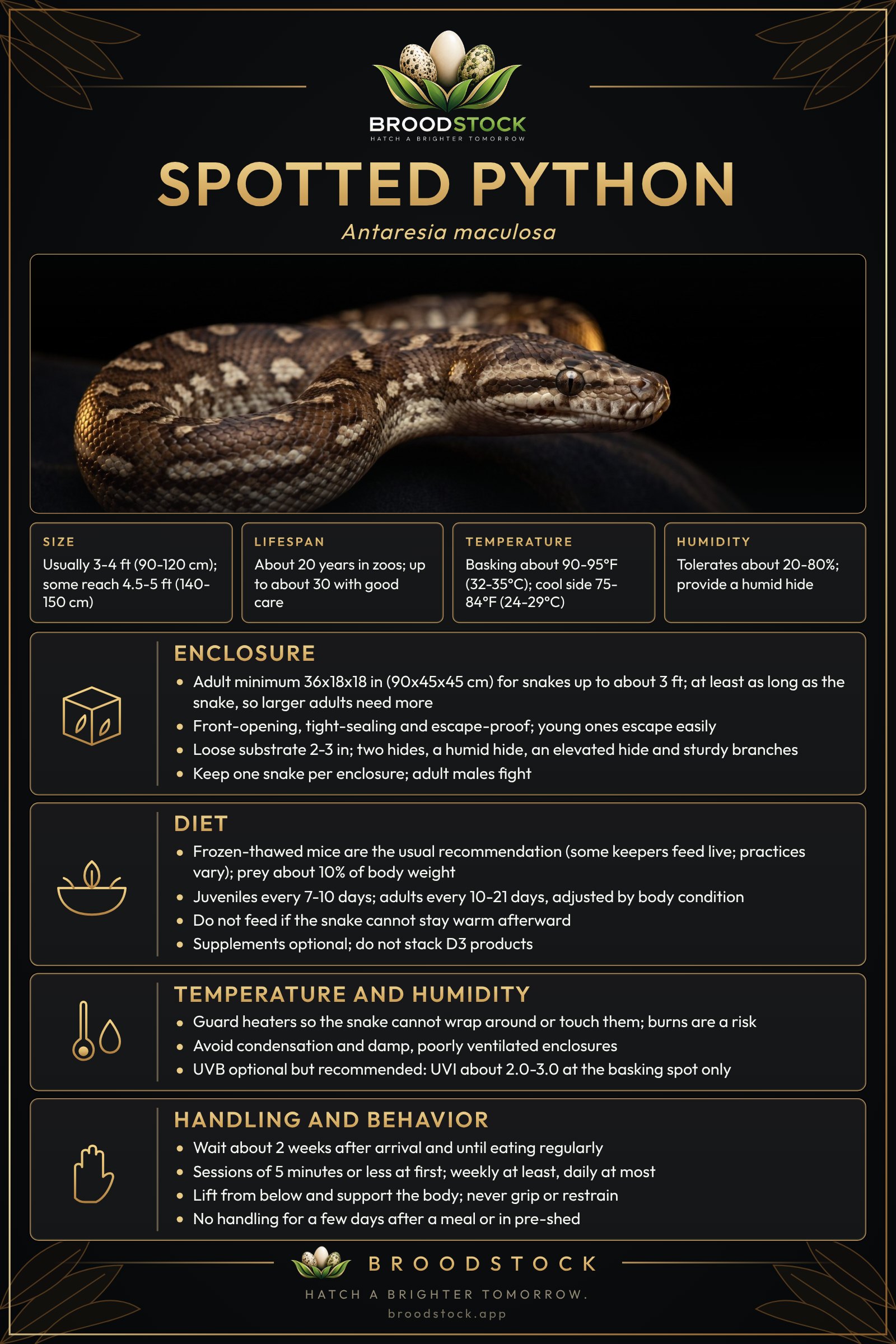
Print it or save it
The care sheet is a one-page summary you can print or keep on your phone. The full care text is below.
Keeping Spotted Python? Broodstock tracks feeding, weights, sheds, enclosures and equipment for every animal you keep, and it is free to start.
Scientific name
Antaresia maculosa
Adult size
Most adults reach about 3-4 ft (90-120 cm). Some, particularly northern (Cape York) animals, reach 4.5-5 ft (140-150 cm), and the record is about 69 in (175-180 cm). Adults weigh about 600-1,200 g, females run slightly larger than males, and hatchlings measure about 10-12 in (25-30 cm).
Lifespan
Zoos commonly report about 20 years, and care guides mention up to about 30 years with good care.
Enclosure
For snakes up to about 3 ft, an adult needs at least 36x18x18 in (90x45x45 cm). The enclosure should be at least as long as the snake, so larger adults and active males need more; 36x24x24 in is a common breeder size. It must be front-opening, tight-sealing and escape-proof, as young ones escape easily. Hatchlings go in small ventilated tubs.
Use 2-3 in of loose substrate (aspen, coconut husk, sand, or a topsoil/sand/clay mix). Avoid paper or mats except during quarantine. Provide two snug hides (warm and cool), a humid hide, an elevated hide, and sturdy climbing branches.
Keep each snake alone, since adult males fight.
Temperature
The basking surface should be about 90-95°F (32-35°C), although Australian vet sheets allow up to 100°F (38°C). The warm hide should be about 90°F (32°C), and the cool side 75-84°F (24-29°C). Heat can go off at night: lows of about 68-72°F (20-22°C) are fine, but do not leave the warm end below 68°F (20°C) for long.
Humidity
Anywhere from about 20-80% is tolerated, so there is no tight target. Include a humid hide, and mist now and then in the early morning. Correct temperatures matter more than humidity for good sheds. Condensation and damp, poorly ventilated enclosures should be avoided.
UVB
UVB is optional but recommended; the snake can live without it but does better with it. A Ferguson zone has not been published for this species, while close relatives are Zone 1-2 (Children's python 1-2, Stimson's 1). Aim for UVI about 2.0-3.0 at the basking spot only, with most of the enclosure shaded. Place it on the warm side over the basking area. A T5 HO 5.0/6% tube (ReptiSun 5.0, Arcadia Forest 6%) goes 10-13 in over mesh or 14-17 in with no mesh; a ShadeDweller-type goes 6-8 in over mesh or 9-10 in without. Replace it every 12 months.
Lighting
Give about 12 hours of light, which can follow local sunrise and sunset.
Heating
Use overhead basking lamps (two 50-75 W bulbs for an average adult, or an infrared lamp unit). A heat mat under the warm hide is optional, run on a thermostat set to 90°F (32°C) with the probe inside the hide. If the room falls below 68°F (20°C) at night, add a low-wattage deep heat projector or radiant panel on a dimming thermostat. Guard heaters so the snake cannot wrap around or touch them, since burns are a risk. A heat source must run 24 h a day for hatchlings under 1 year.
Diet
The staple is whole frozen-thawed mice, and variety helps (the wild diet includes lizards, frogs, bats and birds). Prey should be about 10% of body weight or 1-1.5x the widest point. Juveniles eat every 7-10 days, and adults every 10-21 days (RSPCA: 1-3 weeks), adjusted for body condition. Adults can fast for long periods, up to months. Do not feed if the snake cannot stay warm afterward. Frozen-thawed is the usual recommendation, and some keepers feed live, so practices vary.
Supplements
Supplements are optional. Every 4-6 feeds, dust thawed prey lightly with a 50/50 calcium and multivitamin mix. Choose a low-D3 product with UVB (Repashy Calcium Plus LoD or Arcadia RevitaliseD3) and one with standard D3 without UVB (Repashy Calcium Plus). Do not stack D3 products. Beyond well-fed prey, there is no vitamin A or gut-loading need.
Shedding
Milky eyes mean a shed is coming, and the snake should not be handled until it finishes. Bad sheds in this species usually come from temperatures that are too high or too low, not humidity, so check the gradient first. Get vet advice for repeated stuck shed.
Handling
Wait about 2 weeks after arrival, and until the snake eats regularly. Keep early sessions to 5 minutes or less, and handle at least weekly but no more than once a day. Lift from below, support the body and move slowly; never grip or restrain the snake. Babies are defensive (rearing up, striking, hiding heads) and usually settle. Do not handle for a few days after a meal and when the snake is pre-shed.
Health signs to watch
See a reptile vet for wheezing (respiratory infection), stuck shed, regurgitation, diarrhoea, lethargy, abnormal movement, or long fasting outside the cool season. Check lids often, since young snakes escape easily. New arrivals need quarantine. Some care guides give up to 6 weeks, whereas Australian vet sheets advise at least 6 months in a separate room. Arrange a vet check on arrival and every 6-12 months.
Welfare
Commercial export of native reptiles is banned in Australia, which means spotted pythons kept elsewhere descend from captive-bred lines. They are not social, so keep one snake per enclosure.
Keep every animal's care in one place
Log feedings, weights and sheds, set reminders, and let Ranger, the built-in AI manager, help with the rest. Free to start, no card needed.