
Print it or save it
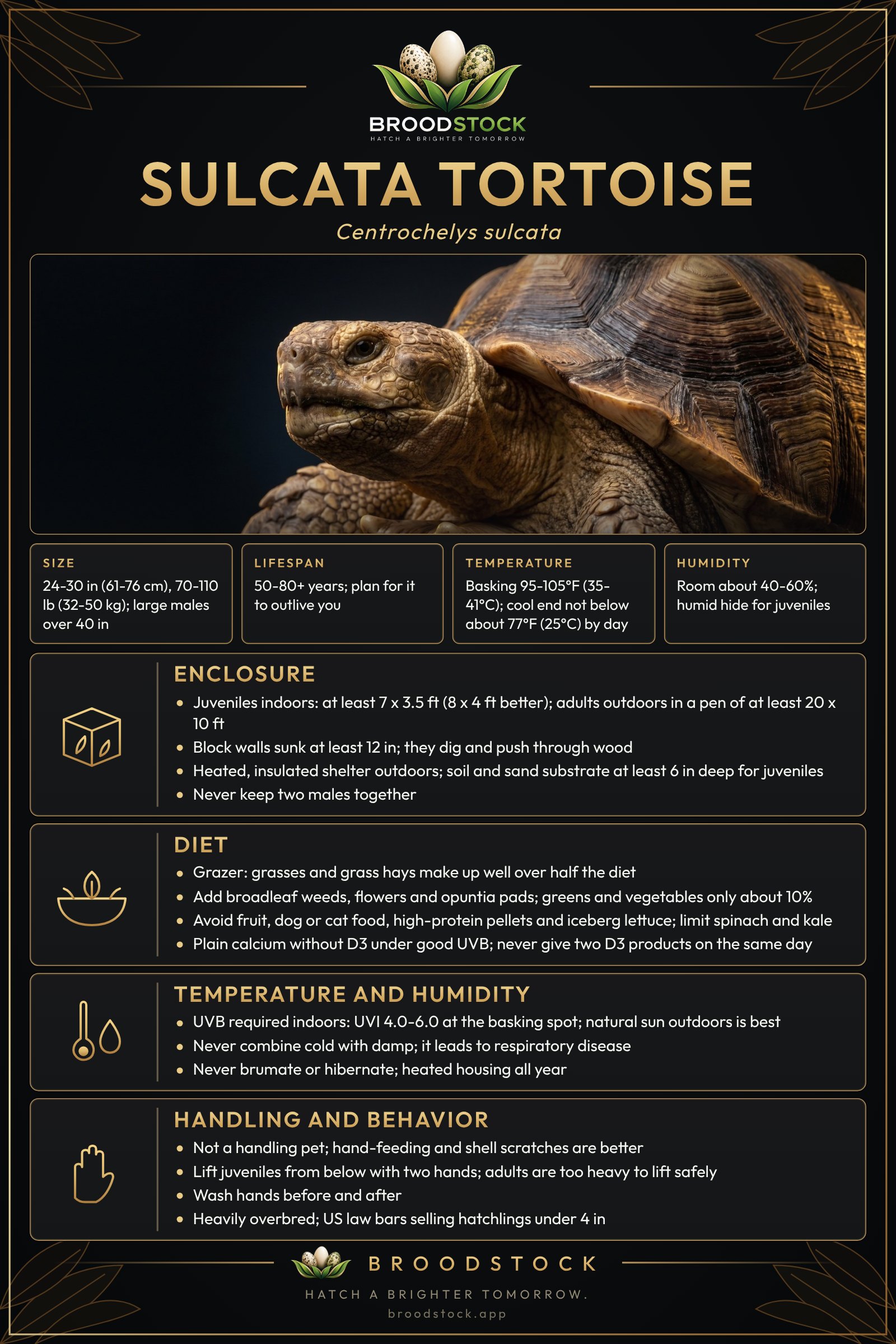
The care sheet is a one-page summary you can print or keep on your phone. The full care text is below.
Keeping Sulcata Tortoise? Broodstock tracks feeding, weights, sheds, enclosures and equipment for every animal you keep, and it is free to start.
Scientific name
Centrochelys sulcata.
Adult size
Typical adults reach 24-30 in (61-76 cm) and 70-110 lb (32-50 kg). Large males can pass 40 in (102 cm) and 200 lb (91 kg), and males run bigger than females.
Lifespan
Expect 50-80+ years, with 70+ often quoted. Plan on the tortoise outliving you.
Enclosure
Hatchlings and juveniles under 10 in need an indoor enclosure of at least 7 x 3.5 ft, and 8 x 4 ft is better (a rule of thumb is 8x by 4x the shell length), with opaque walls 2.5 ft high. Use a soil and sand mix at least 6 in deep as juvenile substrate, and put hides at the cool end.
Adults belong outdoors in a secure pen of at least 20 x 10 ft (200 sq ft). Sulcatas dig and push through wood, so build the walls of block sunk at least 12 in into the ground, and add an insulated, heated shelter or barn. If an adult must stay indoors for a while, give it at least 8 x 10 ft.
Never keep two males together.
Temperature
Basking surface: 95-105°F (35-41°C). Warm or ambient side: 80-90°F (27-32°C). Cool end: no lower than about 77°F (25°C) in the daytime. Hatchlings and juveniles need 70-75°F (21-24°C) at night, while adults handle a wider range.
Outdoors, heat the shelter to 70-75°F (21-24°C) whenever nights fall below 50°F (10°C), and move the tortoise inside once days stay under about 70°F (21°C).
Humidity
Keep room air moderate and well ventilated, around 40-60%, though some vets advise staying under 50%. Hatchlings and juveniles also need a humid microclimate: damp substrate below the surface, a humid hide or burrow, and humid nights, often above 80% inside the hide for juveniles. Adults cope better with dry air. Soak juveniles every day. Practices vary, and some keepers raise sulcatas drier.
Never combine cold with damp, since that leads to respiratory disease.
UVB
Indoors, UVB is required (Ferguson zone 3). Aim for UVI 4.0-6.0 at the basking spot, checked with a Solarmeter 6.5. Use a T5 HO 10-14% tube in a reflective fixture, covering about half the enclosure length over the warm side.
Arcadia T5 HO 12% and Zoo Med ReptiSun 10.0 sit about 9-12 in away through mesh, or 14-16 in with no mesh. Arcadia 14% sits 10-13 in away through mesh, or 15-20 in with none. Natural sun outdoors is best and takes the place of the lamp.
Lighting
Indoors, run about 12-13 hours of light in summer and 11-12 in winter, since this tropical species needs little seasonal change. A 6500K LED daylight bar is recommended. Outdoors, natural daylight does the job.
Heating
Indoors, use overhead halogen flood bulbs (two 75W for a juvenile enclosure; adjust the wattage as needed) together with a radiant heat panel on a proportional thermostat for ambient and night warmth. Outdoors, heat an insulated shelter with radiant panels or ceramic heaters on a thermostat. Do not use heat rocks.
Diet
Sulcatas are grazers, so feed very high fiber with low protein and low sugar. Well over half the diet (up to about 85% according to some) should be grasses and grass hays (timothy, orchard, Bermuda), along with broadleaf weeds and flowers (dandelion, plantain, mallow, clover, hibiscus) and opuntia cactus pads. Grocery greens and vegetables are only a small share, about 10%.
Growing tortoises can eat as much as they like each day. Near adult size, cut this to roughly a shell-sized portion daily. Always provide fresh water.
Avoid fruit, dog or cat food, high-protein or growth pellets, iceberg lettuce and plants treated with pesticides, and limit spinach, kale and other brassicas.
Supplements
When the tortoise has good UVB or sun, use plain calcium without D3 (such as Repashy SuperCal NoD or Zoo Med Repti Calcium without D3). Dust it lightly on most meals for hatchlings and juveniles; adults are commonly dusted 1-3x/week. Keep a cuttlebone available, but do not rely on it as the only calcium.
Give a multivitamin containing vitamin A about 1-2x/month: Rep-Cal Herptivite (beta carotene, no D3), Arcadia EarthPro-A (provitamin A, no D3) or Nekton-Rep (preformed vitamin A plus a little D3).
Use calcium with D3 only when UVB is missing or unreliable, for example Zoo Med Repti Calcium with D3, or Repashy Calcium Plus, an all-in-one with D3 and vitamins (skip the separate multivitamin that week). Two D3 products should never land on the same day. A high-protein diet cannot be corrected with calcium.
Shedding
Skin comes off in thin little flakes as the tortoise grows, which is normal. The shell itself does not shed; new keratin forms beneath each scute as the shell grows.
Scutes that lift, peel or fall off, soft or pitted areas, reddish fluid under a scute, or a bad smell are not normal. They need a reptile vet, because they may mean a shell infection, often tied to dirty or wet conditions or to poor diet, UVB or calcium.
Handling
This is not a tortoise for handling. Lift juveniles from underneath with two hands; adults are too heavy to lift safely. Hand-feeding and scratching the shell are better ways to interact. Wash your hands before and after.
Brumation
Never brumate or hibernate a sulcata. It is a tropical Sahel tortoise and needs heated housing all year. If one slows down in cool weather, it needs more heat rather than a rest.
Health signs to watch
Take the tortoise to a vet for any of these: respiratory signs (nasal discharge, wheezing, open-mouth breathing); not eating or a change in droppings; constipation or straining; bladder stones (straining, gritty urates); a soft shell or beak deformity (metabolic bone disease); heavy pyramiding; eye problems; dehydration (sunken eyes, thick urates); and digging or escape injuries.
The usual causes are too much protein, too little water or humidity, and too little UVB or heat.
Welfare
Overbreeding of sulcatas is heavy. Adults reach about 24-30 in (60-75 cm) and 80-110 lb or more, can live 50+ years and need about half an acre of space. US rescues report they are full and can take only a few adults. American Tortoise Rescue calls for a halt to sales.
The IUCN lists the species as Vulnerable, and it is on CITES Appendix II, with wild populations disappearing in parts of its range. Under US law, hatchlings under 4 in cannot be sold.
Keep every animal's care in one place
Log feedings, weights and sheds, set reminders, and let Ranger, the built-in AI manager, help with the rest. Free to start, no card needed.