
Print it or save it
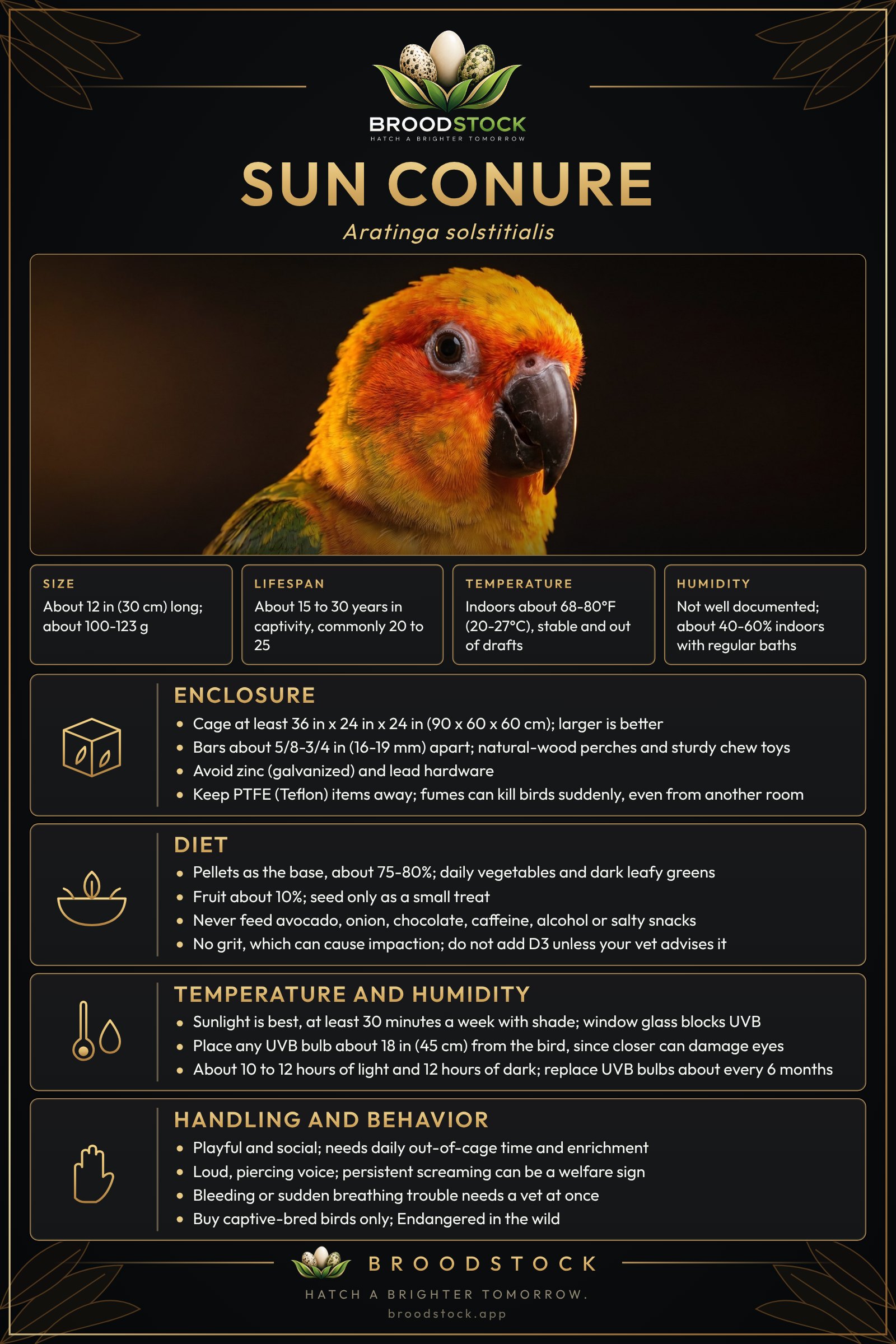
The care sheet is a one-page summary you can print or keep on your phone. The full care text is below.
Keeping Sun Conure? Broodstock tracks feeding, weights, sheds, enclosures and equipment for every animal you keep, and it is free to start.
Scientific name
Aratinga solstitialis.
Adult size
Birds measure about 12 in (30 cm) long and weigh roughly 100-123 g, with around 120 g typical.
Lifespan
In captivity they live about 15 to 30 years, and 20 to 25 is common.
Enclosure
A single pet needs a cage at least 36 in long x 24 in wide x 24 in high (90 x 60 x 60 cm), and larger is better. Space the bars about 5/8-3/4 in (16-19 mm) apart. These are strong chewers, so supply varied natural-wood perches and sturdy chew toys.
Avoid hardware that contains zinc (galvanized) or lead. Keep appliances with a PTFE (Teflon) coating away from the birds.
Temperature
Indoors, they are comfortable at about 68-80°F (20-27°C). Keep the temperature stable, away from drafts and from direct sun through glass. A healthy bird copes with a bit of heat and cold.
Limits for an outdoor aviary are not well documented. Breeders commonly provide a sheltered, heated area when it drops below about 50°F (10°C), and shade plus water above about 90°F (32°C).
Humidity
Humidity needs are not well documented. Keepers commonly aim for about 40-60% indoors and bathe the birds regularly.
UVB
UVB is recommended. The best source is direct, unfiltered sunlight, at least 30 minutes a week, with shade available; window glass blocks UVB. Indoors, a full-spectrum bird bulb (CRI 91 or higher) helps but cannot replace sunlight.
Hang the bulb about 18 in (45 cm) from the bird, because closer can damage the eyes. Put it on the same timer as the day length, and replace it about every 6 months as its UVB output fades. Birds that get no sun obtain vitamin D3 from the pellet part of the diet.
Lighting
For normal days, give about 10 to 12 hours of light and 12 hours of dark. To stop chronic laying, cut the light to about 10 hours and remove the nest box.
Heating
Keep the room at a steady 68-80°F (20-27°C). Never use heat lamps, space heaters or other heating elements with PTFE (Teflon) coatings, and keep birds out of the kitchen. Fumes from overheated nonstick items can kill birds suddenly, even when released in another room.
Diet
Make formulated pellets the base, about 75-80% for conures. Add vegetables and dark leafy greens daily, fruit as a small share (about 10%), and seed only as a small treat. Dark leafy greens that are rich in vitamin K are important.
Never feed avocado, onion, chocolate, caffeine, alcohol or salty snacks. Avoid processed foods and anything cooked in oil or butter, and limit dairy. Take away uneaten fresh food after a couple of hours.
Supplements
Keep cuttlebone or a mineral block available at all times, and replace it when soiled. Pellets already supply vitamin D3, so do not add a D3 supplement unless your vet advises it, since too much D3 is harmful.
Do not offer grit. Conures hull their seed, and grit can cause impaction. A bird eating mostly pellets needs no multivitamin; powdered vitamins on moist food help only while converting a seed-eater to pellets.
Vitamin K matters especially for Aratinga conures, so feed dark leafy greens. Low vitamin K is a suspected factor in bleeding conure syndrome.
Shedding
Molting is not well documented for this species. Usually there are one or two molts a year, and indoor birds may molt lightly all year.
Handling
Sun conures are playful, affectionate and very social. They need time out of the cage every day plus enrichment, or they become persistently loud. The voice is loud and piercing in bursts, so set a buyer's expectations before a sale. Birds hand-raised from young tame most easily.
Health signs to watch
Take the bird to an avian vet for any of these: a fluffed, sleepy bird; tail bobbing; a hen that strains or has a swollen abdomen (egg binding, an emergency); soft-shelled eggs (low calcium); feather picking; abnormal feathers or beak (PBFD); signs of psittacosis, such as green urates or eye or nose discharge (it can infect people); weight loss with undigested food (PDD); breathing trouble (aspergillosis); and obesity in small cages.
Sudden labored breathing, wobbling or collapse can mean PTFE (Teflon) fumes. Get the bird into fresh air and to a vet at once.
Aratinga conures such as suns are linked to hemorrhagic (bleeding) conure syndrome. Nosebleeds, blood in the droppings, sudden bruising or swelling, or weakness need a vet immediately. Low vitamin K is a suspected factor.
Persistent screaming can be a welfare sign (loneliness, insecurity), which is different from normal loud calling.
Welfare
The IUCN lists sun conures as Endangered, with about 1,000-2,500 mature birds left in the wild and numbers decreasing. They are also on CITES Appendix II, mainly because of trapping for trade, so buy captive-bred birds only.
Sell only fully weaned birds: the Australian Veterinary Association states that unweaned parrots should not be sold, and California law bars pet retailers from releasing a parrot until it feeds itself.
Keep every animal's care in one place
Log feedings, weights and sheds, set reminders, and let Ranger, the built-in AI manager, help with the rest. Free to start, no card needed.