
Broodstock / Care sheets / Tiger Salamander
Tiger Salamander Care Sheet
Ambystoma tigrinum (eastern tiger salamander)
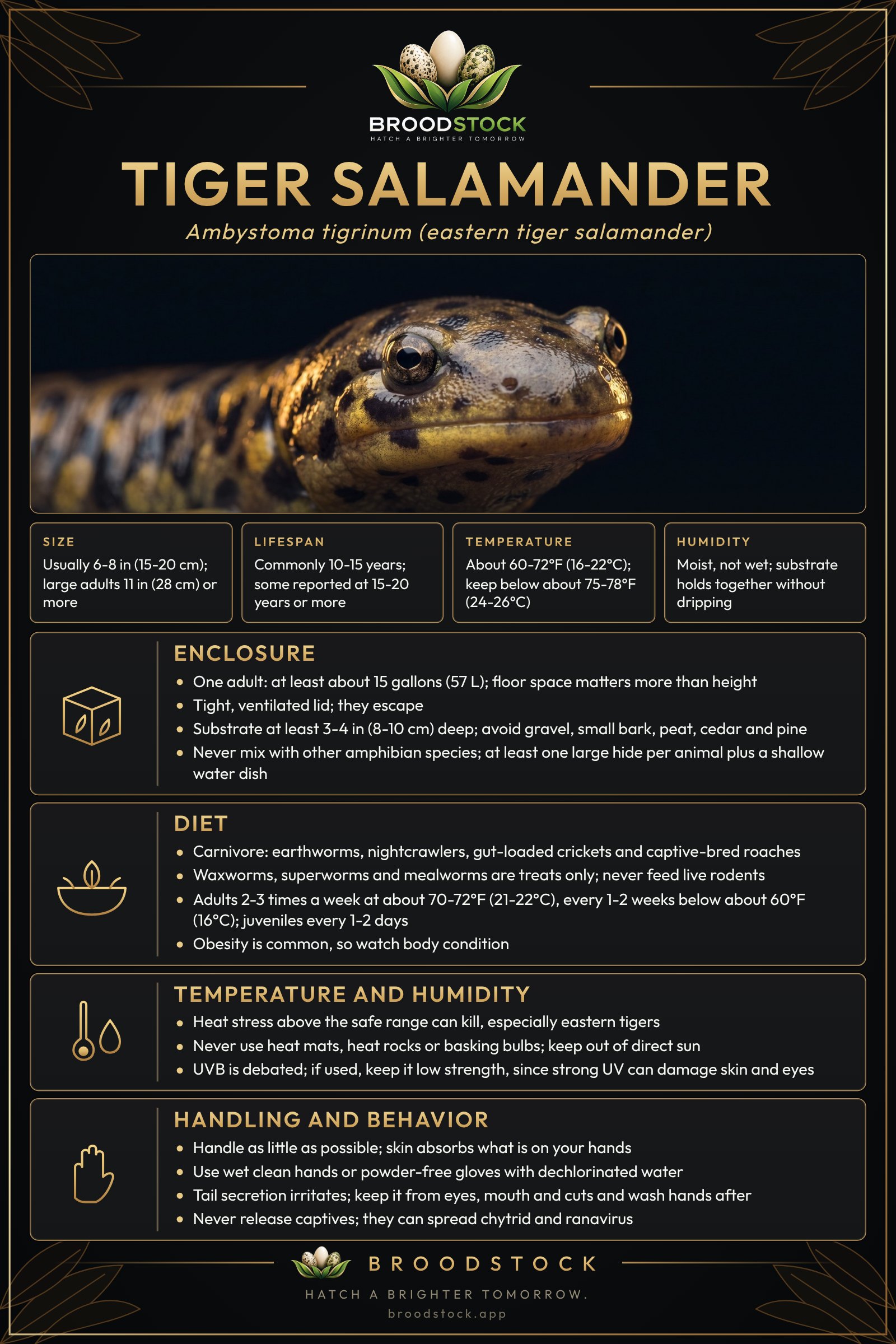
Print it or save it
The care sheet is a one-page summary you can print or keep on your phone. The full care text is below.
Keeping Tiger Salamander? Broodstock tracks feeding, weights, sheds, enclosures and equipment for every animal you keep, and it is free to start.
Scientific name
The eastern tiger salamander is Ambystoma tigrinum. Western animals sold as tiger salamanders, including the barred tiger salamander, are now usually treated as a separate species, Ambystoma mavortium. Care is essentially the same, except that the barred form tolerates warmer days.
Adult size
Adults are usually 6-8 in (15-20 cm) in total length. Large captive adults commonly reach 11 in (28 cm) or more, and animals of 13-14 in (33-36 cm) are on record. Captive animals get close to adult size within about a year.
Lifespan
In captivity they commonly live 10-15 years, and well kept animals have been reported at 15-20 years or more. Published figures vary widely between care guides.
Enclosure
Adults live on land and burrow. One adult needs a tank of at least about 15 gallons (57 L) with a 24x12 in (61x30 cm) floor. Some guides accept 10 gallons for a small adult, but bigger is better. Two adults need a 20-gallon long (about 30x12 in, 75x30 cm) or larger. One animal can also live in a large ventilated plastic tub (about 58 qt). Floor space matters more than height, and the lid must be tight and ventilated, because they escape.
Use substrate at least 3-4 in (8-10 cm) deep: additive-free topsoil, coco fiber or a mix, wetter at one end and drier at the other. Avoid gravel and small bark, which get swallowed with prey and cause impaction, and avoid very acidic peat, cedar, pine, reptile carpet and artificial turf.
Provide at least one large hide per animal, plus a wide, shallow water dish they can climb in and out of easily. Spot clean daily and change the substrate completely every few months. Never mix them with other amphibian species.
Larvae ('waterdogs') are fully aquatic. They need clean, still water, low stocking (about three large larvae per 10 gallons) and no fish.
Temperature
These are cool keepers. Aim for about 60-72°F (16-22°C); a room at around 72°F (22°C) or slightly lower is ideal. Stay below about 75-78°F (24-26°C), because long spells above that cause heat stress and can kill, especially eastern tigers. Barred tigers (Ambystoma mavortium) cope with brief daytime highs in the low 80s°F (27-28°C). Extra heat is usually unnecessary if the room stays above about 60°F (16°C). Keep the enclosure out of direct sun.
Humidity
Keep the enclosure moist but not wet. Substrate should hold together when squeezed without dripping, with a moisture gradient across the enclosure. Some guides suggest around 70% air humidity, read on a hygrometer, while others rely on substrate moisture alone. If it turns soggy, increase ventilation, since soggy conditions can lead to skin infections.
Tap water must be dechlorinated (treat for chlorine and chloramine; letting it stand only removes chlorine), or use spring water. Avoid making distilled or deionized water the main supply. They often soak and defecate in the dish, so change its water every 1-3 days.
UVB
Evidence on amphibian UVB needs is limited, and care guides disagree. Some say UV data is lacking and keep tigers under ordinary or room light; others recommend a low-output 2.0-5.0% UVB tube for 10-12 hours a day. Keepers differ on this.
If you use UVB, keep it low strength with plenty of shade and burrow depth, because strong UV can damage amphibian skin and eyes, and replace bulbs on the maker's schedule. For choosing a zone, the best guide is the UV-Tool from Baines and colleagues (2016), which covers amphibians.
Lighting
Provide about 10-12 hours of light and 12 hours of dark, on a timer, or use ambient room daylight. Choose low-heat lighting (LED or fluorescent; 4,000-10,000K if growing live plants). Do not use white or colored lights at night, and avoid any light that warms the enclosure above the safe range.
Heating
Most homes need none. Overheating is the bigger risk, so keep the enclosure in a cool room away from windows, heaters and hot lamps, and check it with a thermometer. If the room falls well below about 55-60°F (13-16°C), the animals slow down and eat less, which is normal and reversible. This species should never be given heat mats, heat rocks or basking bulbs.
Diet
Tiger salamanders are carnivorous. Staples are whole earthworms and nightcrawlers, gut-loaded crickets and captive-bred roaches, along with silkworms, hornworms and soldier fly larvae. Waxworms, superworms and mealworms are treats only, being fatty or hard to digest. A large adult may rarely get a thawed pinky or fuzzy mouse, and never a live rodent. For larvae, offer bloodworms, brine shrimp, blackworms and chopped earthworm.
Feed adults 2-3 times a week at about 70-72°F (21-22°C), offering what is eaten in about 15 minutes. When it is cooler than about 60°F (16°C), drop to once every 1-2 weeks. Feed juveniles every 1-2 days. Obesity is common, so watch body condition.
Supplements
Care guides disagree, and practices vary. Some experienced keepers say a varied, worm-based diet needs no dusting, while others dust crickets and roaches 1-2 times a week with calcium plus D3 and an amphibian multivitamin. Worms are a well-balanced staple, while insect-heavy diets benefit more from dusting and gut-loading. Opened supplements should be replaced about every 6 months.
Shedding
Healthy animals shed every few days to weeks, often in one piece, and usually eat the skin, so it is rarely seen. Stuck shed, especially on the toes, points to low moisture or illness and calls for a husbandry check or a vet visit.
Handling
Handle them as little as possible. Their skin absorbs whatever is on your hands, and handling stresses them. When you must, use wet clean hands (no soap or lotion residue) or powder-free gloves wetted with dechlorinated water, support the whole body and keep sessions short. Use a fine net or a container to move them.
Skin glands, especially on the tail, can release a sticky white secretion that irritates. Keep it away from your eyes, mouth and cuts, and wash your hands afterwards. Many tigers become very tame and will accept food from tongs.
Brumation
In the wild, tigers spend winter in burrows. Captive adults do not need to hibernate, but most keepers allow a seasonal cool-down: at about 50-60°F (10-16°C) they eat much less and may stay buried. Only cool healthy animals that are in good weight.
Health signs to watch
See an amphibian vet for any of these: refusing food or lethargy; red, ulcerated or discolored skin; excess mucus or shedding; swelling or bloating; cloudy, sunken or swollen eyes; stuck shed; and floating or abnormal posture.
Common problems are obesity, gut impaction from gravel or substrate, metabolic bone disease and vitamin A deficiency on poor insect diets, skin infections from wet or dirty setups, heat stress, and toxicity from chemicals (skin absorbs insecticides, fertilizers, soap and hand lotion).
On biosecurity, tigers can carry and spread chytrid (Bd) and ranavirus, and ranavirus can kill most of a larval group. Quarantine new animals for at least 6 to 8 weeks in a separate room with their own tools, and ask a vet about PCR skin swabs for chytrid. Never release animals or dump tank water outdoors, and do not buy bait-shop waterdogs, a known ranavirus route.
Disinfect tools and tanks with a strong bleach solution or Virkon Aquatic. The 2023 NEPARC protocol uses at least 1.6% sodium hypochlorite for 5 minutes to cover chytrid including Bsal, which works out to about 6 cups of 6% household bleach, or 4 cups of 8.25% bleach, per gallon of water. Then rinse well with dechlorinated water and dry fully.
Welfare
The law varies by state and country. Several US states limit or ban wild collection, possession, sale or use as bait. For example, Wisconsin bans selling native amphibians, with an exception that lets Class A captive wild animal farm license holders sell eastern tiger salamanders, and rules change, so check current ones. The California tiger salamander (Ambystoma californiense) has federal listing, as endangered or threatened depending on the population, so collecting, keeping or trading it requires federal permits. Check with your state wildlife agency before buying, selling, collecting or shipping, and keep proof of lawful purchase.
Most tigers in the trade are wild-caught, so captive breeding is rare; be honest about origin. Never release captives, because they can spread chytrid and ranavirus to wild amphibians. Heat, chemicals and gravel kill more captive tigers than disease does, so avoid all three.
Keep every animal's care in one place
Log feedings, weights and sheds, set reminders, and let Ranger, the built-in AI manager, help with the rest. Free to start, no card needed.