
Print it or save it
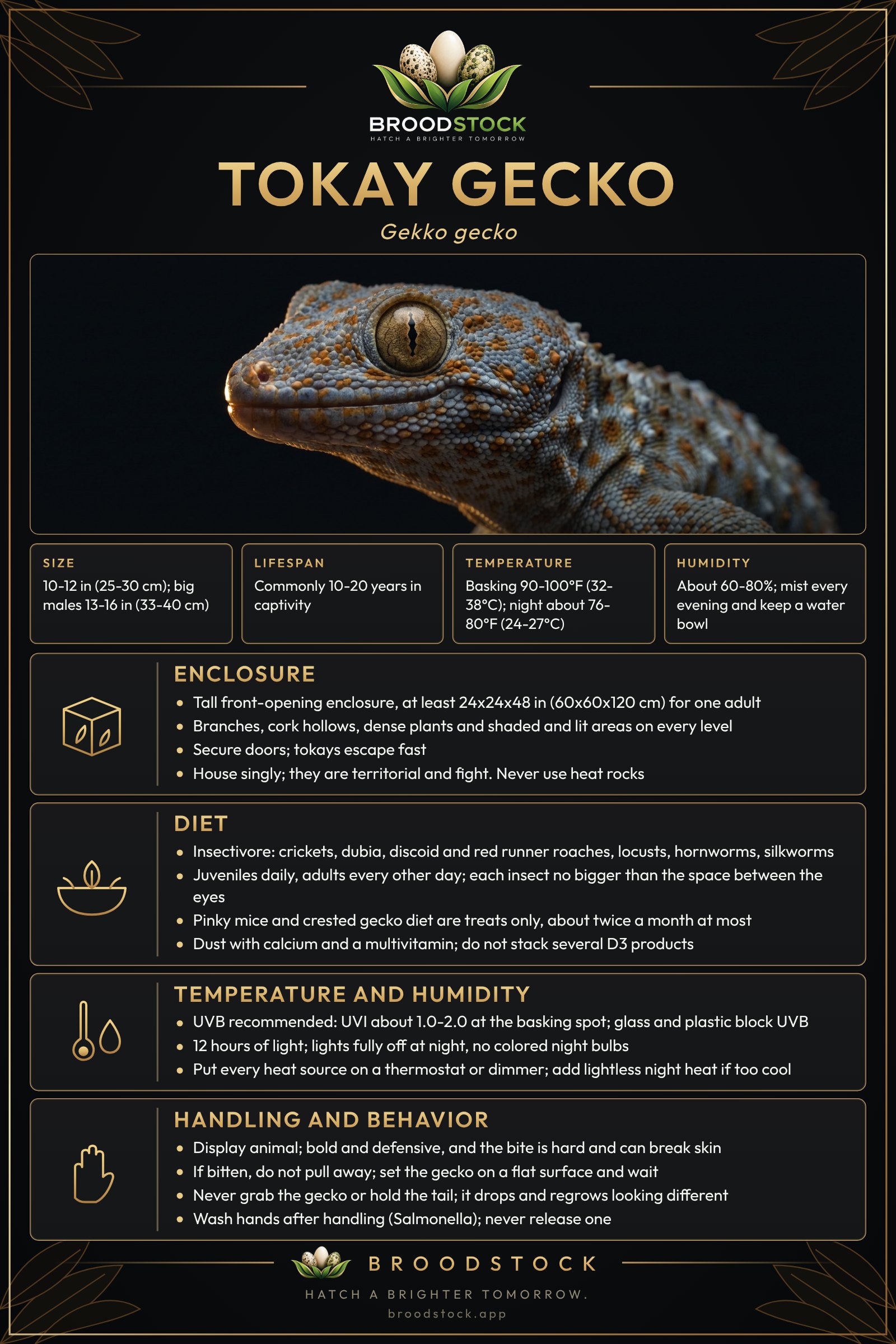
The care sheet is a one-page summary you can print or keep on your phone. The full care text is below.
Keeping Tokay Gecko? Broodstock tracks feeding, weights, sheds, enclosures and equipment for every animal you keep, and it is free to start.
Scientific name
Gekko gecko.
Adult size
Most adults are 10-12 in (25-30 cm) in total length, and big males can reach about 13-16 in (33-40 cm). Females stay smaller and seldom exceed about 12 in (30 cm).
Adult weight is not well documented, and the figures disagree. One breeder guide gives about 140-200 g (5-7 oz) for adults, while a long-time breeder reports wild-caught Indonesian females arriving at 30-40 g and growing to about 70 g (2.5 oz) in captivity.
Lifespan
They commonly live 10-20 years in captivity. Current care guides say about 15-20 years with good care, while older care sheets quote 10+ years.
Enclosure
Use a tall, front-opening, arboreal enclosure. The current minimum for one adult is 24x24x48 in (60x60x120 cm), and very large animals (over about 12 in) need at least 36x24x48 in (90x60x120 cm). Some care sheets list smaller minimums (18x18x36 in), so keepers differ, but bigger is better.
Furnish every level with branches, cork hollows and tubes, vines, dense plants and magnetic ledges, with shaded and lit areas. Lay about 2 in (5 cm) of moisture-holding substrate (a topsoil and coco fiber mix, or bioactive) with leaf litter on top. Avoid gravel, wood chips and walnut shell.
Tokays escape fast, so use secure doors. House them singly, because they are territorial and fight.
Temperature
Basking surface: 90-100°F (32-38°C). Cooler, shaded area: 80-85°F (27-29°C). Night: about 76-80°F (24-27°C). Tokays like warmer nights than most homes provide, so add lightless night heat if the enclosure falls below that range. A digital probe or infrared thermometer is the way to read the basking surface.
Humidity
Average about 60-80%, measured mid-enclosure. Some guides aim for 70-80%, while one long-time breeder keeps 50-60%, so keepers differ. It is normal for humidity to be higher at night and in the cool zone, and drier during the day.
Mist every evening, and in the morning if needed. Tokays drink droplets, but also keep a water bowl on a ledge. Keep substrate damp, not wet, and ventilate well, because conditions that stay soggy or stay dry both cause health problems.
UVB
UVB is recommended but not strictly required. A tokay can get by on dietary D3, but UVB gives better results. Aim for UVI about 1.0-2.0 at the basking spot near the top. Options include a T8 ReptiSun 5.0 or an Arcadia ShadeDweller-type lamp.
The basking branch should sit at least 6 in (15 cm) under the lamp. Through mesh, a ShadeDweller Max works at about 4-8 in from the gecko and a T8 5.0 at about 8-10 in. If you can, verify the output with a Solarmeter 6.5. Replace bulbs every 12 months, although some older care sheets say 6 months. Glass and plastic block UVB.
Lighting
Give 12 hours of light on a timer, or sync it to local sunrise and sunset. Turn lights fully off at night, and do not use colored night bulbs.
Heating
Put heat overhead, above the basking branch. ReptiFiles suggests two roughly 100 W incandescent bulbs in a dual dome on a dimmer, while others use one or two 50 W halogen floods depending on enclosure size. If night heat is needed, use a ceramic heat emitter or deep heat projector. Run every heat source on a thermostat or dimmer, with the probe on the basking surface. Heat rocks must never be used.
Diet
Tokays eat insects, and wild ones also take the odd frog, lizard or small snake. Feed juveniles daily and adults every other day, offering what is eaten in about 5 minutes. Each insect should be no bigger than the space between the eyes.
Good feeders are crickets, dubia, discoid and red runner roaches, locusts, hornworms and silkworms. Feed the insects a gut-load diet for 1-3 days beforehand. Pinky or fuzzy mice and crested gecko diet are treats only, no more than about twice a month. If the gecko is putting on fat, feed less.
Supplements
Dust insects with calcium at most or all feedings, and include a multivitamin. Under UVB, a common recommendation is an all-in-one low-D3 product such as Repashy Calcium Plus LoD. Without UVB, use calcium with D3; one vet-written care sheet suggests it daily for juveniles and 2-3 times a week for adults, plus a multivitamin 1-2 times a week. Keepers differ on schedules. Do not stack several D3 products.
Shedding
A tokay sheds in patches rather than in one piece, and often eats the shed. Humidity must stay in range, and a humid hide of damp moss should be on offer. Check the toes and tail tip, because retained shed there can constrict blood flow and cause tissue loss.
Never pull shed off. A vet care sheet suggests warm, shallow soaks, while many keepers prefer raising humidity or using a damp-towel box, so approaches differ. Avoid handling during a shed, since the gecko is more irritable.
Handling
This is mainly a display animal. Tokays are bold and defensive: they gape, bark and bite hard, and a bite can break skin and hold on. If one bites, do not pull away. Set the gecko on a flat surface and wait for it to let go.
Wait at least 2 weeks after arrival, then build trust by offering insects from soft-tipped tongs. Some will eventually climb onto a hand. Animals that are captive-bred and handled from a young age tend to be calmer.
Never grab the gecko or hold it by the tail. The tail drops, and it regrows over about a month looking different. Wash your hands afterward (Salmonella).
Brumation
Tokays do not brumate.
Health signs to watch
See a reptile vet for any of these: weight loss, refusing food, lethargy, nasal discharge or open-mouth breathing (respiratory infection); a red mouth with cheesy discharge (mouth rot); skin lesions or infections; diarrhea or abnormal droppings (parasites, which are common in wild-caught animals, so get a fecal test); limping; a soft jaw or deformities (metabolic bone disease); retained shed on toes or eyes; vent prolapse; and straining, or a female that keeps laying without rest (egg binding, calcium depletion).
New animals need quarantine, and every animal needs a yearly exam.
Welfare
Tokays have been on CITES Appendix II since 2019 because of huge trade, mostly dried geckos for traditional medicine, at over a million a year. Many pet tokays are wild-caught, and some exports labeled captive-bred are suspected to be wild-caught animals relabeled. Choose breeders who can show you their own adults and eggs. Wild-caught tokays frequently carry parasites, and they are more stressed and more defensive.
The bite is strong, so this is not a pet for young children.
Tokays are established as introduced animals in Florida and elsewhere, so never release one.
Keep every animal's care in one place
Log feedings, weights and sheds, set reminders, and let Ranger, the built-in AI manager, help with the rest. Free to start, no card needed.