
Broodstock / Care sheets / Uromastyx
Uromastyx Care Sheet
Uromastyx spp. (mainly U. geyri, U. ornata, U. ocellata, U. dispar)
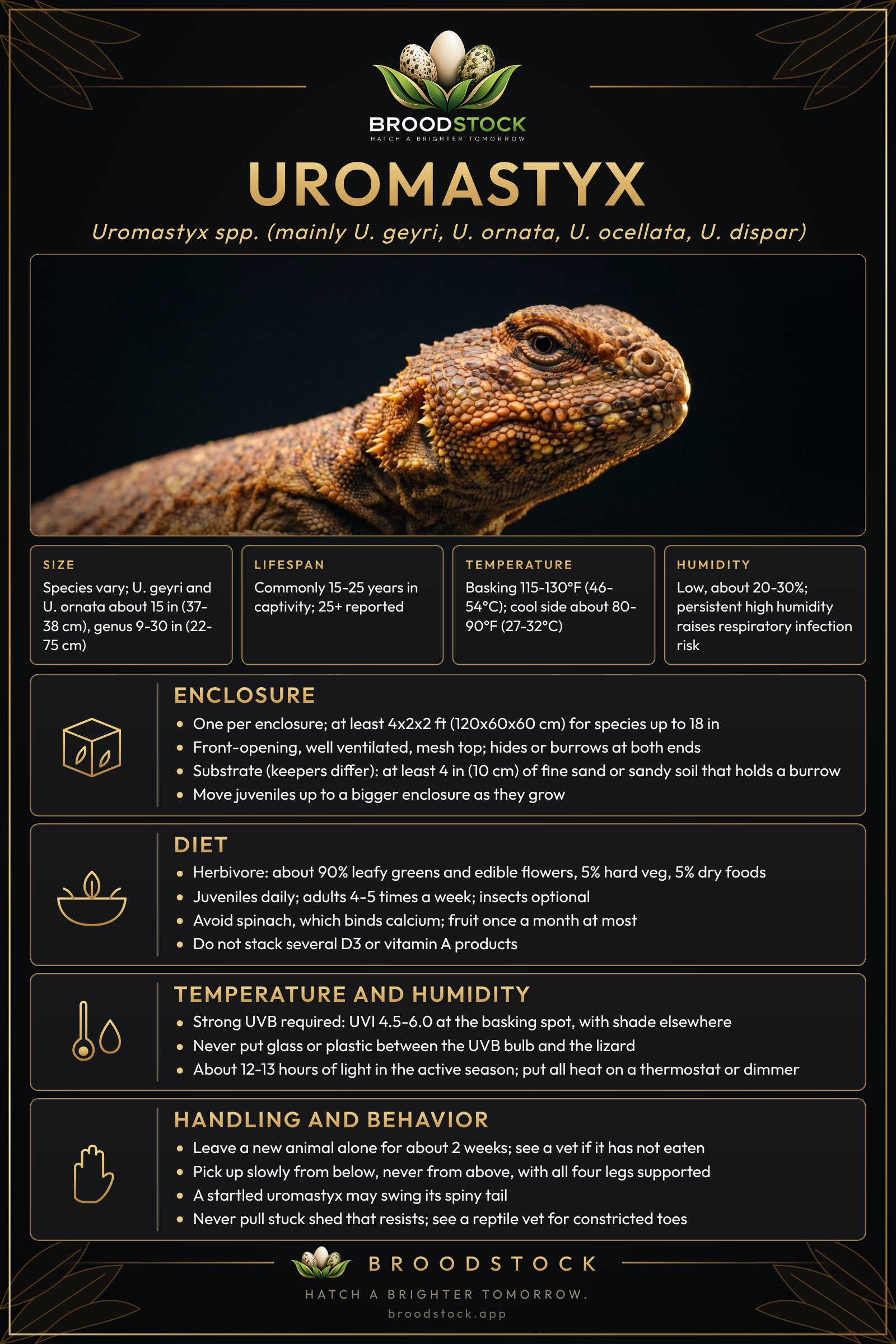
Print it or save it
The care sheet is a one-page summary you can print or keep on your phone. The full care text is below.
Keeping Uromastyx? Broodstock tracks feeding, weights, sheds, enclosures and equipment for every animal you keep, and it is free to start.
Scientific name
Uromastyx spp., mainly U. geyri, U. ornata, U. ocellata and U. dispar.
Adult size
Size depends on the species. Of the commonly kept species, geyri, ornata and dispar maliensis come to about 15 in (37-38 cm) in total, while ocellata reaches about 11 in (28 cm). Across the genus the range is 9-30 in (22-75 cm), and the giant, Uromastyx aegyptia, is 30 in or more.
Lifespan
These are long-lived lizards: commonly 15-25 years in captivity with good care, and 25+ years is reported. Some suggest up to 60 years, but that upper figure is poorly documented.
Enclosure
Keep one per enclosure. Minimums are 4x2x2 ft (120x60x60 cm) for species up to 18 in (geyri, ornata, dispar, ocellata), 6x2x2 ft for up to 24 in, 8x3x3 ft for up to 30 in, and at least 8x4x4 ft (240x120x120 cm) for the aegyptia species. Choose a front-opening, well ventilated enclosure with a mesh top, a basking rock or slate stack, and hides or burrows at both ends. A juvenile can start in a smaller enclosure but should move up in size as it grows.
Keepers differ on substrate. A common naturalistic choice is at least 4 in (10 cm) of fine sand or sandy soil (about 2.5 cu ft for a 4x2x2) that can hold a burrow, with a slightly moist lower layer under a dry top inch. Some vets prefer solid substrates with a separate dig box of slightly moist soil. Use paper towels for sick or quarantined animals.
Temperature
Basking surface: 115-130°F (46-54°C), with many keepers aiming for 120-130°F (49-54°C). Warm floor: 95-100°F (35-38°C). Cool side: about 80-90°F (27-32°C). Night: 65-75°F (18-24°C). Use an infrared temp gun to read surface temperatures.
Humidity
Keep it low, about 20-30% ambient, measured on the cool-side floor. Keep the top inch of substrate dry with a slightly moist layer below, so burrows hold some humidity. Two species differ: Uromastyx yemenensis wants about 50% and Uromastyx macfadyeni about 30-35%. Persistent high humidity raises the risk of respiratory infection.
UVB
Strong UVB is required. Aim for UVI 4.5-6.0 at the basking spot (measure with a Solarmeter 6.5), with shade elsewhere. Use a T5 HO 12-14% desert tube such as Arcadia Dragon 14%, in a reflective fixture, covering about half the enclosure length over the basking side. Mount it about 8-12 in (20-30 cm) above the basking spot over mesh, or 14-19 in (36-48 cm) with no mesh. Never put glass or plastic between the bulb and the lizard. Replace T5 tubes on the maker's schedule, commonly 12 months.
Lighting
Give about 12-13 hours of light in the active season. Add bright 6500K full-spectrum daylight lighting, separate from the UVB.
Heating
Provide strong basking heat from overhead: halogen flood bulbs, about 10-12 in (25-30 cm) above a basking platform or rock. For a 4x2x2 ft enclosure, two 100 W PAR38 halogens is a common setup. Adjust with a dimmer, platform height or wattage.
Put all heat on a thermostat or dimmer, track temperatures with a digital probe and check surfaces with an infrared temp gun. Add night heat only if the room drops below about 65°F (18°C), using a ceramic emitter or deep heat projector (no light).
Diet
Uromastyx are herbivores. About 90% of the diet is leafy greens and edible flowers (collard, turnip, mustard and dandelion greens, endive, escarole, arugula, bok choy, spring mix; hibiscus, dandelion, rose and nasturtium flowers). About 5% is hard veg (squash, bell pepper) and about 5% dry foods (seed or lentil mix, grass hay).
Feed juveniles daily, as much as they eat, and adults 4-5 times a week. Seeds or lentils go in small amounts, about once a week for adults; some breeders give more, so keepers differ, and hatchlings under 6 months get none. Insects are optional: at most one mealworm or superworm about weekly for juveniles and every other week for adults, and many breeders feed none. Fruit is for once a month at most. Avoid spinach, which binds calcium.
On water, keepers differ. Many keep a small, shallow bowl of fresh water available, while some breeders offer none because adults get most of their water from food.
Supplements
Greens get dusted with calcium plus a multivitamin about twice a week. Any feeder insects get a 50/50 mix of calcium and multivitamin. Low-D3 options are Miner-All Indoor (calcium with D3) plus Vit-All (multivitamin with beta carotene, no D3), or the all-in-one Repashy SuperVeggie (contains calcium, vitamin D and vitamin A; use it alone, not with another multivitamin). A different suggestion, from a vet clinic sheet, is plain calcium 1-2 times a week with a vitamin A multivitamin 1-2 times a month.
With strong UVB, a calcium that is low in D3 or has none is enough, such as Repashy SuperCal NoD, Zoo Med Repti Calcium without D3 or Miner-All Outdoor. Do not stack several D3 or vitamin A products. Uro Grit, used as labeled, can cover seed needs, and Repashy SuperPig is optional for color. Avoid giving large amounts of bee pollen. Some breeders with good UVB and diet dust only once or twice a month or not at all, so practice varies.
Shedding
Uromastyx shed in patches. Retained shed on the toes and tail tip can constrict and cause tissue death, and a damp burrow layer or humidity box helps. For stuck shed, give shallow lukewarm soaks of about 10-15 minutes, daily during a bad shed, and never pull skin that resists. Repeated bad sheds point to too-dry burrows, dehydration or illness. See a reptile vet if a toe or the tail tip looks constricted or dark.
Handling
Leave a new animal alone for about 2 weeks. If it has not eaten by then, see an experienced reptile vet. Tame it with hand or tong feeding first.
Pick it up slowly from below, never from above, staying close to the ground, with all four legs supported, and restrain it only loosely. Young and captive-bred animals tame most easily, while wild-caught adults take longer. A startled uromastyx may swing its spiny tail.
Brumation
Many uromastyx slow down or stop eating during a cooler, darker winter period. In a healthy animal at a good weight this is normal, but confirm it with weight checks or a vet check. Water should stay available, and regular weigh-ins are needed.
Health signs to watch
See a reptile vet for any of these: wheezing, bubbles at the nose or open-mouth breathing (respiratory infection, often from humidity too high or temperatures too low); a swollen jaw, soft bones or tremors (metabolic bone disease from poor UVB, calcium or excess phosphorus); no stool, straining or bloating (impaction from oversized food, many insects, or substrate eaten while too cool); weight loss or not eating outside a normal winter slowdown; stuck shed constricting toes; and runny or smelly stool (parasites; do a fecal exam yearly). Parasites are often present in wild-caught animals.
Welfare
Many uromastyx sold over the years were wild-caught. CITES reviews recorded tens of thousands of U. geyri exported from Mali and Niger, with ranched animals from Benin and Togo of uncertain origin, and the wild species is assessed as close to Vulnerable. Since some export routes have closed, captive breeding matters more, so buy proven captive-bred animals.
Keep every animal's care in one place
Log feedings, weights and sheds, set reminders, and let Ranger, the built-in AI manager, help with the rest. Free to start, no card needed.