
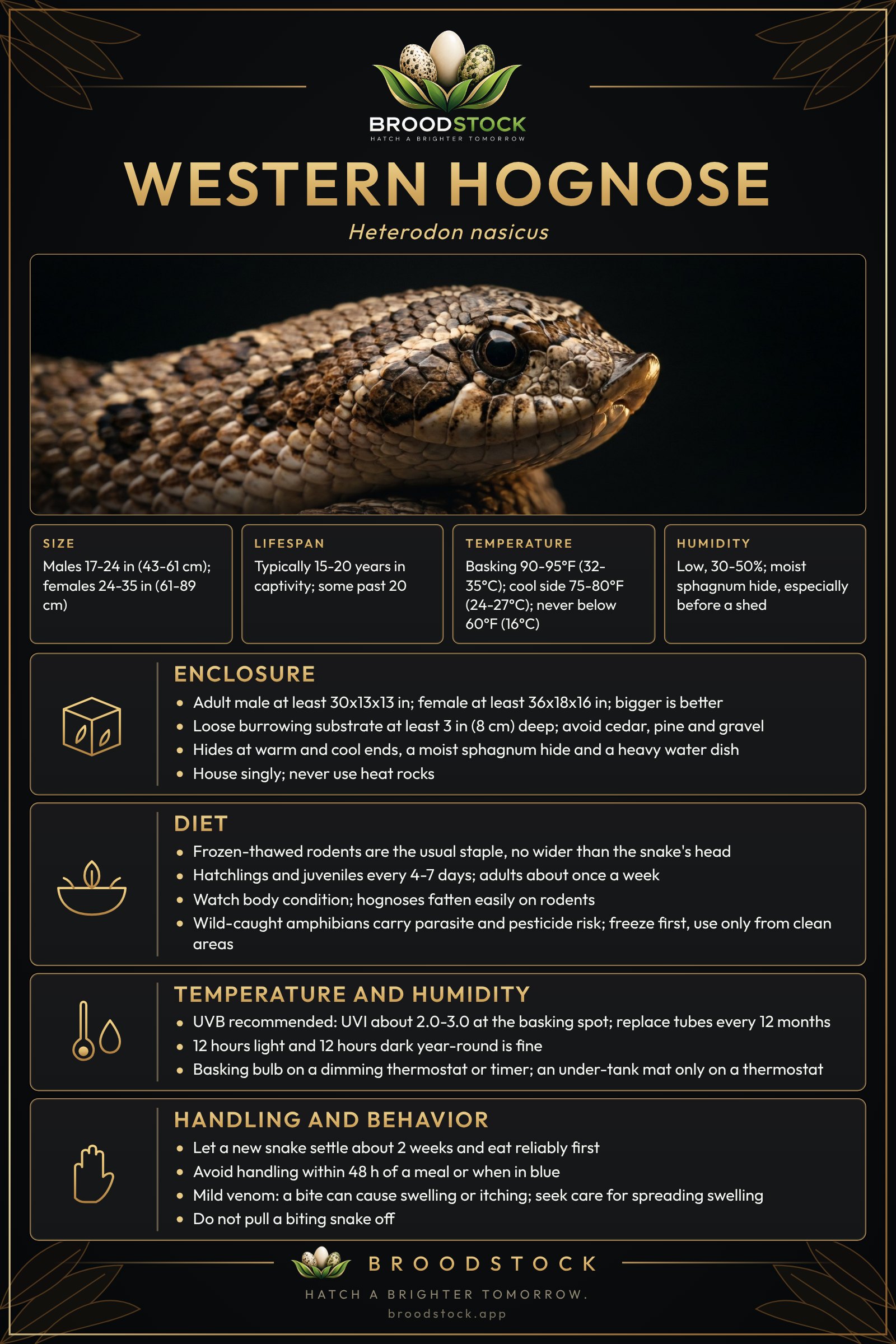
Print it or save it
The care sheet is a one-page summary you can print or keep on your phone. The full care text is below.
Keeping Western Hognose? Broodstock tracks feeding, weights, sheds, enclosures and equipment for every animal you keep, and it is free to start.
Scientific name
Heterodon nasicus.
Adult size
The sexes differ strongly in size. Adult males are usually 17-24 in (43-61 cm), while adult females are usually 24-35 in (61-89 cm) and occasionally a little more. Weight runs about 80-350 g, with large females the heaviest.
Lifespan
Captive hognoses typically live 15-20 years, and some pass 20 (one zoo collection reported about 21 years). Some care guides give a shorter 10-15 years.
Enclosure
Minimum sizes are 30x13x13 in (about 20 gal) for an adult male and 36x18x16 in (about 40 gal) for an adult female, and 36x18x18 in is a good general adult size. Juveniles up to about 1 year need 20x10x12 in (10 gal), and hatchlings under 6 in (15 cm) need 5 gal. A larger enclosure is always better.
Use loose burrowing substrate deep enough to dig in: at least 3 in (8 cm), and more for large females. A sand and topsoil mix or aspen works; avoid cedar, pine and gravel. Provide hides at the warm and cool ends, a moist (sphagnum) hide and a heavy water dish. House them singly.
Temperature
Basking surface: 90-95°F (32-35°C). Cool side: 75-80°F (24-27°C). Nights: about 68-72°F (20-22°C), and never below 60°F (16°C).
Humidity
Keep it low, 30-50% ambient, with a moist sphagnum hide available, especially before a shed.
UVB
UVB is recommended but not strictly required (Ferguson zone 2). Aim for a UVI of about 2.0-3.0 at the basking spot. Use a T5 HO 5.0 or 6% linear tube (Zoo Med ReptiSun 5.0 or Arcadia Forest 6%) covering 1/2 to 2/3 of the enclosure length, about 10-14 in (25-35 cm) above the snake through mesh (14-18 in, 35-45 cm, without). An Arcadia ShadeDweller MAX at 4-6 in (10-15 cm) through mesh is another option. Replace every 12 months, and check with a Solarmeter 6.5 if possible.
Lighting
A year-round cycle of 12 hours light and 12 hours dark is fine. If you want a seasonal cycle, use about 14 h of light in spring, 16 h in summer, 10 h in autumn and 8 h in winter. During brumation cooling, keep the lights off.
Heating
Use an overhead halogen or incandescent basking bulb (start around 50 W through mesh; two bulbs give a wider basking area) on a dimming thermostat or timer, with probe thermometers at the basking spot and the cool end. As alternatives, deep heat projectors or ceramic emitters work. An under-tank mat may be used only on a thermostat (common in racks) and is a secondary option. Never use heat rocks.
Diet
Frozen-thawed rodents are the usual staple. Offer prey no wider than the snake's head, and several small items rather than one large one. Feed hatchlings and juveniles every 4-7 days, and adults about once a week, though longer gaps are normal for adult males in the cool season. Hognoses fatten easily on rodents, so keep an eye on body condition.
Scenting prey with fish (tuna or salmon juice) helps fussy eaters. Some keepers use amphibian scent, but practices vary. Wild-caught amphibians carry parasite and pesticide risk, so freeze them first and use them only from clean areas.
Supplements
Most nutrients already come from whole prey, which makes supplements optional. If you use them, dust prey lightly and only occasionally (not every meal) with a calcium plus multivitamin. With UVB, pick a low-D3 product (Repashy Calcium Plus LoD or Arcadia RevitaliseD3 are examples). Without UVB, pick one with standard D3, such as Repashy Calcium Plus. Use only one product that contains D3. Opened supplements should be replaced about every 6 months. Gut-loading is not relevant here.
Shedding
Shedding is more frequent in young snakes than in adults. Signs of an approaching shed are dull color, blue cloudy eyes, hiding, poorer appetite and a more defensive snake. When it is in blue, offer a moist sphagnum hide or dampen part of the substrate.
After each shed, check the eye caps and tail tip. Repeated stuck sheds suggest the enclosure is too dry or the snake is dehydrated. See a vet if eye caps are retained or the skin under retained shed looks red or blistered.
Handling
Let a new snake settle for about 2 weeks and eat reliably first. Start with sessions of about 5 minutes and build up, to no more than about an hour, 1-2 times a week and not more than daily. Avoid handling within 48 h of a meal or when the snake is in blue.
Normal defensive displays are neck flattening, hissing, bluff strikes with the mouth closed, musking and playing dead. The species is rear-fanged with mild venom. A bite, usually a feeding mistake from prey-scented hands, can cause local swelling or itching. Rare cases are more serious, so seek care for spreading swelling. A snake that is biting should not be pulled off.
Brumation
Brumation is optional for pet snakes. Do not do it with snakes under 12 months or unhealthy ones; get a vet check first. Stop feeding about a month before cooling, with the heat still on so the gut empties. Then turn the heat off and cool to 50-60°F (10-16°C) for about 10-12 weeks (westerns roughly December to the end of February). Some keepers use milder cooling in the 60s°F (16-21°C).
Provide fresh water always. Weigh every 1-2 weeks, and stop and see a vet if weight drops more than 10%. The temperature must never get close to 38°F (3°C). Keep the heat off for about 2 weeks after the snake returns to its enclosure, then restore heat and offer a small first meal.
Health signs to watch
Weigh weekly, since sudden weight loss is an early sign. See a reptile vet for any of these: wheezing, open-mouth breathing, or nasal or mouth mucus (respiratory infection); red or cheesy gums (mouth rot); mites; regurgitation; retained eye caps or repeated bad sheds; prolonged refusal with weight loss (normal seasonal fasting and pickiness are common); belly blisters; and egg binding in females.
New snakes need quarantine, and fecal tests should check for parasites.
Welfare
More than 50 designer morphs exist. No welfare study specific to hognose was found.
Keep every animal's care in one place
Log feedings, weights and sheds, set reminders, and let Ranger, the built-in AI manager, help with the rest. Free to start, no card needed.