
Broodstock / Care sheets / White's Tree Frog
White's Tree Frog Care Sheet
Ranoidea caerulea (also listed as Litoria caerulea and Pelodryas caerulea; a 2020 study treats it as a species complex)
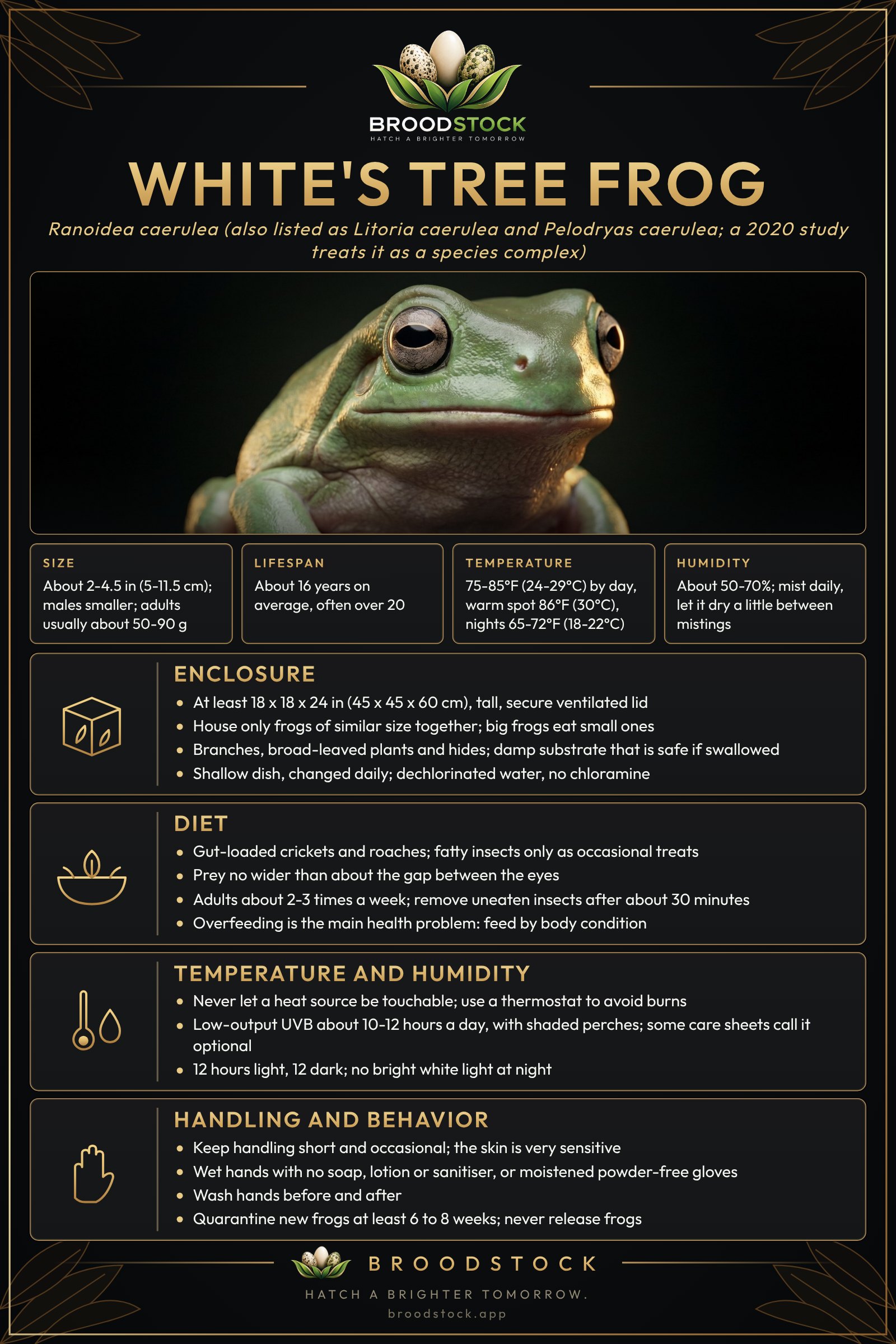
Print it or save it
The care sheet is a one-page summary you can print or keep on your phone. The full care text is below.
Keeping White's Tree Frog? Broodstock tracks feeding, weights, sheds, enclosures and equipment for every animal you keep, and it is free to start.
Scientific name
Ranoidea caerulea. You may also see it listed as Litoria caerulea or Pelodryas caerulea, and a 2020 study treats it as a species complex.
Adult size
Adults measure roughly 2-4.5 in (5-11.5 cm) from snout to vent. Most females reach about 4-4.5 in (10-11.5 cm), while males stay noticeably smaller (a vet source puts the difference at about 30-50%). Expect an adult weight of about 50-90 g. Captive-bred frogs go on sale at under about 2 in (5 cm).
Lifespan
Captive frogs average about 16 years and often pass 20. One guide says 7-10 years is closer to what happens in practice.
Enclosure
These frogs climb and can share a home. Give 1-3 adults an enclosure of at least 18 x 18 x 24 in (45 x 45 x 60 cm) or 20 gal (75 L), tall rather than long, with extra room for every added frog. The lid must be secure and ventilated.
Fit sturdy branches at least as thick as the frog's body, plus broad-leaved plants (live or artificial) and hides for cover. Use a substrate that holds moisture and is safe if swallowed, such as coconut fibre or a fine soil mix. Keep it slightly damp but never wet, and avoid large particles that a frog could swallow.
Offer a large, shallow water dish the frog can sit in, and change it daily. House only frogs of similar size together, because big frogs eat small ones. Spot clean every day and do a full clean with an amphibian-safe disinfectant roughly once a month.
Temperature
Build a warm gradient. Daytime sits around 75-85°F (24-29°C), with a warm spot near 86°F (30°C); one vet sheet permits a basking spot up to 95°F (35°C). The cool end should read about 72-77°F (22-25°C), and nights about 65-72°F (18-22°C). Sources disagree on exact ranges, so practices vary. Provide a gradient and let the frog's behaviour guide you.
Humidity
Aim for moderate humidity of about 50-70%, with vet sources giving 60-70%, and keep ventilation good. Mist once a day, often in the evening, so the enclosure dries out a little between mistings. A constantly wet, stuffy enclosure leads to skin problems.
Water for misting and for the dish must contain no chlorine or chloramine. Treat it with a dechlorinator, or use spring water or filtered tap water. Leaving tap water to stand removes chlorine but not chloramine.
UVB
Vet sources recommend low-output UVB to help the frog use calcium. Run a low-output UVB tube for about 10-12 hours a day over part of the enclosure, at the distance the maker recommends. One exotic vet aims for a UVI of about 0.7-1.6 where the frog basks. Add shaded perches so the frog can get out of it, and remember that glass and plastic block UVB. Replace lamps on the maker's schedule.
Evidence for amphibians is limited but growing. A zoo study found normal bone density in a captive-bred frog species given UVB plus dietary supplements. Some care sheets call UVB optional, so practices vary.
Lighting
Use a timer for about 12 hours of light and 12 hours of dark. Keep bright white lights off at night.
Heating
Make the warm area with a low-wattage heat bulb, or a heat mat on the side or back wall. Always run it through a thermostat, and shield it so the frog cannot touch it, since burns are a risk. A min/max thermometer lets you track the temperatures.
Diet
This frog eats insects. Gut-loaded crickets and roaches are the staples, and other commercial insects also work. Waxworms, superworms, earthworms in excess and pinky mice are fatty, so treat them as an occasional extra at most (about monthly in one guide).
Choose prey no wider than the gap between the frog's eyes. Feed juveniles daily or every other day. Adults eat about 2-3 times a week, a few large insects at each feed. Take out live insects the frog has not eaten after about 30 minutes.
Overfeeding is the main health problem in this species, so judge portions by body condition and not by how eager the frog looks.
Supplements
Dust insects with calcium (with or without D3, depending on whether you use UVB). Also give an amphibian multivitamin that contains preformed vitamin A, not just beta-carotene, at least once a week. Vet guidance is about twice a week for juveniles and once a week for adults. Some keepers instead dust lightly at most feeds and alternate calcium with the multivitamin, so practices vary. Gut-load feeder insects for about 24 hours.
Shedding
The frog sheds regularly and usually eats the skin. Wild frogs in dry spells can wrap themselves in a cocoon of shed skin and mucus. Patches of stuck skin, cloudy or discoloured skin, or redness point to low humidity, poor water quality or infection.
Handling
White's tree frogs tolerate handling, but keep it brief and infrequent, because their skin is very sensitive and takes up residues. Use wet hands with no soap, lotion or sanitiser on them, or moistened powder-free gloves. Wash your hands both before and after.
Brumation
Captive frogs do not truly hibernate.
Health signs to watch
Take the frog to an amphibian vet for any of these:
Obesity, shown by fat folds over the eyes and head, a 'dumpy' body and poor activity, which shortens life. Metabolic bone disease, with a soft jaw, bent limbs or a weak grip. Short tongue syndrome from vitamin A deficiency, where the frog keeps missing prey. Red legs or belly, skin sores or lethargy, which suggest bacterial infection ('red leg').
Also watch for fungal or skin disease from poor hygiene, which can turn fatal quickly, and for gut impaction from oversized insects or swallowed substrate. Internal parasites are another concern, so have a new frog's faeces checked. This species can catch chytrid (chytridiomycosis).
For biosecurity, quarantine new frogs for at least 6 to 8 weeks using separate tools, and disinfect equipment. Never release frogs, and keep enclosure water and substrate away from wild amphibians.
Welfare
Obesity is the most common welfare problem. These frogs look 'dumpy' naturally, but heavy fat folds should not appear, so feed by condition. Do not keep them with smaller frogs or other species. Never release frogs or tadpoles, since chytrid has been found in this species.
The species is not CITES listed, but Australia bans commercial export of its native frogs. Pet-trade animals are therefore captive-bred or come from Indonesia (New Guinea populations), so buy captive-bred.
Keep every animal's care in one place
Log feedings, weights and sheds, set reminders, and let Ranger, the built-in AI manager, help with the rest. Free to start, no card needed.