
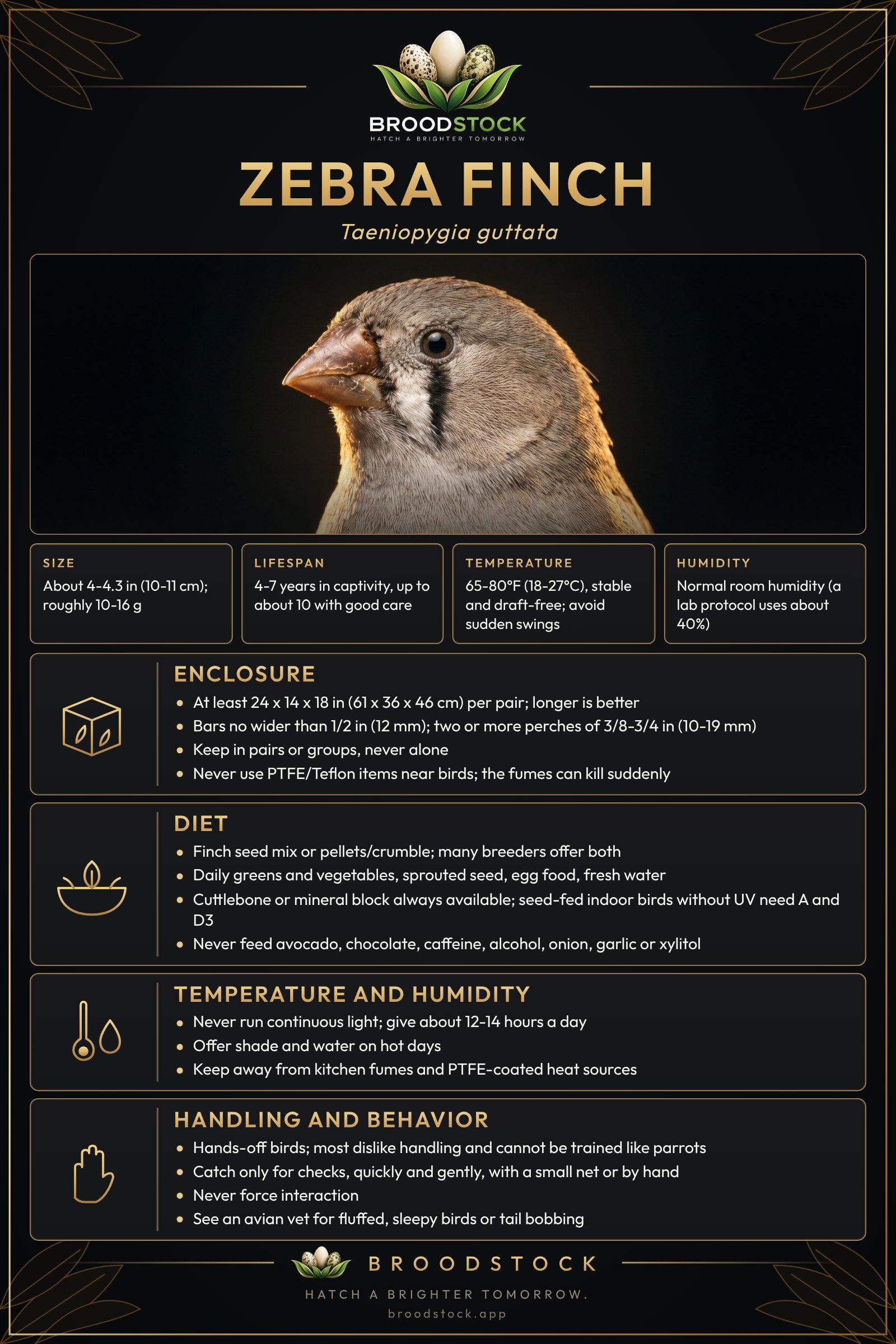
Print it or save it
The care sheet is a one-page summary you can print or keep on your phone. The full care text is below.
Keeping Zebra Finch? Broodstock tracks feeding, weights, sheds, enclosures and equipment for every animal you keep, and it is free to start.
Scientific name
Taeniopygia guttata
Adult size
Adults are about 4-4.3 in (10-11 cm) long and weigh roughly 10-16 g, with around 12 g being typical.
Lifespan
In captivity expect about 4-7 years, and up to about 10 with good care. In the wild they usually reach 2-3 years.
Enclosure
Allow at least about 24 x 14 x 18 in (61 x 36 x 46 cm) for a pair. Larger and longer is better, as these birds fly along the length of the cage. Bars should be no more than 1/2 in (12 mm) apart, and you need at least two perches about 3/8-3/4 in (10-19 mm) thick.
Zebra finches are social, so keep them as pairs or groups and never singly.
Keep the cage away from kitchen fumes. Never use PTFE/Teflon-coated items (non-stick pans, some heat lamps, heating elements, irons) anywhere near the birds. Their fumes can kill birds without warning, even from another room.
Temperature
Indoors, hold the room at about 65-80°F (18-27°C), steady and free of draughts. UK breeders regard about 45°F (7°C) as the coldest acceptable bird-room temperature, but you should still aim for the normal range. Prevent sudden swings, and on hot days provide shade and water.
Humidity
Normal room humidity suits them; a lab care protocol uses about 40%. Put out a shallow bath dish and change it daily.
UVB
UVB needs are not well documented for finches. The best source is unfiltered natural sunlight, such as an outdoor flight or an open window (glass blocks UV), with shade always on offer. Avian vet evidence on UVB bulbs is mixed, so a lamp is optional. If you use one, pick a bird-specific full-spectrum/UVB lamp, avoid flickering fluorescent tubes, follow the maker's distance and run it on the normal daily cycle.
Either way, check that the diet supplies vitamin D3, through pellets or a balanced finch supplement.
Lighting
Give about 12-14 hours of light a day (a lab range is 10-14 h). Never leave lights on continuously, since that is linked to health problems.
Heating
Never use PTFE/Teflon-coated heat sources (non-stick pans, some heat lamps, heaters, irons) near birds. Small birds die quickly from the fumes.
Diet
Build the diet on a good finch seed mix (mixed millets plus canary seed) or on finch pellets/crumble. Many breeders offer both. Add leafy greens and vegetables daily, along with sprouted or soaked seed and egg food (hard-boiled egg or a commercial rearing food). Supply fresh water every day.
Never give them any of these: avocado, chocolate, caffeine, alcohol, onion or garlic, fruit pits or apple seeds, xylitol, or salty, fatty or sugary human food.
Supplements
Keep a cuttlebone or mineral block available at all times, along with a small amount of fine mineral grit (avoid too much). Crushed baked eggshell gives laying hens extra calcium. A seed-fed bird kept indoors with no UV needs a vitamin supplement containing A and D3. Iodine is not a recognized need for zebra finches.
Shedding
Young birds molt into adult plumage by about 90 days, and males show cheek patches from about 35 days. Adults molt once a year. Give extra protein (egg food) during a molt. Patchy feather loss on the head or neck outside a molt usually means cagemates are plucking or mites are present.
Handling
Zebra finches are best left alone. They do not train the way parrots do, and most dislike being handled, though hand-raised birds may be calmer. Catch a bird with a small net or by hand only when you must check it, doing so quickly and gently. Never force contact.
Health signs to watch
See an avian vet if you notice any of the following:
A fluffed-up, sleepy bird. Tail bobbing, clicking or wheezing, which suggest air sac mites. Crusty white growths on the beak, face or legs, pointing to scaly face/leg mites. A hen that strains, sits on the floor or has a swollen belly, which suggests egg binding.
A wet or crusted vent, or diarrhea, can indicate gut infections such as Campylobacter and trichomonas. Weight loss with whole seed in the droppings suggests avian gastric yeast (megabacteria). Also report an overgrown beak or nails, and know that PTFE fumes can cause sudden death.
Welfare
Continuous lighting is linked to health problems in one lab protocol (single source).
Keep every animal's care in one place
Log feedings, weights and sheds, set reminders, and let Ranger, the built-in AI manager, help with the rest. Free to start, no card needed.